 Vipin PG
Twitch Error 3000 usually shows up with a message like “A network error caused the video download to fail part-way.” That phrasing makes it sound like a pure internet problem. But honestly? It’s rarely that simple. I’ve watched this error pop up because of browser decoding failures, blocked cookies, aggressive extensions, corrupted cache, browsers that hadn’t been updated in ages, or sometimes just a stream that wasn’t loading right on Twitch’s end. If you’re in the middle of watching and Twitch suddenly throws this error at you, take a breath. The fix usually comes down to figuring out which trigger you’re dealing with , because there are several. That’s the whole point of this guide. Not recycled advice that’s been copied from article to article for three years, but fixes that actually hold up right now. Before you touch a single setting, do one quick check: open Twitch in an Incognito or Private browsing window. If the stream loads fine there, you’re almost certainly looking at a cache issue, a cookie problem, or a misbehaving extension. That one test alone can save you twenty minutes of unnecessary digging.
What is Twitch Error 3000?
Twitch Error 3000 is a browser-based playback error. According to Twitch, it means your device is having trouble decoding and displaying the video stream , and that distinction matters. It’s not always a Twitch server outage. It’s not always your internet dying. Sometimes the browser receives the stream just fine and then fumbles the handoff. That’s also why this error tends to show up on desktop browsers way more often than on mobile apps. The browser environment has a lot more moving parts: extensions, cookie policies, graphics acceleration settings, cached site data, permissions, browser version compatibility. More variables means more things that can go wrong.
Why Twitch Error 3000 Happens
There are a handful of common causes, and most of them are still worth knowing about.
- Corrupted cache or cookies: Old site data can quietly break Twitch playback or authentication without any obvious warning signs.
- Blocked third-party cookies: Modern browser privacy controls have gotten stricter, and Twitch can behave oddly when those cookies get blocked too hard.
- Problematic extensions: Ad blockers, privacy tools, script blockers, even some video improve extensions , any of these can interfere with playback in ways that aren’t always obvious.
- Hardware acceleration issues: Your browser might be using GPU acceleration in a way that clashes with video decoding.
- Outdated browser version: Twitch supports current browser releases. If your browser hasn’t been updated in months, that’s a real problem.
- Unstable network path: Packet loss, DNS issues, VPN conflicts, or a weak Wi-Fi signal can all interrupt video delivery mid-stream.
- Twitch-side problems: Sometimes it really is on Twitch’s end. That’s why checking the official Twitch status page early on is worth a few seconds of your time.
Check This First Before Changing Anything
Run three quick tests before you start poking around in settings.
- Reload the stream once or twice.
- Open Twitch in Incognito or Private mode.
- Try another live channel to see whether the issue is limited to one stream or affecting the whole site.
If every stream breaks, the problem is likely in your browser, your network, or Twitch itself. If only one channel is acting up, it might just be that specific broadcast session having a bad moment. Also worth confirming: are you on a browser Twitch actually supports? Twitch currently recommends the two most recent versions of Chrome and Firefox, along with the latest versions of Edge and Safari, according to its supported browser list. That detail gets overlooked more than you’d think.
How to Fix Twitch Error 3000
1) Clear Browser Cache and Cookies
This is still the best place to start , no drama, no guesswork, just wiping out the stale data and letting Twitch load fresh. It solves a surprising number of playback errors. In Chrome, open the browser menu, go to Delete browsing data, set the time range to All time, and clear both cookies and cached files. That matches the official Google cache guide and still works reliably. Here’s the step-by-step path:
-
- Click the three dots in the top-right corner of your browser window.
- Go to “More tools” > “Clear browsing data.”

- Select “Cookies and other site data” and “Cached images and files.”
- Choose “All time” from the time range dropdown.
- Click “Clear data.”
Close the browser completely after that, reopen it, and test Twitch again. Firefox users can do the same thing from the Privacy & Security section , clear site data and cached web content. Yes, this feels almost too simple, but that’s exactly why it works so often.
2) Check Whether Third-Party Cookies Are Blocking Twitch
This matters more now than it did a few years ago. A lot of older guides just say “enable third-party cookies” and call it a day. That’s a bit blunt, because modern browsers actually let you allow cookies per site , temporarily or permanently , without flinging the door wide open for everything. Chrome’s settings let you manage this under Privacy and security > Third-party cookies. Google even acknowledges that some sites may not behave correctly when those cookies are blocked. Twitch can absolutely fall into that category depending on your setup, your login state, and how embedded playback is handled. Rather than allowing all cookies globally, try adding Twitch as an exception first. Chrome walks through this in its third-party cookies help. If you’d rather just use the direct approach, here it is:
- Click the three dots in the top-right corner.
- Go to “Settings” > “Privacy and security” > “Cookies and other site data.”
- Select “Allow all cookies” or “Block third-party cookies in Incognito.”
That can work, but being more selective is generally the smarter move.
3) Disable Hardware Acceleration
This is a real fix, not just a checkbox step. Twitch’s own troubleshooting documentation points to decoding and display problems , and that overlaps pretty directly with GPU-assisted browser rendering. When your browser hands video decoding off to the graphics card and something goes wrong in that pipeline, Error 3000 has a way of showing up. In Chrome, turn off graphics acceleration, relaunch, and test. Here’s the navigation path:
-
- Click the three dots in the top-right corner.
- Go to “Settings.”
- Scroll down and click on “Advanced.”

- Under the “System” section, turn off “Use hardware acceleration when available.”
- Restart your browser.
Firefox users can find the same option under Settings > General > Performance. Mozilla’s hardware acceleration article has the current steps. If disabling it fixes the stream right away, that tells you exactly what was wrong , the video decoding path.
4) Disable Extensions That Interfere With Playback
This one catches more people off guard than you’d expect. Ad blockers, privacy filters, anti-tracking tools, script blockers, custom DNS helpers, video improve extensions , any of them can break Twitch playback in strange ways. Sometimes it’s not even that they’re blocking Twitch directly. They block one dependency Twitch relies on, and suddenly playback collapses. That’s exactly why the Incognito test is so handy. Most extensions are off by default in private mode. If Twitch works there but not in your regular window, extensions are your starting point.
-
- Click the three dots in the top-right corner.
- Go to “More tools” > “Extensions.”

- Toggle off each extension and check if Twitch works after disabling each one.
Start with ad blockers, privacy extensions, video downloaders, and anything that alters page scripts or media playback. Those tend to be the usual suspects.
5) Update Your Browser
This isn’t filler. Twitch officially supports current browsers, and older builds can cause real problems with codec support, DRM handling, or playback compatibility. If your browser hasn’t been updated in a while, that should be the first thing you fix , before chasing down more obscure causes. The steps are simple:
-
- Click the three dots in the top-right corner.
- Go to “Help” > “About Google Chrome.”
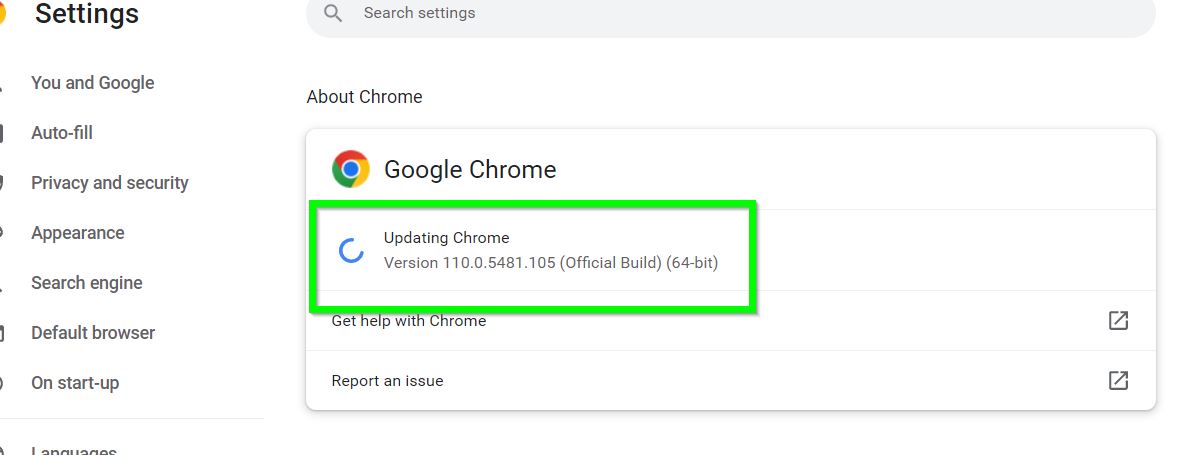
- If an update is available, Chrome will automatically download and install it.
- Restart your browser after the update.
Same goes for Edge and Firefox , update those too. There’s no real point troubleshooting playback in a browser version that Twitch itself doesn’t support anymore.
6) Check Twitch Server Status
Sometimes the simplest answer is the right one: Twitch is down, or at least struggling. Before you reset half your browser config, spend thirty seconds checking platform status. Skip the third-party outage sites and go straight to the source. Twitch’s own service status page will show you if there’s an active incident affecting video playback, ingest, or general site performance. After checking there, services like Downdetector can help confirm whether other users are hitting the same wall.
7) Check Your Network Connection
The error message does say “network error,” and sometimes it’s telling the truth. But it’s not always about your download speed. Packet loss, unstable Wi-Fi, an overloaded router, unreliable DNS, or a VPN routing through a bad path can all cut a stream off mid-watch. Run through these quick checks:
- Restart your router and modem.
- Switch from Wi-Fi to wired Ethernet if that’s an option.
- Temporarily disable your VPN or proxy.
- Try a different DNS resolver if pages are loading slowly or inconsistently.
- Test Twitch on another device connected to the same network.
- Test the same device on a completely different network, like a mobile hotspot.
If Twitch works in a different browser but not on a different network, you’re dealing with a browser problem. If it fails on multiple devices on the same connection, the network path becomes a lot more suspicious.
8) Try Another Browser
The point is more of a shortcut to figuring out where the problem actually lives. If Twitch fails in Chrome but works without a hitch in Firefox or Edge, the issue is almost certainly specific to your Chrome setup. That narrows things down considerably. It sounds obvious, but it’s genuinely useful for avoiding the trap of blaming Twitch when the real problem is one browser profile stuffed with broken settings, stale data, or conflicting extensions.
9) Reset Browser Settings if Nothing Else Works
You’ve cleared data, disabled extensions, checked cookies, updated the browser , and Twitch is still throwing Error 3000. At that point, a full browser reset is worth considering. This is especially true if the problem started right after a browser update, a new extension install, or some privacy tweak you can’t quite remember making. A reset is more aggressive than clearing cache, so save it for later in your troubleshooting process. But when a browser profile has gotten genuinely messy over time, it can be the cleanest way out.
10) Contact Twitch Support
If you’ve worked through everything and the problem is still happening consistently, it’s time to bring Twitch into the loop. When you reach out, include your browser version, your operating system, whether the error hits all streams or just specific channels, and what you’ve already tried. That information makes the support process a lot less frustrating on both ends. Also mention whether the issue shows up in one browser or every browser you’ve tested. That single detail helps separate a local browser fault from something tied to your account or the platform itself.
Extra Fixes That Are Worth Trying
A few more things to check when the standard fixes don’t do the job.
- Disable VPN temporarily: Certain VPN routes don’t play nicely with streaming delivery paths, and the slowdown isn’t always obvious until you test without it.
- Turn off strict tracking protection for Twitch only: Privacy tools can sometimes over-filter scripts or cookies in ways that break specific sites.
- Sign out and sign back in: Session problems can occasionally mess with playback behavior in ways that aren’t immediately obvious.
- Use a fresh browser profile: One of the quickest ways to confirm whether your current profile is the culprit.
- Check security software: Antivirus web shields and content filters can sometimes get in the way of live streaming without making it obvious that they’re the problem.
And here’s something worth knowing: if a brand-new browser profile works but your regular one doesn’t, the issue is almost never Twitch. It’s your local browser environment doing something it shouldn’t.
How to Prevent Twitch Error 3000 in the Future
You probably can’t prevent it forever. But you can make it a lot less likely to come back.
- Keep your browser current. Twitch works best on supported releases, and old browsers create real compatibility gaps.
- Don’t stack your browser with random extensions. Every add-on you install increases the odds of a playback conflict somewhere down the line.
- Clear old site data occasionally. Browsers accumulate stale data over time, and it doesn’t take long before that starts causing weird behavior.
- Be thoughtful with privacy settings. Blocking everything sounds appealing until the sites you actually use start misbehaving.
- Keep an eye on Twitch’s status page when something feels off. It can spare you from troubleshooting a problem that was never yours to fix.
If browser weirdness on streaming sites is a recurring thing for you, it also helps to keep one clean backup browser around. I know that sounds a bit tedious. But when Twitch suddenly refuses to cooperate, having a known-good browser profile nearby makes the whole process a lot faster.
Final Thoughts
Twitch Error 3000 is annoying, but it’s almost always fixable. In most cases, it comes down to one of five things: broken cache, blocked cookies, a misbehaving extension, hardware acceleration trouble, or a browser that’s fallen out of date. Everything else tends to be secondary. Start simple. Test in Incognito. Clear your data. Check Twitch’s status. Then work through cookies, extensions, and graphics acceleration in that order. That sequence gives you the best shot at finding the fix quickly , without touching a bunch of settings you never needed to change in the first place. If you’re running into other browser or streaming issues alongside this, guides like how to fix and to fix may help you track down related problems.