 Vipin PG
Employee identification has evolved far beyond plastic cards displaying a name, photograph, and company logo. Today, organizations can incorporate wireless chips, scannable codes, and cloud-based management systems into their employee credentials, making identification more useful for security, workplace operations, and digital interactions.
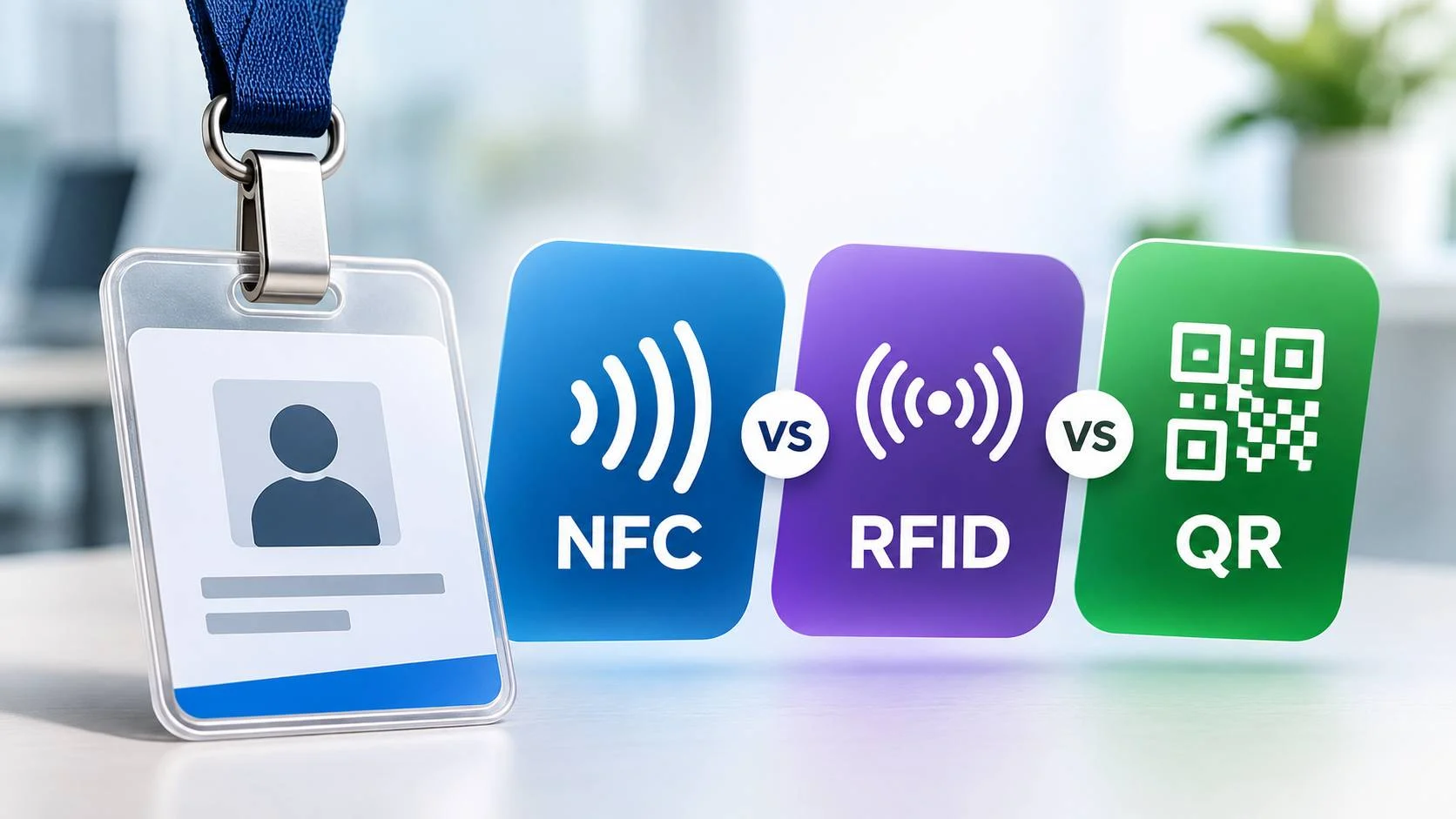
Three technologies are particularly relevant to modern employee identification: Near Field Communication (NFC), Radio Frequency Identification (RFID), and Quick Response (QR) codes.
Although these technologies sometimes serve overlapping purposes, they differ significantly in cost, compatibility, security, and functionality. Understanding these differences helps businesses select an identification system that meets their operational requirements without unnecessary complexity.
Understanding RFID Technology in Employee Identification
Radio Frequency Identification uses electromagnetic fields to communicate between a reader and an electronic tag or chip embedded in a card.
Unlike traditional barcodes, RFID credentials generally do not require direct visual contact with a scanner. An employee can present a compatible card near a reader, allowing the system to retrieve its identifier and determine whether access should be granted.
RFID technology operates across several frequency ranges, including low-frequency, high-frequency, and ultra-high-frequency systems. These variations support different reading distances and applications.
In workplace environments, RFID is commonly associated with:
- Building access control
- Employee attendance tracking
- Restricted-area authorization
- Parking access
- Equipment and asset identification
- Integration with physical security systems
Businesses implementing RFID should pay particular attention to compatibility between their existing readers and credential technology.
For example, legacy 125 kHz proximity cards are not interchangeable with 13.56 MHz smart cards simply because both use radio communication.
Organizations can obtain customized RFID ID cards that combine employee photographs, company branding, and compatible credential technology into a single physical badge.
However, not all RFID systems provide equivalent security. Older proximity technologies may transmit identifiers without strong cryptographic protection, making them less suitable for high-security environments.
For sensitive applications, organizations should consider modern credentials that support cryptographic authentication and secure key management.
How NFC Technology Works
Near Field Communication is a short-range wireless communication technology operating at 13.56 MHz.
NFC is closely related to high-frequency RFID, but it is particularly useful because compatible smartphones can interact with NFC tags and other supported devices.
An NFC-enabled employee card can be programmed to direct a compatible smartphone to a website, display digital contact information, or initiate another supported action.
For example, a company representative attending a conference could present an NFC-enabled badge to a visitor. The visitor taps the badge with a compatible smartphone and opens the representative’s digital business profile.
This eliminates the need to manually type contact information or exchange printed business cards.
NFC applications include:
- Digital business card sharing
- Employee profile access
- Contactless information exchange
- Visitor information services
- Equipment identification
- Supported access-control systems
One important distinction is that an NFC tag containing a website link is not equivalent to a secure access-control credential.
Secure NFC-based authentication requires compatible hardware, appropriate credential technology, and a properly configured authentication system.
Businesses should distinguish between simple information-sharing NFC tags and credentials intended for security-sensitive applications.
QR Codes: Simple, Affordable, and Widely Compatible
QR codes offer a different approach to employee identification.
Instead of requiring an embedded electronic chip, a QR code stores encoded information in a two-dimensional printed pattern.
A smartphone camera or compatible scanner can read the code and retrieve the information.
This makes QR codes particularly attractive to organizations seeking digital functionality without investing in specialized contactless card hardware.
A QR code printed on an employee badge might link to:
- An employee verification page
- A digital business card
- A company directory
- A professional license verification page
- An internal employee portal
- A visitor-facing contact profile
For example, a healthcare organization could place a QR code on staff identification cards that directs visitors to an official employee verification page.
The verification system could display approved information such as the employee’s name, department, and current credential status.
However, QR codes should not be treated as inherently secure. A static code can be photographed, copied, or reproduced.
For sensitive verification workflows, the code should point to a secure server that validates current credential status rather than relying solely on information printed or encoded in the badge.
NFC vs. RFID vs. QR Codes: Key Differences
Each technology offers advantages depending on the organization’s requirements.
| Feature | RFID | NFC | QR Code |
|---|---|---|---|
| Communication | Radio frequency | Short-range radio | Optical scanning |
| Embedded chip required | Yes | Yes | No |
| Smartphone compatibility | Depends on technology | Broad, but device-dependent | Broad |
| Typical use | Access control | Digital interactions | Verification and information |
| Specialized reader | Often required | Depends on application | Usually not |
| Security | Depends on credential design | Depends on implementation | Depends on backend verification |
| Relative deployment cost | Moderate to high | Moderate | Low |
For organizations focused on physical access control, compatible RFID or secure NFC-based credentials may be appropriate.
For digital networking and contact sharing, NFC provides a convenient user experience.
For businesses seeking inexpensive employee verification and information access, QR codes can offer a practical starting point.
These technologies are not mutually exclusive. A single employee ID card can incorporate more than one.
Why Hybrid Employee ID Cards Are Becoming More Useful
Many organizations operate across physical and digital environments.
Employees may need to enter secured buildings, identify themselves to customers, access internal resources, and share professional information.
A hybrid badge can support several of these requirements.
Consider a commercial property management company employing maintenance personnel, leasing agents, and administrative staff.
Its employee identification cards might include:
- A photograph and printed employee name for visual verification.
- An RFID credential compatible with the building’s access-control system.
- A QR code linking to an official employee verification page.
- An NFC tag containing a digital business profile for customer-facing personnel.
This approach can reduce the need for employees to carry multiple identification items.
It also creates a more consistent company identity across different departments and locations.
However, hybrid cards require careful planning. The organization must ensure that each embedded technology is compatible with its intended readers, applications, and security policies.
The Role of Cloud-Based ID Card Management
The physical credential is only one part of an employee identification program.
Organizations also need a reliable method for creating, updating, replacing, and retiring credentials.
Traditional badge workflows often rely on spreadsheets, manually maintained design files, and individual printing requests.
These methods can become difficult to manage as organizations expand or hire employees across multiple locations.
A centralized platform can help standardize employee identification workflows.
Modern employee ID card management solutions can support consistent badge designs, employee information updates, and coordinated card ordering across departments.
Depending on the platform, administrators may be able to manage badge templates, submit employee photographs, and organize requests without maintaining separate design processes at every office.
For businesses with remote or hybrid employees, centralized badge management can simplify onboarding.
A new employee’s information can be submitted through an approved workflow, reviewed, and prepared for card production before their first day.
When combined with appropriate access-control administration, this can become part of a broader employee identity lifecycle.
It is important to distinguish badge production management from electronic credential provisioning. Printing a card does not automatically activate or revoke its access-control permissions.
Security Considerations When Choosing Employee ID Technology
Security should be a primary consideration when selecting employee identification technology.
Credential Cloning
Some older RFID systems are vulnerable to cloning because they rely on static identifiers or weak authentication methods.
Organizations handling sensitive facilities or information should evaluate credentials that support stronger cryptographic protections.
QR Code Manipulation
A QR code can direct users to a malicious website if the printed code is replaced or tampered with.
Businesses should use trusted domains, secure HTTPS connections, and clear verification procedures.
Lost or Stolen Badges
Physical identification cards can be misplaced or stolen regardless of their technology.
Organizations should establish procedures for reporting missing badges, disabling associated access permissions, and issuing replacements.
Employee Privacy
Employee badges may contain personal information, including names, photographs, identification numbers, and department assignments.
Organizations should minimize unnecessary exposure of this information.
Public verification pages should display only approved details, while sensitive employee records remain protected by appropriate authentication and authorization controls.
Credential Lifecycle Management
A secure identification program should cover the entire employee lifecycle, from onboarding through role changes and termination.
Issuing credentials is only the beginning. Organizations also need procedures for updating permissions, replacing damaged cards, and revoking access when employment ends.
Choosing the Right Technology for Your Organization
There is no universally superior employee identification technology.
The best choice depends on the organization’s physical infrastructure, security requirements, workforce size, and intended applications.
Small businesses that primarily need professional employee identification may find photo badges with QR codes sufficient.
Customer-facing organizations may benefit from NFC-enabled cards that simplify contact sharing and digital interactions.
Facilities requiring controlled physical access may need RFID credentials compatible with their installed security systems.
Larger organizations may benefit from hybrid cards supported by centralized badge management workflows.
Before investing, IT and operations teams should evaluate existing reader compatibility, credential security, employee privacy requirements, replacement costs, and long-term scalability.
The Future of Employee Identification
Employee identification is gradually becoming more connected to digital identity management.
Physical cards remain valuable because they provide immediate visual identification and can work with established access-control infrastructure.
At the same time, NFC, QR codes, and cloud-based administration create opportunities to make badges more functional.
Future developments may include closer integration with mobile credentials, automated onboarding workflows, stronger authentication technologies, and improved employee identity verification.
The objective is not necessarily to eliminate physical identification cards. Instead, organizations can combine the reliability of physical credentials with the flexibility of digital services.
Conclusion
RFID, NFC, and QR codes each address different employee identification needs.
RFID is well suited to compatible physical access-control environments. NFC offers convenient short-range digital interactions. QR codes provide an inexpensive method for connecting printed identification to online information and verification services.
For many businesses, the most practical solution is a carefully designed combination of these technologies.
By selecting compatible credentials, implementing appropriate security controls, and establishing centralized management procedures, organizations can create employee identification systems that remain useful as their operational requirements evolve.