
 Vipin PG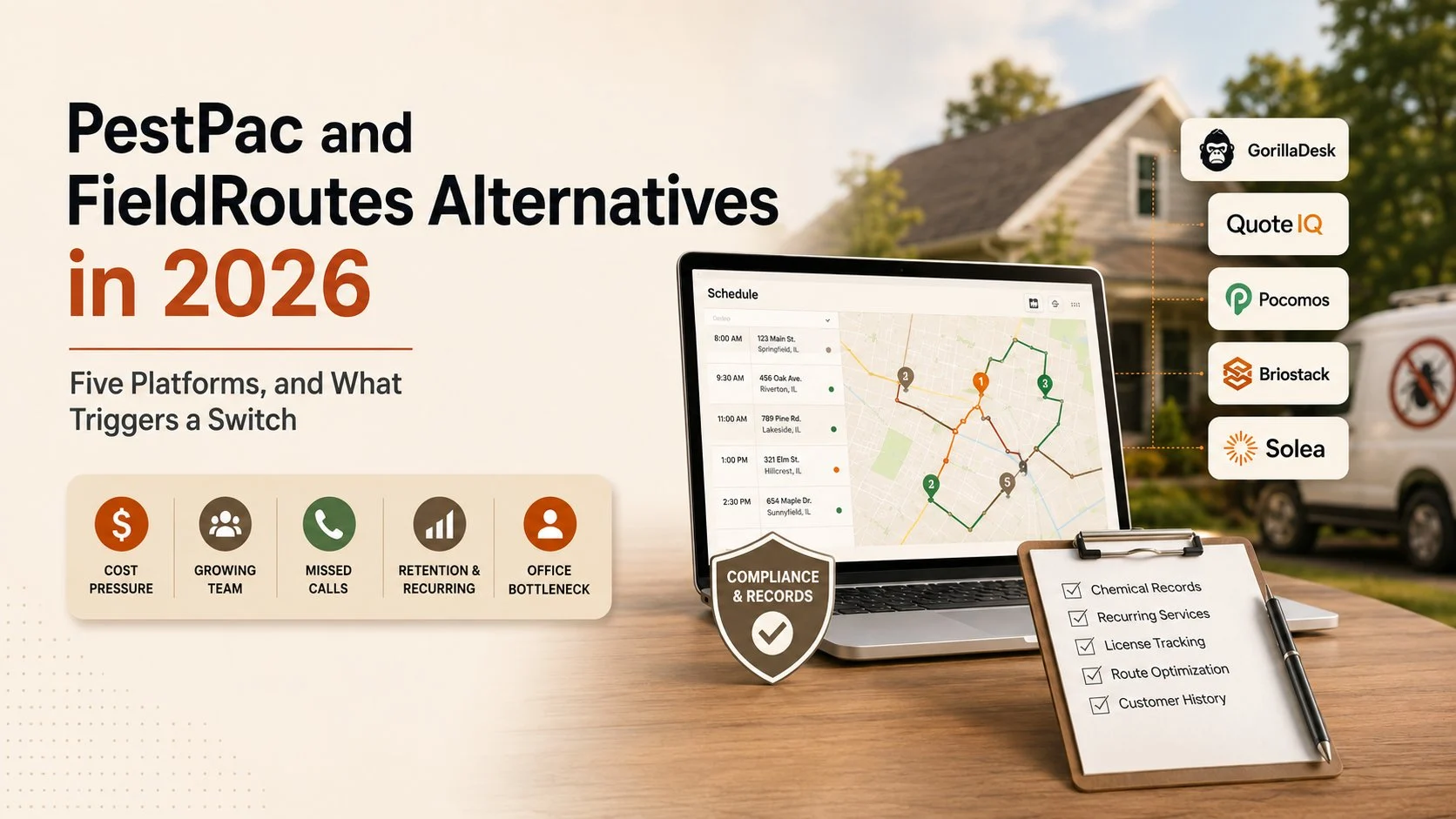
Most people searching for a PestPac or FieldRoutes alternative aren't shopping. Something specific broke.
The subscription outgrew the value. Per-seat pricing started punishing headcount growth. Onboarding stalled at week nine. Or the office hit a ceiling and the next fix is hiring, not software.
So this piece is organised by the trigger rather than by rank. Five pest-native platforms, each matched to the operational problem that makes it the right move , because "best alternative" is meaningless without knowing what you're leaving and why.
How this comparison was built
Five platforms, reviewed on 5 August 2026. Generalist field service tools are excluded and the last section explains why.
Pricing comes from published vendor pages where one exists, and from contractor-reported figures where it doesn't. The source is stated either way.
Review data is from G2 and Capterra product pages captured the same day. Ratings move monthly , verify before signing.
One caveat covering every number below. No platform in this category has been independently benchmarked by a third party. Every efficiency percentage originates with the vendor that benefits from it, mine included, and is labelled accordingly.
The question that separates the category
Feature count stopped being the useful comparison around 2024. The line that matters now:
Does the AI act, or does it only suggest?
Two tiers have formed.
- AI-assisted platforms added intelligence to conventional workflows , smart routing, chatbots, predictive analytics , where a human still does the work.
- AI-native platforms put agents in the workflow, and the human handles exceptions.
That split is why most alternatives lists have gone stale. Plenty of them still compare feature checklists written before the distinction existed. If a comparison doesn't tell you which tier a platform sits in, it's answering a question buyers stopped asking.
Trigger: you're under 10 technicians and the enterprise cost stopped making sense
GorillaDesk
From $49 per month, no long-term contract, onboarding measured in days.
G2 rates it 4.8 from 42 reviews , the highest satisfaction score in the category, from a small but consistent sample. On head-to-head G2 comparison data it beats PestPac on ease of use (9.7 to 7.9), invoicing (10.0 to 8.8) and support (9.8 to 7.9).
The ceiling is real: limited multi-branch support, manual licence tracking, no AI receptionist. You will outgrow it, and that's fine , most operators who switch to it aren't planning ten years ahead.
Trigger: you want a number before you take a sales call
QuoteIQ
Published pricing, every tier, from $29.99 to $699 per month.
Recurring service plans, route-aware scheduling and chemical-aware estimating, sized for solo operators through roughly 50-technician shops.
Lighter on multi-branch compliance depth than the enterprise platforms. If you run commercial multi-unit accounts or get audited regularly, this isn't the one.
Trigger: per-seat pricing is punishing you for hiring
Pocomos
Unlimited users, no per-seat fee, priced on active customers instead , so cost tracks the book of business rather than the payroll.
Strong visual routing and route-density tooling, with pest-specific workflows throughout.
Scheduling is operator-driven rather than autonomous, and the integration ecosystem is smaller than the legacy platforms'. You're trading breadth for predictable cost.
Trigger: retention is the constraint, not call volume
Briostack
Seasonal and recurring scheduling logic built specifically for pest control, with sales territory tools, rep performance tracking, and accounting and revenue forecasting support.
A clean dashboard and a genuine grasp of the quarterly-service model , the recurring side of this business is what it was designed around.
AI capability is limited to automation rules rather than agents. Marketing automation is thinner than FieldRoutes'. Pricing is custom, so you're back on a sales call.
Trigger: the next fix is hiring an office manager
Solea
Solea AI is built around AI workers rather than AI features. An AI CSR answers calls, texts and web chat around the clock and books into the live schedule. An AI Scheduler rebuilds routes as jobs cancel, move or run long. An AI Sales Rep follows up on unsigned quotes and renewals. An AI Coach reviews and scores calls.
The architecture is the claim: a job booked by the CSR lands in the live schedule and re-optimises immediately, with no sync step in between.
On outcomes: Solea publishes a figure of up to 82% savings in customer service and dispatch costs, drawn from its own customers after at least two months of use. Pest Management Professional repeated that figure in a November 2025 product announcement , reported, not independently verified. Treat it as a vendor claim.
Pricing is custom and demo-gated, driven by technician count, call volume and how many office roles the AI absorbs. Model it against office payroll rather than against a $199-a-month subscription: for most mid-market operations it costs more per month than a legacy platform and less than the headcount it displaces.
Where it's weak: newest entrant here by a wide margin, smallest installed base, no published rate card, and the technician-facing app is less mature than GorillaDesk's or Pocomos'. The advantage sits on the dispatch side, not in the truck. If the office runs fine and the bottleneck is field productivity, this is the wrong purchase.
Free alternatives: there aren't any at operational scale
Worth being direct about why.
Pest control software has to carry chemical and application records, state reporting, recurring service logic and route data. Under FIFRA and most state pesticide regulations, you are legally required to maintain application records. If your software doesn't generate compliant ones, you're keeping them manually and carrying the regulatory risk yourself.
What exists instead is a genuine low-cost tier , QuoteIQ from $29.99 a month and GorillaDesk from $49, both with published pricing and no annual contract. Several generalist tools offer free trials, which are trials, not tiers.
Anything advertised as a permanently free pest control CRM is a trial, a lead-capture form, or missing the compliance layer that makes the software worth having.
Why the generalists don't qualify
Jobber and Housecall Pro have excellent mobile apps. They have no chemical tracking depth, no IPM workflows and no state compliance reporting.
That's not a small gap. It's the part of the job that carries legal exposure, and it's why every platform in this piece is pest-native.
How to choose in one afternoon
Four questions, in this order:
- What does your office cost annually? Salaries, benefits, overtime, the answering service. That number is the real comparison point, not the subscription line.
- How many calls ring out during peak season? If you don't know, that's the answer. Missed calls in spring and autumn are where the revenue leaks.
- Does the AI act, or suggest? Ask any vendor to demonstrate a scheduling decision made without a human clicking approve. Watch the demo; don't read the datasheet.
- What breaks when you migrate? Chemical history, recurring service agreements and technician licence records are the three that habitually break. Get the answer in writing before you sign.
Answer those four honestly and the shortlist writes itself.