
 Vipin PG
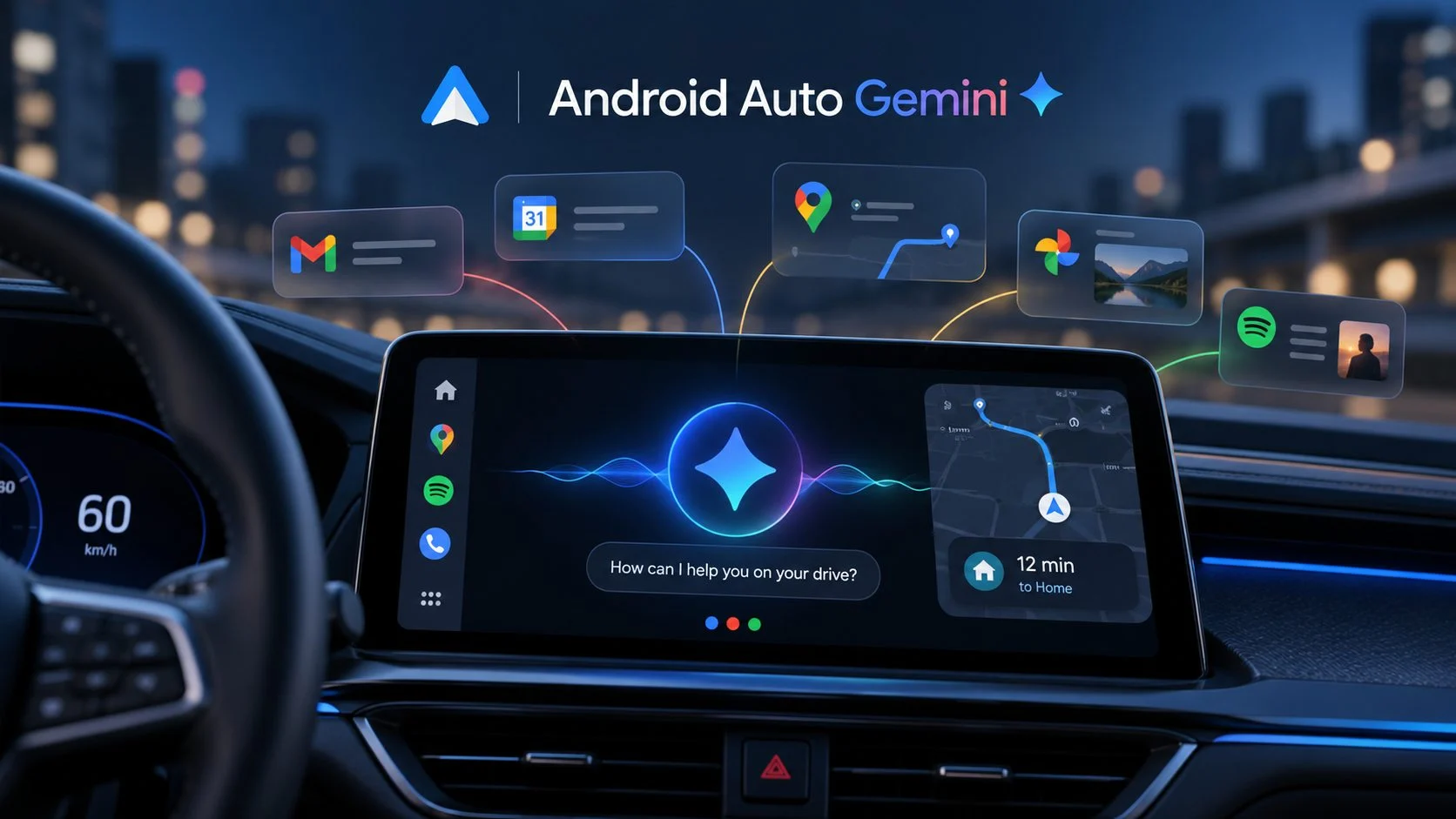
Android Auto is starting to support Gemini’s Personal Intelligence feature, allowing drivers to ask questions based on information stored in connected Google apps. Google announced the rollout on October 20, 2026, with support for cars with Google built-in planned for the coming months.
The feature can use information from services such as Gmail, Calendar, Google Photos and Maps to answer questions involving personal details. Access is optional, and existing voice commands for navigation, calls, music and general questions continue to work without personalization.
Google is releasing the feature gradually. Availability depends on the user’s account, location and settings, while some details about consent and reviewing personalized answers inside the car remain undocumented.
Google begins rolling out Personal Intelligence on Android Auto
Google’s announcement concerns an additional feature within Gemini rather than the introduction of Gemini itself. According to the company, Gemini is already available globally on Android Auto and cars with Google built-in.
Personal Intelligence allows Gemini to use information from connected Google services when responding to a request. For example, a driver can ask about an upcoming flight without manually searching through emails for booking details.
Google said the Android Auto rollout began on October 20, 2026. However, the feature is being released in stages, so eligible users may not see it immediately.
The company’s Gemini eligibility guidance confirms that access is gradual and may not yet be available to every eligible account.
How Gemini uses information from connected Google apps
Personal Intelligence allows Gemini to retrieve relevant details from connected services and use them to answer a driver’s question.
One example provided by Google involves asking for a flight’s departure gate and whether the flight is running on time. Gemini could retrieve the gate information from an email and respond to the flight-status question in the same conversation.
Google also describes several other uses. Drivers could ask Gemini to find a restaurant along their route that matches their preferences or get directions to a medical appointment saved in their calendar. Another example involves finding a car wash previously photographed with a phone.
These examples describe how Google expects the feature to work. They have not been presented as independent tests of its accuracy, and Google has not established that Gemini will successfully retrieve every relevant piece of information.
The usefulness of these requests depends on whether the necessary information is available through an eligible connected service and whether Gemini can retrieve it correctly.
Existing voice commands continue to work with Gemini
Google says Gemini supports the familiar voice commands available through Google Assistant, including making calls, sending messages, getting directions and controlling music.
Gemini also supports more conversational requests. Drivers can ask detailed questions, speak naturally and continue a conversation with follow-up questions.
Personal Intelligence adds account-based information to these interactions. Drivers who leave personalization disabled can continue using Gemini for ordinary voice commands and general questions.
The transition from Google Assistant to Gemini is still underway. Google has said it will share further details as it upgrades Assistant users during 2026.
Although Google says Gemini understands the same commands as Assistant, its documentation does not include a complete command-by-command comparison or a confirmed date for finishing the migration.
More information about supported commands and the transition is available in Google’s Android Auto voice-assistant guide.
Supported Google apps and eligibility requirements
Google identifies Gmail, Calendar, Google Photos, Google Maps, YouTube and Search among the services that Personal Intelligence can use.
Availability varies according to the service, device, account type, location and personalization settings. Having Gemini on Android Auto does not automatically mean every listed service can be connected.
According to Google’s current eligibility documentation, Personal Intelligence requires users to meet several conditions:
- Users must be at least 18 years old.
- A personal Google Account is required. Work, school and supervised accounts are excluded.
- The Keep Activity setting must be enabled.
- Search-based personalization requires Web & App Activity.
- YouTube personalization requires YouTube History.
- Workspace connections require Smart features in other Google products to be enabled.
Google Photos personalization has additional requirements and is supported only in certain countries and territories. Users may also need to complete setup steps within Google Photos.
Google’s launch information excludes the European Economic Area, Switzerland, the United Kingdom and Nigeria.
Drivers should therefore check both account eligibility and regional support before expecting the feature to appear.
How Personal Intelligence settings work in the car
Google says Personal Intelligence is optional. Users can decide whether to enable it and choose which connected apps Gemini is permitted to access.
Anyone who has already enabled Personal Intelligence in the Gemini app will have that preference carried over to the car.
Connected services can be reviewed in Gemini settings, where users can disconnect or reconnect apps as needed. Google explains these options in its Connected Apps instructions.
Some aspects of the in-car experience remain unclear. Google’s published documentation does not specify whether Android Auto displays a separate consent confirmation when Personal Intelligence becomes available.
It also does not describe whether drivers will receive permission prompts during individual trips, be able to inspect the sources behind an answer directly on the car display, or have access to a dedicated correction interface.
The documented management options are available through Gemini settings. Users should not assume the car interface provides the same controls until Google confirms them.
Disabling Personal Intelligence does not remove Gemini’s standard voice features. Navigation, calls, music controls and general questions remain available, although responses will no longer use the additional personal context.
When will Personal Intelligence reach more vehicles?
Google started releasing Personal Intelligence for Android Auto on October 20, 2026.
Cars equipped with Google built-in are expected to receive the feature in the coming months. Google has not announced a specific launch date for that expansion.
The company has also not provided a country-by-country release schedule or disclosed how many eligible accounts have received the update.
As of October 21, 2026, the rollout remains gradual. Meeting the eligibility requirements does not guarantee that Personal Intelligence is already available in a particular vehicle.
Users will need to check whether the feature has appeared in their Gemini settings and Android Auto experience.
Voice interaction can still distract drivers
Gemini’s conversational features may reduce the need to manually search through messages, calendars or navigation screens. However, using voice commands does not eliminate driver distraction.
The National Transportation Safety Board has warned that hands-free interactions can still create cognitive distraction. A driver may have both hands on the steering wheel while concentrating on a conversation instead of surrounding traffic.
Research presented by the National Highway Traffic Safety Administration has also found that voice interfaces can reduce visual and manual distraction while doing relatively little to reduce cognitive distraction.
That research did not evaluate Gemini Personal Intelligence or the specific examples described in Google’s announcement. It therefore cannot establish how distracting this feature is compared with existing Android Auto voice controls.
Drivers should keep requests brief and avoid lengthy conversations or complicated tasks that require substantial attention.
What drivers should check before using Personal Intelligence
Before using personalized Gemini responses in Android Auto, drivers should review the services connected to their Google Account.
The first step is to check Personal Intelligence and Connected Apps settings in Gemini. Users should confirm that only the services they want Gemini to access are enabled.
They should also verify that their account meets Google’s age, activity and regional requirements.
Since the rollout is gradual, it is worth checking whether Personal Intelligence is actually available for the account rather than relying on the announcement alone.
Personalized answers may involve information from multiple services, including emails, appointments and location-related records. Drivers should verify important details when it is safe to do so, particularly if an incorrect answer could affect travel arrangements or appointments.
If a response appears incomplete or inaccurate, the safer option is to stop in an appropriate location before checking the underlying information.
Google has not documented a validated in-car procedure for reviewing personalized sources or correcting complex answers without distracting the driver.
Accuracy and in-car controls still need testing
Google’s announcement explains what Personal Intelligence is designed to do, but several questions remain unanswered.
The company has not published comparative measurements of response accuracy or speed for personalized requests in Android Auto. There are also no published measurements establishing how the new feature affects driver distraction.
Another unanswered question concerns source transparency. Google’s current documentation does not explain how drivers can inspect the specific emails, calendar entries or other records used to generate an answer directly within Android Auto.
There is also limited information about how Gemini handles conflicting details between connected services or what happens when the information needed for a request is unavailable.
Independent testing could help answer these questions. One useful approach would be to ask the same travel-related question in both Android Auto and the Gemini mobile app, then compare the answers, source visibility and correction process.
For now, Personal Intelligence offers drivers a way to access information from their Google accounts through conversational voice requests. Its practical reliability will depend on the accuracy of those responses, the availability of connected information and how well the feature works during everyday driving.