 Vipin PG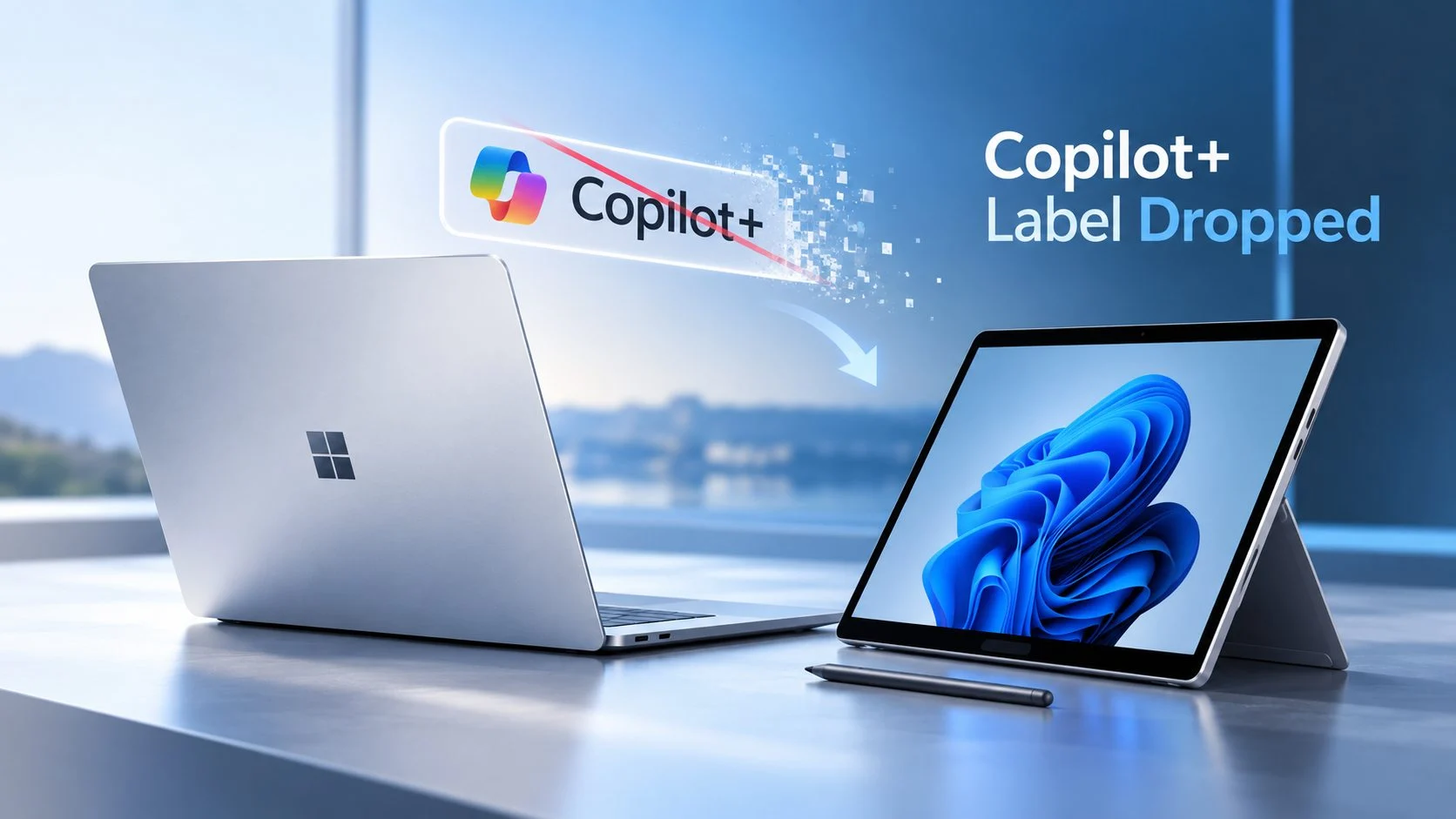
Microsoft’s newest Surface PCs were announced this week without the badge the company spent two years promoting. At Snapdragon Summit 2026 in Maui, Microsoft introduced the Surface Pro 12-inch (2nd Edition), the Surface Laptop 13-inch (2nd Edition) and a redesigned Surface Mouse. The official Devices Blog post never calls either PC a Copilot+ PC.
That was deliberate. Brett Ostrum, Microsoft’s corporate vice president for Surface devices, confirmed as much when Windows Central’s Zac Bowden asked him about the missing branding at the summit.
Microsoft and Qualcomm on the missing badge
Ostrum’s answer to Windows Central was blunt: “these are not called Copilot+ PCs.” He went on to say they “do meet all the requirements of our previous bar for what Copilot+ devices are. We still lean into the narrative around AI on the edge and being able to have a hybrid solution out there.”
Qualcomm’s Kedar Kondap, senior vice president and general manager of compute and gaming, gave the same publication a different framing. The category, he said, existed “to be able to deliver [NPU] experiences” and to define “a certain bar and metric.” Customers now get “the same experiences, probably without just using [Copilot+ PC] terminology now.”
What the new Surface machines actually are
Both PCs run Qualcomm’s Snapdragon X2 Plus. Microsoft claims up to 17 percent faster Office productivity workloads, more than 60 percent faster graphics, up to 95 percent faster local AI inferencing on the NPU and up to 18 percent more efficient battery performance compared with the previous Snapdragon X Plus generation. The panels are 25 percent brighter at 500 nits, and both models come in Black.
- Surface Pro 12-inch starts at $1,149.99 and adds an optional 5G configuration.
- Surface Laptop 13-inch starts at $1,199, rated by Microsoft at up to 22.5 hours of local video playback.
- Surface Mouse starts at $79.99 with haptic feedback, Bluetooth 6.0 and a customizable action button for Copilot.
All three arrive on October 13 in select markets, with commercial availability through Surface for Business. Microsoft Ink Canvas, a pen-first app for sketching, annotating, generating images and summarizing text, comes preinstalled on the Pro 12-inch and reaches other supported Surface and Windows devices on the same date.
The hardware requirement has not moved
Dropping a name is not the same as dropping a specification. Microsoft’s developer documentation still describes a Copilot+ PC as a Windows 11 machine with an NPU rated above 40 TOPS, and the company’s support library uses the same definition. Recall, Cocreator and automatic super resolution stay tied to hardware that clears that bar, and the new Surface Pro and Laptop clear it. Ostrum said so himself.
What changed is the signal available to a buyer. A product name no longer says whether a machine qualifies, so the spec sheet is the only reliable place to look.
Why the phrase disappeared
Microsoft used the term in its own headlines as recently as May 2025, when it introduced the “all-new Surface Copilot+ PCs.” The June 2026 Surface Pro and Surface Laptop launch post dropped the phrase entirely, and this week’s post does not mention it either.
Recall’s 2024 debut started the slide. Security researchers flagged weaknesses in how the feature stored what it captured, Microsoft delayed it, and the first Copilot+ machines shipped without their headline experience. OEMs started trimming the wording from product names soon after, and by June 2026 neither the NVIDIA RTX Spark powered Surface Laptop Ultra nor the Surface RTX Spark Dev Box carried the badge. NVIDIA sells RTX Spark under its own local AI identity.
Price then split the category. Copilot+ PCs require at least 16GB of memory, and Microsoft now sells cheaper 8GB Surface configurations that do not qualify at all. A badge that appears on some machines in a product family and not others stops doing the one job a badge has.
What to check before buying
Two numbers on the spec sheet decide which local AI features a Windows PC actually gets: the NPU rating and the memory. A rating above 40 TOPS plus 16GB of RAM puts a machine in the same hardware class Microsoft used to call Copilot+, whatever the box says now. Microsoft’s own AI components page lists which features depend on that hardware, including the Phi Silica on-device language model.
Copilot itself runs on any machine with an internet connection, so a PC that runs Copilot was never the same thing as a Copilot+ PC. If I were buying one of the new Surface models at $1,149, or the equivalent from Dell, HP or Lenovo, I’d check the NPU rating and the memory before anything else.