 Vipin PG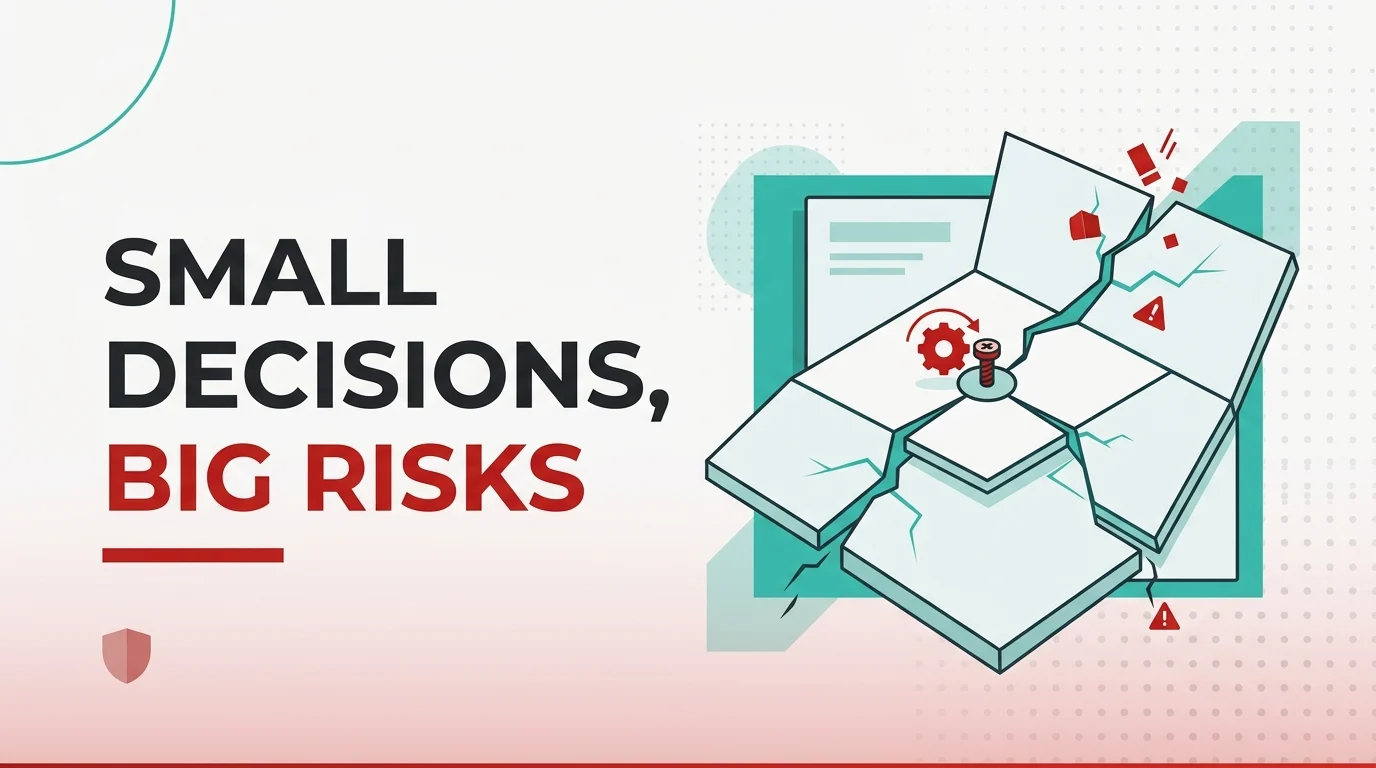
You likely spend hours agonizing over quarterly business strategies, marketing budgets, and operational expansions. Business leaders obsess over big strategic moves because they directly impact the bottom line. But when was the last time you thought about your company’s email spam filter or a delayed software update?
These seemingly minor, day-to-day tech choices quietly expose your company to massive vulnerabilities. Ignoring these small tech decisions inevitably leads to bigger business risks. Many mid-sized organizations operate under a false sense of security, believing that as long as the internet works and computers turn on, their data is safe.
Dangers of “Small” Tech Decisions
Most business network breaches do not start with a sophisticated, cinematic hacking sequence. They start with a busy employee clicking “remind me tomorrow” on a routine software update. These common, seemingly harmless IT choices are exactly what cybercriminals count on.
Consider the endpoints in your organization, especially with remote workers. Allowing a remote employee to access company data on a personal device without proper endpoint security is a small decision made for convenience. Yet, it creates a direct, unprotected bridge right into your central server. Relying on basic, out-of-the-box email filters is another frequent oversight. These filters catch obvious spam, but they easily miss targeted phishing attempts designed to steal login credentials.
A major misconception among business leaders is that a standard IT team can handle complex modern security. Many businesses make the seemingly small decision to leave their digital protection in the hands of a generalized IT team, assuming basic firewalls and antivirus software are enough. However, cybersecurity experts provide dedicated protection that goes beyond routine IT support, helping businesses uncover vulnerabilities, improve their security posture, and reduce the risk of costly cyber incidents.
Standard IT support is designed to keep your systems running smoothly. Specialized cybersecurity is designed to keep those systems from being hijacked. Choosing the right specialized team transforms security from a business roadblock into a secure foundation for scalable growth.
| Feature | Standard IT Support | Specialized Cybersecurity |
|---|---|---|
| Primary Goal | System uptime and employee productivity. | Risk mitigation and data protection. |
| Approach | Reactive (fixing broken hardware or software). | Proactive (hunting for threats before they strike). |
| Tooling | Basic antivirus, standard firewalls, helpdesk. | Continuous vulnerability scanning, real-time threat detection. |
| Compliance | General best practices. | Strict adherence to NIST, CMMC, and industry regulations. |
How Minor Oversights Snowball into Major Business Risks
Threat actors actively look for minor vulnerabilities because they require the least amount of effort to exploit. The threat landscape has changed drastically over the last few years, making these small gaps more dangerous than ever. The complexity and intensity of cyberattacks, such as social engineering and ransomware, have risen exponentially, fueled by hackers utilizing AI tools to exploit small security gaps.
When these gaps are found, the financial devastation is staggering. According to recent research, the global average cost of a data breach reached $4.88 million in 2024, representing the biggest jump since the pandemic. This massive cost is driven heavily by business disruption, post-breach remediation, and lost customer trust. For a mid-sized operation, a hit of this magnitude is often unrecoverable.
Beyond the immediate financial hit, the operational impacts of an attack are severe. Imagine a ransomware attack locking you out of your client database, financial records, and internal communication channels. Costly downtime cripples your operation, halts production, and forces your team to sit idle while you bleed revenue. You lose days, sometimes weeks, trying to restore backups that may or may not be compromised.
Everyday tech decisions also directly impact your company’s regulatory compliance standing. Frameworks like NIST and CMMC require specific, documented security controls. Failing to enforce strict access management or maintain encrypted backups means failing these standards. The consequences of non-compliance aren’t just a slap on the wrist; they result in hefty fines, legal liabilities, and the immediate loss of lucrative government or enterprise contracts.
Building a Culture of Security
Small tech decisions are not just about hardware and software. They are also about everyday employee behavior and the internal policies that govern them. An employee’s choice to click a suspicious link or use a weak password is a “small” human decision with disastrous consequences.
Your workforce is often your first line of defense, but without guidance, they are your biggest liability. As industry research notes, “Security behavior and culture programs (SBCPs) enable an organization-wide approach to minimizing cybersecurity incidents associated with employee behavior.” Training your team changes how they interact with technology on a daily basis.
Establishing proactive internal policies is the best way to protect against human error. This means implementing mandatory security awareness training, enforcing multi-factor authentication (MFA) across all accounts, and running simulated phishing tests. When security becomes a part of the company culture, those small, dangerous tech decisions happen much less frequently.
Proactive Cybersecurity
To survive in today’s threat landscape, businesses must clearly define the difference between outdated IT models and modern security strategies. A “proactive” cybersecurity strategy means actively looking for trouble before it finds you. In practice, this involves real-time threat detection, continuous vulnerability management, and regular, rigorous security assessments.
Contrast this with the outdated reactive “break-fix” model. Break-fix means you only call your IT provider when something is already broken. Waiting for a server to crash or a breach to happen is no longer a viable business strategy. By the time a reactive IT team responds to a ransomware alert, the damage is already done, and the data is already gone.
The return on investment for a proactive methodology is clear when you weigh the alternatives. Paying a consistent, flat-fee rate for 24/7 dedicated protection is significantly cheaper and more predictable than the cost of disaster recovery. You are not just paying for software; you are paying to eliminate the unpredictable, catastrophic costs associated with extended downtime and regulatory fines.
Conclusion
Allowing small tech vulnerabilities to persist will inevitably lead to major financial and operational disasters. A missed software patch or a lack of employee training might seem inconsequential today, but threat actors use these exact oversights to dismantle businesses. The risks of relying on standard, generalized IT support are simply too high when modern attacks are automated and ruthless.
Moving to a proactive, dedicated cybersecurity model does more than just stop hackers. It builds a secure, predictable foundation for your business to grow without the constant fear of digital disruption. By neutralizing threats before they escalate, you protect your revenue, your reputation, and your compliance status.