
 Vipin PG
If you’ve spent any time in homelab or self-hosting communities lately, you’ve probably noticed one name coming up constantly: TorBox. A year ago it was a niche option. Now it’s the default recommendation almost everywhere Real-Debrid used to be. That shift didn’t happen by accident, and understanding why is actually a good way to understand how this entire category of service works. This article breaks down what TorBox actually is, why it suddenly took off, what you get for your money, and , just as importantly , what the legal reality looks like once you strip away the technical jargon.
What Exactly Is a “Debrid” Service?
Think of a debrid service as a middleman with a fast internet connection. Normally, when you download a torrent, your computer connects directly to a swarm of other users, and your IP address is visible to everyone in that swarm , including anyone monitoring it for copyright purposes. A debrid service removes you from that swarm entirely. You send it a torrent link, its servers do the actual downloading, and then it hands you the finished file over a standard, encrypted web connection , the same kind of connection you’d use to watch Netflix or check your email. Your internet provider sees encrypted web traffic, not a torrent handshake. TorBox goes a step further with caching. If someone else has already requested the same file, TorBox usually already has a copy sitting on its servers, so you get it almost instantly instead of waiting for a fresh download. 
Why Is Everyone Suddenly Talking About TorBox?
The short version: its biggest competitor got a lot less useful, almost overnight. Real-Debrid, based in the EU, has spent years as the go-to option in this space. But new obligations under the EU’s Digital Services Act changed things for EU-based providers. Courts ruled that platforms couldn’t be forced into broad, blanket monitoring of everything users upload or request , but they could be required to act on specific, detailed lists of terms flagged by rights holders. In response, Real-Debrid rolled out automated filters that block files based on their naming patterns, and it also cleared out large portions of its cached library. The problem is that a huge share of everyday media files use pretty standard naming conventions to describe their quality and format. Filtering based on those patterns ended up catching a lot more than intended, and the service became noticeably less reliable for a lot of users. TorBox, which operates outside the EU, wasn’t subject to the same rules, so it didn’t need to apply the same filtering. That’s really the whole story: one option got harder to use, and people moved to the one that didn’t. Worth being clear about: TorBox still says it follows the U.S. DMCA takedown process and responds to valid copyright complaints. It just isn’t required to run the same kind of preemptive, automated filtering that its EU-based competitors now are.
How TorBox Actually Works, In Plain Terms
There are really three ways people get torrented content, and it’s worth knowing the difference:
- Regular torrenting: Your device connects directly to other users. Your IP is visible. Speed depends on how many people are sharing the file at that moment.
- A seedbox: A rented server that runs the torrent client for you, 24/7. This isolates your home IP, but you’re renting dedicated infrastructure, which usually costs more.
- A debrid service like TorBox: Shared cloud infrastructure. It downloads and caches files, and you retrieve them over a normal web connection. Cheaper than a seedbox because the cost is split across many users.
One thing worth knowing if you’re into private tracker communities: many of them have historically restricted or banned debrid services outright, because a service that grabs a file and disappears without contributing anything back disrupts the upload/download balance those communities depend on. If you’re part of a private tracker, it’s worth checking their specific rules before assuming a debrid service is welcome there. 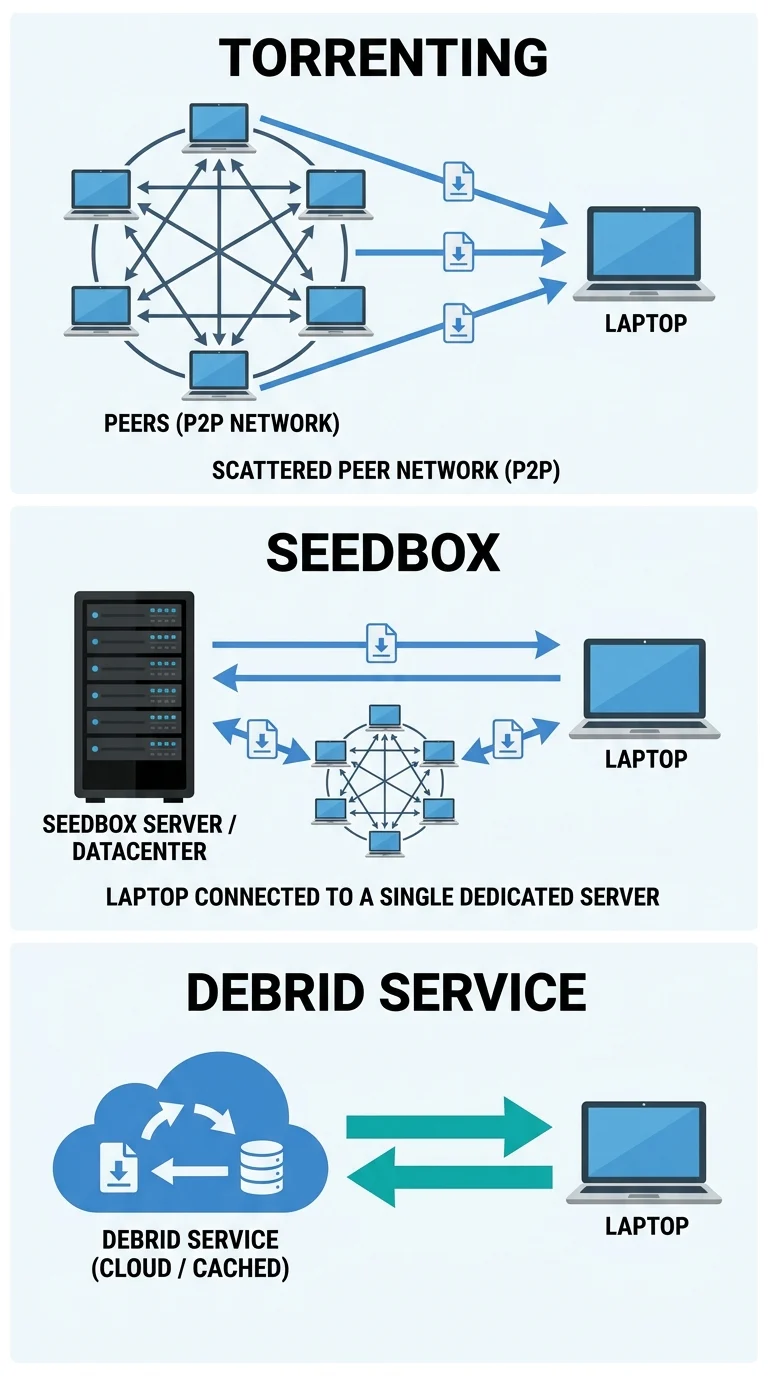
Plans and Pricing
TorBox uses a tiered subscription model. Here’s roughly what each tier includes:
| Plan | Price | Simultaneous Downloads | Usenet Access |
|---|---|---|---|
| Free | $0/mo | 1, with a daily download cap | No |
| Essential | $3/mo | 3 | No |
| Standard | $5/mo | 5 | No |
| Pro | $10/mo | 10 | Yes |
The free tier is genuinely limited , it’s really just enough to test whether the service suits you. Most regular users end up on the Essential or Standard tier, and the Pro tier mainly makes sense if you specifically want Usenet access built in.
Usenet: The Feature Most People Don’t Expect
Usenet is an older technology than BitTorrent, and it works completely differently. Instead of connecting to other users, files sit on large, centralized servers run by commercial providers , some of which retain files for over a decade. That makes Usenet particularly useful for older or harder-to-find content that’s dropped off torrent networks entirely. TorBox’s Pro plan bundles direct Usenet access alongside its regular torrent caching, which normally would mean paying for a separate Usenet provider on top of your debrid subscription. Folding both into one plan and one API is a genuinely convenient bit of design.
It Plays Nicely With Media Center Apps
TorBox has an official add-on for Stremio, a popular open-source media center app. Once you connect your TorBox account, Stremio can pull in TorBox’s cached files alongside its other sources, which generally means faster, more reliable playback compared to relying purely on live torrent swarms. If you’re building out a home media setup, this kind of integration is a big part of the appeal , it fits into the same ecosystem homelab users are usually already comfortable with.
What About Privacy?
On the privacy side, TorBox keeps things fairly minimal. Signing up only requires an email address; it doesn’t collect the kind of personal identifying information a lot of other services ask for. According to its own policy, TorBox doesn’t inspect the actual content of the files passing through its system, and transfer-related metadata gets automatically cleared out after a period of inactivity. Payment processing is handled through a separate, PCI-compliant third-party provider, so TorBox itself never touches your raw card details.
The Legal Reality You Shouldn’t Skip Past
This is the part that matters most, so it’s worth being direct about it: a debrid service hides your torrenting activity from your internet provider, but it does not make downloading copyrighted material legal. Those are two completely separate things. TorBox’s own terms explicitly prohibit using the service to access licensed or copyrighted material without permission, and it operates a standard DMCA takedown process for valid infringement complaints. In most countries, unauthorized downloading or distribution of copyrighted content remains a civil and, in some cases, criminal matter , regardless of how the traffic is routed. In India, for example, copyright law carries potential fines and prison terms for infringement, and courts have at times ordered broad blocking of piracy-related sites. Enforcement in practice tends to focus more on large-scale distributors than individual downloaders, but that’s a description of enforcement patterns, not a legal exemption , the underlying risk to an individual user doesn’t disappear. The safest way to use any tool like this is for content you actually have the rights to access , things like your own media backups, legally purchased files, open-source software distributed via torrent, or Linux ISOs. If you’re downloading something you haven’t paid for or don’t otherwise have permission to access, no amount of encryption changes the legal picture.
One Important Mix-Up: TorBox (the App) vs. TorBox (the Router)
Here’s something that trips people up: there’s a completely different project also called “TorBox,” and it has nothing to do with the debrid service described above. The other TorBox is a piece of open-source software you install on a Raspberry Pi to turn it into a Wi-Fi router that routes all connected traffic through the Tor network. It’s built for people who need strong anonymity , journalists, activists, and people in heavily censored regions , not for streaming or downloading media. Its own developers are upfront that it’s not a good fit for general browsing if your safety genuinely depends on staying anonymous. Ordinary browsers leak identifying details in all sorts of ways , tracking cookies, browser fingerprinting, and so on , that can undo the protection Tor is supposed to provide. For serious anonymity needs, tools built specifically for that job, like the Tor Browser or the Tails operating system, are the safer choice. Tor’s network is also built for light, low-bandwidth use, so running torrents or streaming video over it is both slow and takes bandwidth away from people who genuinely rely on it. Two products, same name, completely different purposes , worth remembering before you go looking for either one. 
Final Thoughts
TorBox’s rise says less about TorBox itself and more about how quickly this corner of the internet can shift when regulations change. It’s a genuinely well-engineered service, and its growth in 2026 largely comes down to timing , a major competitor got squeezed by new rules right as TorBox was maturing. If you’re evaluating it, judge it the way you’d judge any cloud service: on speed, reliability, pricing, and privacy practices. And separately from that, keep the legal picture in mind , the tool being fast and private doesn’t change what’s legal to download in your country.