 Vipin PG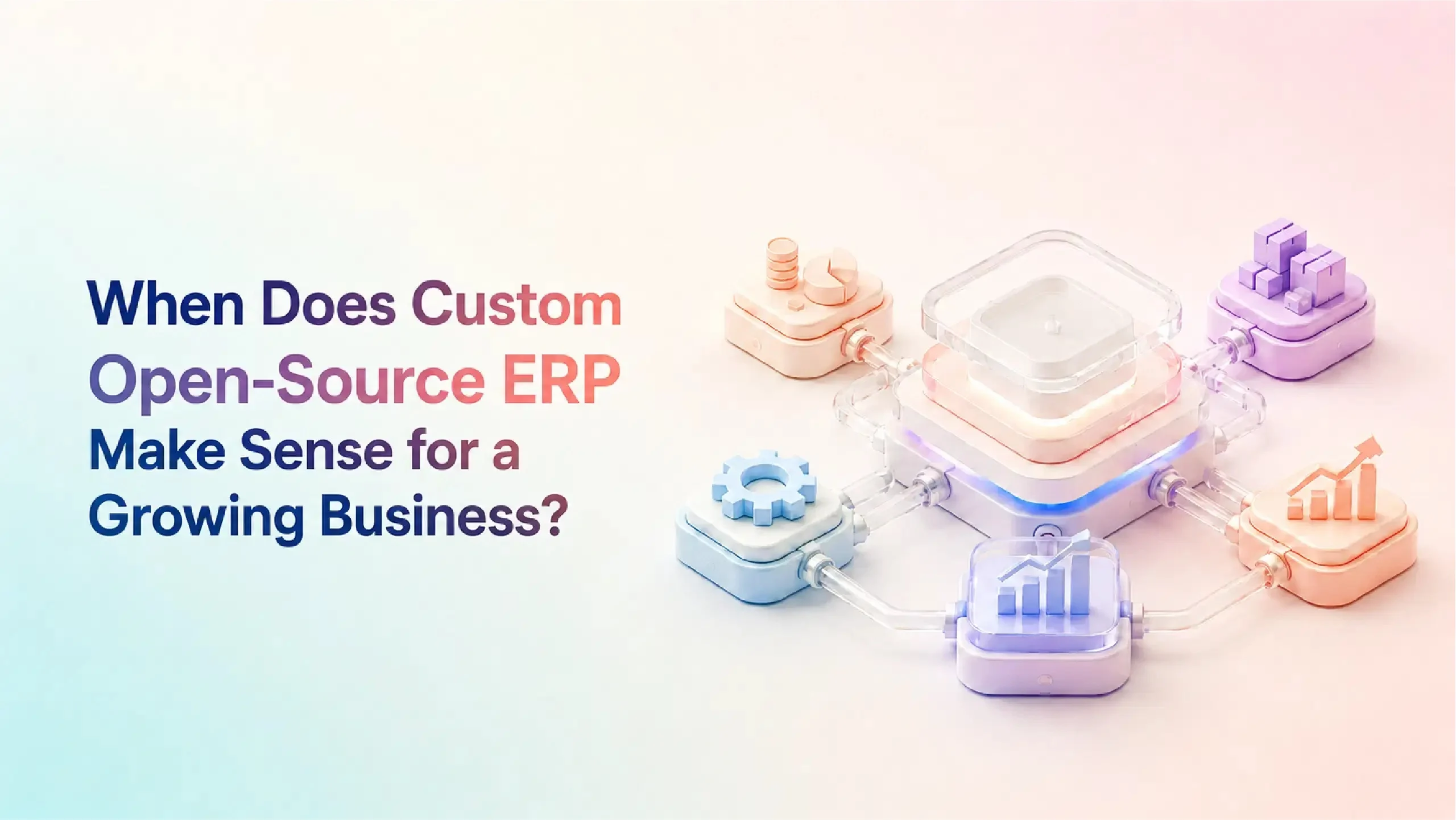
ERP requirements tend to change as a business grows. A system that worked well with one location, a small product catalog, or relatively simple accounting processes may become harder to manage once the company adds warehouses, ecommerce channels, business units, suppliers, or more complex fulfillment workflows.
At that stage, the ERP decision becomes less about adding another software tool and more about deciding how business processes, data, integrations, and reporting should work together.
Standard ERP platforms can handle many of these requirements, particularly when processes are relatively conventional. Businesses with specialized workflows, legacy integrations, or industry-specific requirements, however, may need more control over how the system is configured and extended. That is where custom open-source ERP becomes worth considering.
What Is Custom Open-Source ERP?
Custom open-source ERP is an ERP system built or adapted using software whose source code can be accessed and modified. Businesses can configure standard ERP capabilities while developing additional workflows, modules, integrations, or interfaces around their operational requirements.
Instead of replacing the entire system every time processes change, companies can extend the ERP as their operations become more complex. For example, a business may customize inventory allocation, procurement approvals, order routing, warehouse processes, financial reporting, or integrations with ecommerce and logistics platforms.
Open-Source ERP vs Proprietary ERP
Open-source ERP gives organizations access to the underlying code and generally provides greater freedom to modify workflows, integrations, data models, and business logic. The practical level of customization still depends on the platform architecture, implementation approach, and technical expertise available.
Packaged proprietary ERP can be the better choice when standardized workflows, vendor-managed upgrades, a large implementation ecosystem, or faster deployment matter more than source-code control.
The better option depends less on whether the software is open or proprietary and more on how closely the platform fits the organization's processes, technical resources, customization requirements, and long-term operating model.

Key Benefits of Custom Open-Source ERP
1. More Flexible Software Costs
Open-source ERP can reduce recurring software licensing costs, particularly when proprietary pricing increases as the business adds users, modules, locations, or transaction volume. Total cost of ownership still depends on implementation, hosting, customization, maintenance, integrations, and ongoing technical support.
2. Flexibility as Operations Become More Complex
Growth rarely means simply adding more users. A company may introduce new warehouses, sales channels, product lines, currencies, approval processes, or regional operations.
A well-designed open-source ERP can be extended around those changes. New modules, integrations, business rules, and workflows can be introduced without rebuilding the entire system, provided the original architecture was designed with future growth in mind.
3. Better Integration Across Business Systems
Growing companies often accumulate specialized software for ecommerce, CRM, warehouse management, shipping, accounting, procurement, and other functions. The ERP increasingly becomes responsible for keeping data and processes connected across those systems.
With a custom open-source ERP, businesses can develop integrations around their actual workflows instead of relying only on predefined connectors. They can also automate repetitive activities such as order routing, approval workflows, inventory updates, purchasing, financial posting, and reporting.
The value comes less from "automation" as a buzzword and more from removing unnecessary manual handoffs between systems and teams.
4. More Control Over Security and Deployment
Open-source ERP can give organizations greater control over where the system is hosted, how users access it, how integrations are secured, and how data is managed.
Access to the source code can also make it easier for technical teams to review custom components and address issues directly. However, open-source software is not automatically more secure than proprietary ERP. Security still depends on configuration, patching, infrastructure, authentication, monitoring, development practices, and ongoing maintenance.
For businesses with specific hosting, compliance, or data-control requirements, that additional control can be valuable.
5. Greater Control Over the ERP Roadmap
Every growing business has unique operational needs, and open-source ERP allows systems to be customized accordingly. Whether through personalized dashboards, industry-specific tools, or compliance-driven reporting, custom ERP solutions align software functionality with business processes. This tailored approach improves user adoption, operational efficiency, and long-term system effectiveness.
Signs Your Business May Be Ready for Custom Open-Source ERP
This approach tends to make the most sense when a business has reached a level of operational complexity that standard software cannot handle cleanly.
Common signals include multiple systems that require extensive integration, specialized approval or fulfillment workflows, complex inventory or manufacturing processes, significant ERP customization requirements, multiple business units or locations, and a need for greater control over data or deployment.
It can also make sense when a company expects its processes to continue evolving and wants an ERP foundation that can be extended rather than replaced every few years. The decision should still be based on total cost of ownership and operational fit, not simply on whether the source code is open.
Choosing an Open-Source ERP Foundation
The open-source ERP ecosystem includes both packaged applications and frameworks that can serve as the foundation for custom enterprise systems. The right choice depends on whether a business primarily needs ready-made functionality, extensive customization, or a combination of both.
Apache OFBiz, for example, combines business applications with a Java-based enterprise framework that organizations can use to support customized systems across order management, inventory, accounting, ecommerce, procurement, manufacturing, and related operations. Moqui takes a framework-oriented approach and can also support highly customized enterprise applications.
Businesses evaluating these platforms should consider architecture, available modules, integration requirements, upgrade strategy, developer expertise, community activity, documentation, and long-term support rather than selecting a platform based on feature count alone.
Is Custom Open-Source ERP Right for Your Business?
A customized open-source ERP system is most valuable when a growing business needs more control than a standard ERP can reasonably provide. It can support specialized workflows, complex integrations, evolving operations, and long-term customization without tying every system decision to a single vendor's product roadmap.
The tradeoff is greater implementation and maintenance responsibility. Businesses should evaluate their processes, technical resources, integration requirements, expected growth, and total cost of ownership before choosing this approach.
For companies with genuinely complex requirements, an established open-source ERP platform can provide a flexible foundation that continues to evolve with the operation.