 Vipin PG
To grow a business, you need leads, but it can be hard to find people who genuinely want to learn about your products or services. In comparison with old-fashioned approaches that use individual research and face-to-face communication, AI-based tools will assist you in determining opportunities, systematizing data, and automating routine activities. But what strategy do you want to rely on to provide good leads?
It depends on the quality of data, the accuracy of the targeting, personalization and human control. Knowing the advantages and drawbacks of both approaches can help you choose the lead-generation approach that builds a stable sales pipeline.
What Is Manual Lead Generation?
Manual lead generation is when a person identifies, researches, qualifies, and contacts potential customers. You may employ Linked In, company websites, professional directories, referrals and networking to discover prospects that fit well into your ideal customer profile.
This method gives you more control over prospect selection and communication, but the outcome depends on your research skills and the time you have.
Key advantages include:
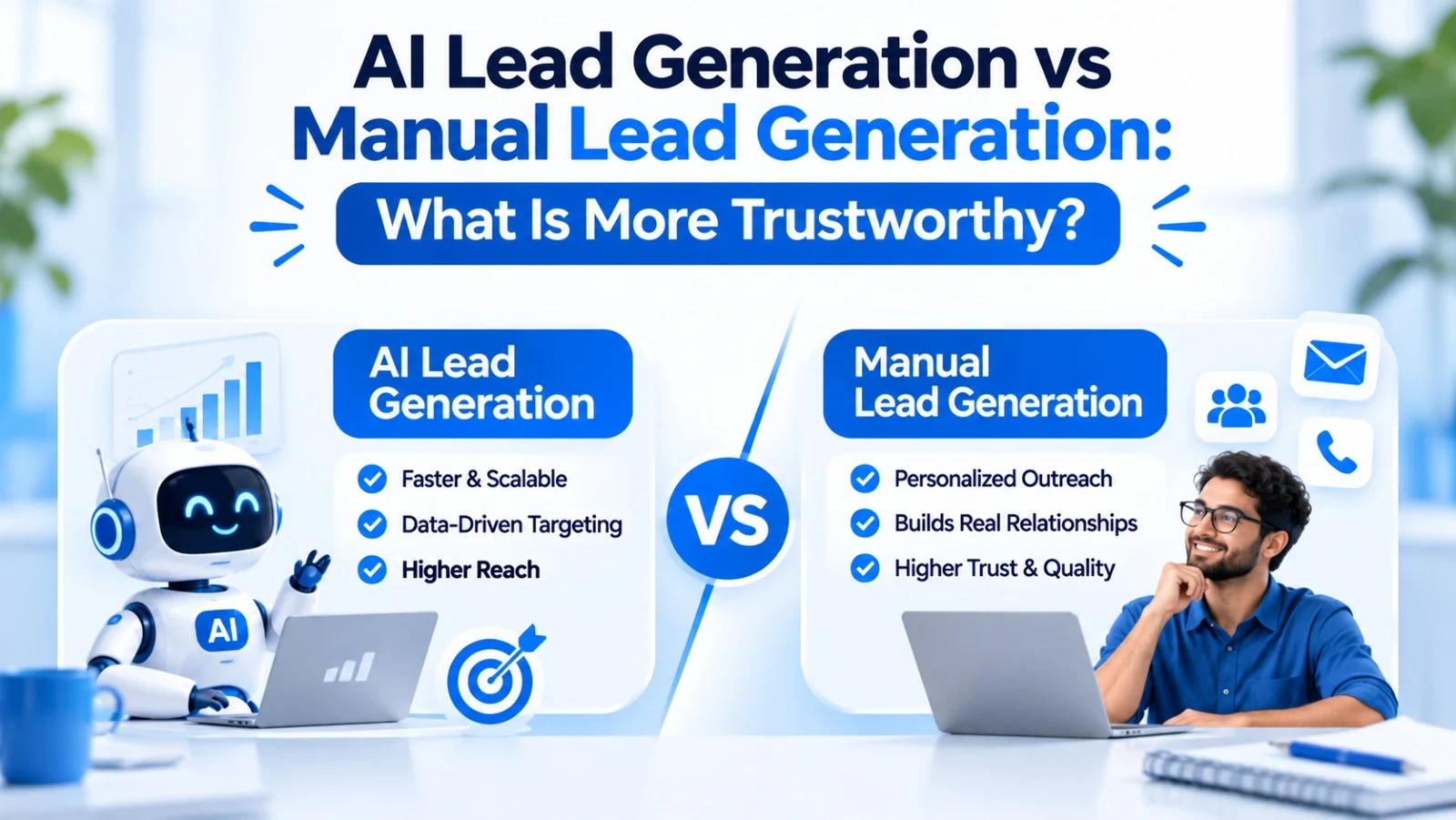
- Customized research: Before reaching out to a prospect, you can research their role, company and business requirements.
- Human judgment: You can understand situations that automated systems may struggle to interpret.
- Relationship building: Face to face conversations make you adjust the conversation to individual feedback.
Yet, manual research may be time-consuming and lead quality may be still influenced by outdated information or human errors.
What Is AI Lead Generation?
AI lead generation involves artificial intelligence and automation of activities like prospect discovery, data enrichment, lead scoring, and outreach preparation. Such tools could be used to scan information against your target audience requirements and assist in prioritizing the relevant contacts depending on the platform.
AI is able to handle large amounts of data in a short amount of time, yet the data it provides is subject to the quality of the existing data, and the system configuration.
AI vs Manual Lead Generation: Which Is More Trustworthy?
The trustworthiness is not established by the human or the algorithm work. You should consider the accuracy of prospect identification, checking the information they present, and the relevance and responsibility of outreach.
1. Data Accuracy and Reliability
You can research the professional profiles and company websites directly with the help of manual research. But human beings may not notice the details or write the information which is already old.
Scalable records can be enriched with AI tools and inconsistencies can be indicated to humans, however, the automated results are not inherently accurate. Before reaching out to prospects, you need to confirm vital information, irrespective of the channel.
2. Personalization and Relevance
There is an opportunity to know the circumstance of a prospect and write a message based on his or her needs when using the manual outreach. The use of AI can assist in making messages more personal based on the available information, whereas generic or wrong personalization may compromise trust.
The best way is to rely on AI to shape the appropriate insights as you read through the message to ensure correctness, context, and tone.
3. Consistency and Scalability
Manual lead generation will be more difficult to sustain as your prospect list increases. The process of research, data entry and follow up may take a lot of time.
A LinkedIn lead generation tool with AI can be used to organize the prospect lists, optimize repetitive processes, and keep follow-ups on a regular schedule. Human control is still necessary to make sure that the high activity is not at the cost of relevance and quality.
How Can You Make AI-Powered Lead Generation More Trustworthy?
Being a responsible user of automating technology involves beyond simply choosing a tool. What you need is a procedure that verifies the quality of the leads, ensures that there is up to date targeting and that people are kept in key decisions.
1. Define Your Ideal Customer Profile
Begin by determining the industries, job titles, company sizes and business challenges that are of interest to your organization. Setting clear criteria can help you to avoid getting so many contacts that are irrelevant.
2. Verify Prospect Information
Verify job titles, companies and accessible contact information prior to initiating a campaign. Eradicate old records and screen dubious matches rather than presume that the AI has found the correct individual.
3. Review Outreach Before Sending
Automation can assist with research and writing but make sure that what you say is true, considerate, and valuable. Do not make unproven assertions, misdirected customization, and duplicated messages that will ruin your reputation.
4. Monitor Results and Respect Boundaries
Follow significant metrics like positive responses, qualified meetings, and conversion rates and not just the number of messages sent. Adhere to stipulated privacy requirements and LinkedIn terms and automation policies. Stop communicating with individuals who refuse to communicate further.
Should You Choose AI or Manual Lead Generation?
It would depend on your sales objectives, the resources that you have, and the complexity of your target audience. The two approaches are not mutually exclusive and there can be practical compromise of efficiency against judgment by combining the two.
A small set of high-value prospects where detailed account research is needed can be handled by manual research. AI-assisted workflows may be valuable when you are required to systematize bigger lists of prospects, handle habitual follow-ups, and keep up to date procedures.
A hybrid approach is the most appropriate balance, allowing automation to do the repetitive tasks and people to validate information, refine messages, and conduct meaningful discussions, in the case of many B2B teams.
Conclusion
Generating AI leads can enhance efficiency and consistency, whereas manual research will further enrich the context and human judgment. None of the methods is a promise of reliable results. To achieve good lead generation, it is necessary to have proper information, targeting, open communication and frequent quality checks.
To make LinkedIn prospecting more structured, Linkziy’s Linkedin Prospecting Tool will put prospect sourcing, contact enrichment, multi-step outreach campaigns, conversation management, and content creation into a single platform.
Being a LinkedIn automation tool, it will allow you to automatize the repetitive LinkedIn tasks and leave the prospect selection and messaging to your own personal control. Learn how Linkziy can help streamline lead generation and make it more consistent and relationship-oriented.
Frequently Asked Questions
1. Does AI lead generation qualify as trustworthy as compared to manual lead generation?
Neither is necessarily more reliable. Reliability is determined by accuracy, verification and responsible processes.
2. Are AI tools capable of coming up with false leads?
Yes. The data generated by AI can also be impacted by outdated, incorrect matches, missing information.
3. Is it more personalized with manual lead generation?
It can provide more context, yet AI-assisted personalization can be useful in case messages are closely checked by a human.
4. How do we do B2B lead generation?
An integrated solution combines AI efficiency with human verification, targeted outreach, and relationship-building.