
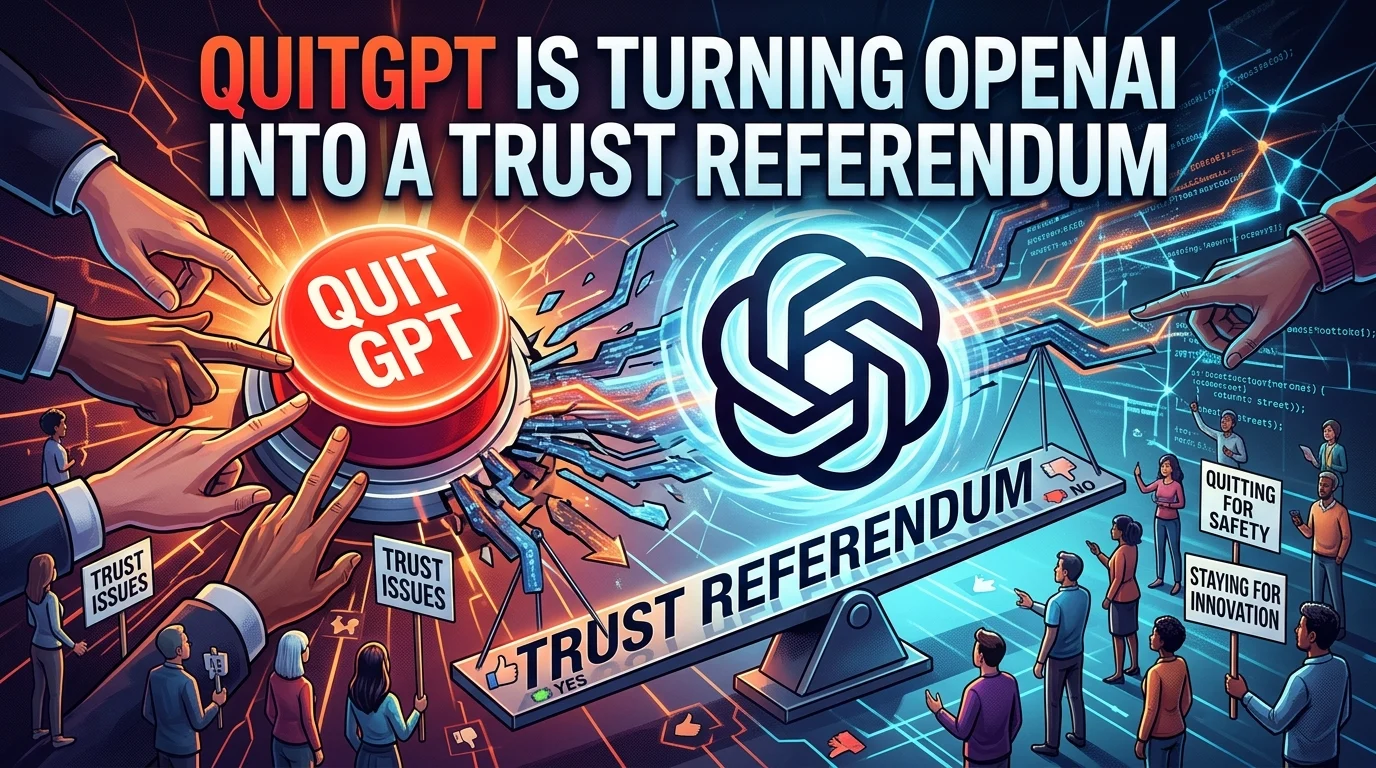
You’re right to call out the context: the headline claim driving a lot of the conversation is that about 2,500,000 people have “stopped using” ChatGPT as the QuitGPT campaign spreads.
But when you trace that figure to its origin, the wording shifts.
On the QuitGPT website itself, the banner states “2.5M+ have taken action as part of the boycott” and describes it as an estimate based on “website signatures, share counts on social media, and credible app usage data.” That is meaningfully different from a verified count of people who permanently stopped using ChatGPT or canceled paid plans.
In other words: 2.5M is best read as “campaign actions” or “pledges,” not audited churn. This doesn’t make the movement irrelevant—it just changes what the figure can responsibly be used to claim.
What triggered QuitGPT in the first place
QuitGPT gained traction in the wake of reporting and public discussion around OpenAI’s expanding relationship with the US Department of Defense, plus broader anxiety that general-purpose AI is quietly becoming national-security infrastructure.
Two developments intensified the reaction:
- Public debate about whether AI vendors can credibly restrict military and intelligence uses once systems are operationalized inside government environments.
- Reporting that OpenAI began pushing for stronger anti–mass surveillance safeguards in the wake of backlash—suggesting that even internally, the boundaries needed sharper definition.
The controversy also became a competitive optics war: coverage describes Anthropic resisting certain Pentagon terms around surveillance and autonomous weapons, then facing political pressure and threats of being labeled a “supply-chain risk.”
Why the QuitGPT campaign spread fast
QuitGPT didn’t need everyone to agree on the same ethical argument. It spread because it offered three things that online movements thrive on:
A simple action with personal impact
Canceling a subscription is immediate and measurable. It turns a moral stance into a concrete transaction.
A narrative that’s easy to understand
“Consumer AI shouldn’t fund military expansion” is legible even if you don’t know anything about model training or governance.
A number that travels well
“2.5M” is the perfect social-media accelerant: short, dramatic, and repeatable. It shows up in viral posts and republished summaries.
The key dispute behind the headline
The real argument isn’t “is OpenAI evil” versus “are protesters irrational.”
It’s this:
Can any AI company realistically control high-stakes downstream use
Even if a contract says “no mass surveillance,” the fear is that “incidental” or secondary uses still happen—because large institutions can repurpose tools, combine them with other data sources, and expand scope over time. That’s why reporting highlighting OpenAI’s own internal acknowledgement of limited control resonated so strongly.
At the same time, it’s also true that contract terms and technical controls can reduce harm—and that’s exactly why OpenAI moving to strengthen safeguards became part of the story.
So QuitGPT sits on a genuinely hard governance question: are safeguards enforceable, or are they mostly reputational?
What the 2.5M figure can and cannot prove
What it can support
- There is real momentum: millions of “actions” or “pledges” is a large awareness signal, and it’s big enough to shape media cycles and corporate responses.
- The campaign is intentionally multi-channel: QuitGPT itself says its estimate includes signatures and social sharing, not only cancellations.
What it cannot verify by itself
- That 2.5M people truly stopped using ChatGPT in the strict behavioral sense
- That 2.5M paid subscribers canceled
- That OpenAI’s user base shrank by 2.5M attributable to this movement
Even coverage that discusses boycotts often describes the figure as a claim or estimate associated with the campaign rather than independently audited platform churn.
Why OpenAI’s response matters more than the boycott math
Whether the true number is 250,000 cancellations or 2,500,000 “actions,” QuitGPT is forcing a new reality:
AI governance is now a consumer-facing trust product.
For years, model quality was the headline metric. Now it’s bundled with questions like:
- What does the company refuse to build
- What use cases does it allow in government deployments
- What oversight exists
- What’s enforceable versus aspirational
OpenAI’s reported efforts to add surveillance safeguards show how quickly public pressure can force specificity.
What happens next
- More transparency battles – As long as defense and intelligence deployments expand, activists and journalists will push for clearer boundaries and proof that restrictions exist in practice, not just in language.
- Competitors will turn “red lines” into a product feature – The company that can credibly demonstrate enforceable restrictions—and communicate them cleanly—will gain a reputational advantage.
- Users and businesses will hedge – Even people who don’t join QuitGPT may start keeping workflows portable across multiple models, because vendor governance can now become a sudden risk.
The bottom line
QuitGPT is not just a hashtag boycott. It’s a public stress test of whether a mainstream AI platform can be both a daily consumer assistant and a defense contractor partner without losing the trust of the people who made it mainstream.
And the most important correction to the viral framing is simple:
2.5M is an estimate of boycott “actions,” not a verified count of people who definitively stopped using ChatGPT.