

When people imagine automation taking jobs, they usually picture factory robots replacing assembly line workers. That image has shaped the debate for decades. But the newest evidence suggests the first serious pressure from generative AI is showing up somewhere very different: inside offices.
A recent study released by Anthropic on March 5, 2026 offers one of the clearest real-world snapshots so far of where AI is already doing meaningful work. The surprising part is not just which tasks AI can perform. It’s the type of workers those tasks belong to.
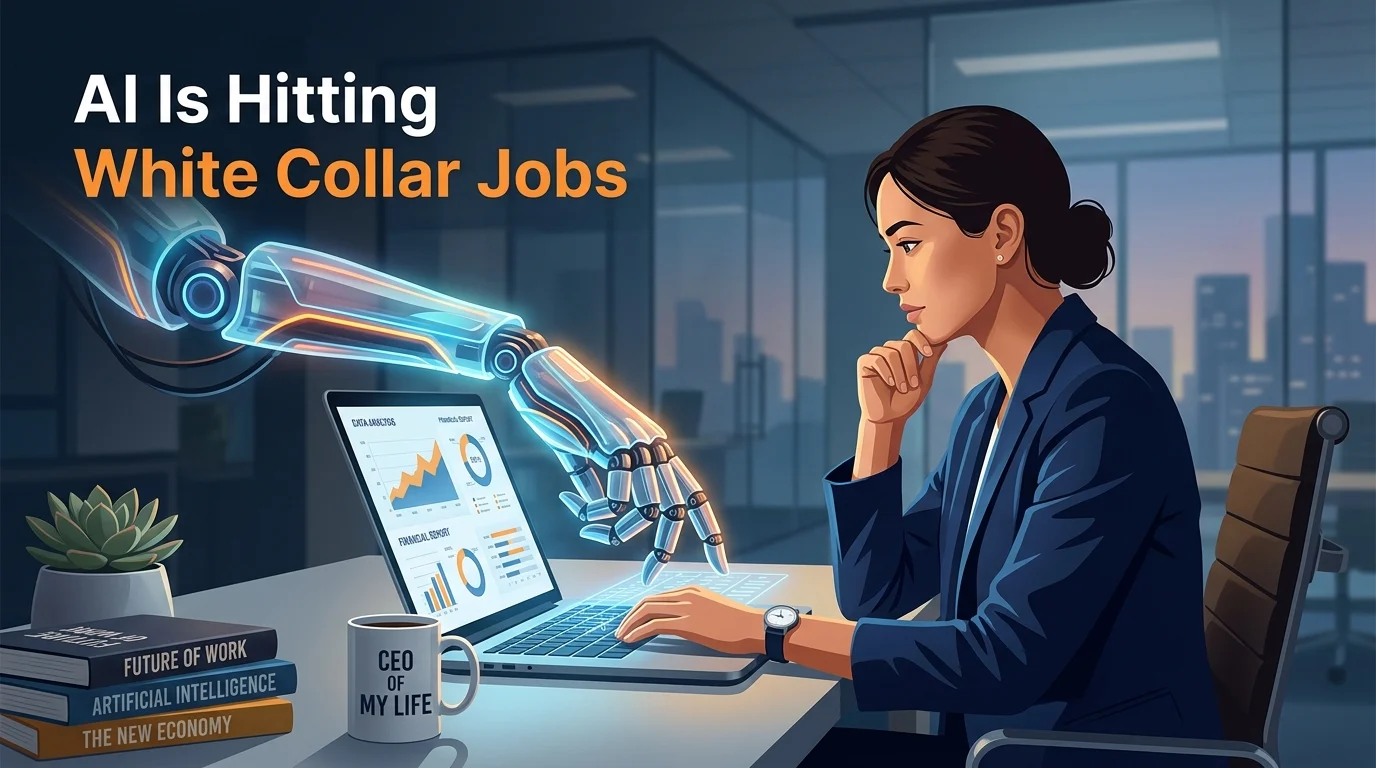
Many of the most exposed roles are not manual jobs at all. They are white-collar positions built around writing, documentation, digital coordination, analysis, and software development. In other words, the kind of work that lives inside documents, spreadsheets, help desks, dashboards, and code editors.
That shift challenges a long-standing assumption about automation: that it would hit physical labor first. Instead, the earliest measurable AI pressure appears to be forming in knowledge work.
Measuring Where AI Is Already Working
What makes this study stand out is the way Anthropic approached the problem.
For years, most research focused on potential exposure — what AI might be capable of if models keep improving. That type of analysis tends to be speculative. It assumes a future where AI systems are widely deployed across industries.
Anthropic took a different route.
The researchers introduced a metric they call “observed exposure.” Instead of asking what AI could theoretically do, they examined millions of real interactions with the Claude AI system to see what tasks people are already using AI for in professional settings.
The metric blends two things:
- Task-level estimates of what language models are capable of performing
- Actual usage patterns showing how AI is being applied in real workflows
Importantly, the analysis focuses on work-related automation, not casual use. Writing an email draft or summarizing a report for work counts. Asking AI to plan a vacation does not.
The goal is simple: measure present-day task penetration, not hypothetical future disruption.
And the results paint an interesting picture.
Even in occupations where AI could theoretically assist with most tasks, real adoption remains far lower. For example, in computer and mathematics roles, models may be capable of handling about 94 percent of tasks in theory, yet Claude’s current measured coverage sits around 33 percent.
So AI isn’t doing everything yet. But it is clearly doing something.
The Jobs With the Highest AI Exposure
The list of occupations with the highest observed exposure reveals a clear pattern.
These roles share three characteristics: they are digital, language-heavy, and structured.
Anthropic’s top ten most exposed jobs include:
- Computer programmers — 74.5% observed exposure
- Customer service representatives — 70.1%
- Data entry keyers — 67.1%
- Medical record specialists — 66.7%
- Market research analysts and marketing specialists — 64.8%
- Wholesale and manufacturing sales representatives
- Financial and investment analysts
- Software quality assurance analysts and testers
- Information security analysts
- Computer user support specialists
None of these jobs involve repetitive physical motion. They revolve around text, documentation, analysis, and digital systems.
That makes them a natural fit for large language models.
Tasks such as summarizing documents, drafting reports, translating technical findings into plain language, classifying information, and generating structured content are exactly what these systems are designed to handle.
And that alignment shows up clearly in how companies are already using them.
What AI Is Actually Automating Inside These Jobs
The study doesn’t just identify exposed occupations. It also breaks down specific tasks where AI is being used.
Inside programming roles, for instance, AI is commonly used to:
- Write and update software code
- Generate documentation
- Assist with debugging or refactoring
For customer service teams, AI tools help with:
- Answering routine customer questions
- Processing orders
- Responding to complaints or support requests
In data entry roles, models are used to:
- Read source documents
- Extract structured information
- Populate digital records automatically
Medical record specialists are using AI to:
- Compile patient information
- Summarize clinical data
- Code records for administrative systems
Market research analysts are leaning on AI for tasks like:
- Preparing written reports
- Summarizing research findings
- Generating data explanations and visualizations
Look closely and a pattern appears.
These tasks all involve transforming information into other forms of information. That’s exactly where language models shine.
They read text, restructure it, summarize it, classify it, or generate new content from it.
So Far, No Major Employment Collapse
Despite the high exposure levels, the study stops well short of claiming that AI has already triggered widespread job losses.
In fact, Anthropic reports no systematic rise in unemployment among workers in highly exposed occupations since late 2022, when generative AI began spreading rapidly.
That matters. A lot.
Public conversation around AI often swings between extremes. Either the technology will replace everyone immediately, or it will remain a harmless productivity tool.
Reality, at least for now, appears far more gradual.
Employment data simply does not show a sudden collapse in white-collar jobs.
But there are early signals that something subtle may be happening beneath the surface.
The First Warning Sign Appears in Hiring
The clearest early signal in the study appears in entry-level hiring.
Among workers aged 22 to 25, the researchers found that entry into highly exposed occupations began to weaken around 2024.
The shift isn’t dramatic. But it is noticeable.
Job-finding rates for young workers entering exposed fields dropped by roughly half a percentage point, and the post-ChatGPT estimate suggests about a 14 percent decline in job-finding rates compared with 2022.
Anthropic is careful not to overstate the result. The statistical signal is weak, and other explanations could exist.
Still, the trend lines are worth watching.
Hiring slowdowns tend to show up long before layoffs do.
Companies often adjust by hiring fewer junior employees rather than cutting existing staff.
Other Research Is Seeing Something Similar
This pattern isn’t appearing in isolation.
A separate study from the Stanford Digital Economy Lab, using ADP payroll data, found that workers aged 22 to 25 in the most AI-exposed occupations saw about a 6 percent decline in employment between late 2022 and September 2025.
Older workers in those same occupations, meanwhile, actually saw employment increase.
The study also found the decline was stronger in fields where AI was used for automation rather than augmentation.
In simple terms: when AI fully replaces a task instead of assisting with it, employment pressure tends to appear sooner.
Anthropic’s results are more cautious. But the direction of both studies points to the same possibility.
If AI does reshape the labor market, the earliest impact may fall on newcomers rather than experienced professionals.
The Demographics of AI Exposure
Another striking finding from the report is who sits inside the high-exposure group.
Workers in these occupations are typically:
- More educated
- Higher paid
- More likely to hold graduate degrees
According to the study, employees in the most exposed roles earn about 47 percent more on average than workers in the least exposed occupations.
That runs directly against the traditional narrative of automation.
Historically, technology first displaced lower-skill labor — factory work, manufacturing, and routine manual jobs.
Generative AI appears to be targeting something different.
It’s hitting the structured cognitive layer of the economy — the parts built around documentation, digital coordination, research, reporting, coding, and administrative analysis.
These are jobs performed at desks, not on shop floors.
Physical Work Remains Largely Outside the Impact Zone
The study also highlights a group of occupations that currently show no measurable AI exposure at all.
Examples include:
- Cooks
- Motorcycle mechanics
- Lifeguards
- Bartenders
- Dishwashers
- Dressing room attendants
These roles require physical presence, spatial awareness, manual dexterity, or direct human interaction — capabilities that language models simply do not possess.
That doesn’t mean physical work is permanently safe from automation. Robotics continues advancing.
But the tools dominating today’s AI wave — large language models — operate almost entirely in the digital realm.
And that shapes where the disruption begins.
The Broader Labor Market Still Looks Stable
Stepping back, the overall labor market outlook remains positive.
The U.S. Bureau of Labor Statistics projects that the economy will add about 5.2 million jobs between 2024 and 2034, representing roughly 3.1 percent employment growth.
Anthropic’s study does not suggest AI will reverse that expansion across the entire economy.
However, it does uncover a subtle correlation.
Occupations with higher observed AI exposure tend to have slightly weaker long-term growth projections.
For every 10-percentage-point increase in exposure, projected employment growth falls by about 0.6 percentage points.
That’s not definitive proof of displacement.
But it does hint that the jobs where AI is already most useful may not be the strongest growth engines in the coming decade.
The AI Labor Debate Is Entering a New Phase
For the past few years, discussions about AI and jobs have often been dominated by extremes.
Some argue that AI will replace huge segments of the workforce almost overnight. Others insist it will simply make workers more productive without reducing employment.
The evidence emerging now suggests something more complicated.
The disruption may arrive slowly and unevenly.
Instead of mass layoffs, the early effects could appear as:
- Slower hiring
- Fewer entry-level roles
- Automation of routine tasks
- Smaller teams doing the same work
A company might keep the same number of employees but hire fewer junior analysts. A support team might handle more tickets without expanding staff. A developer assisted by AI might produce the output of several people from a decade ago.
None of those changes look dramatic on their own.
But over time, they reshape professions.
The Office Is Becoming the First Testing Ground
The most important takeaway from Anthropic’s research isn’t that an AI employment crisis has already arrived.
It’s that the first real pressure points are becoming visible.
The office — not the factory — is emerging as the initial testing ground for AI substitution.
Knowledge work built around documents, analysis, coding, reporting, and digital coordination sits directly in the path of language-model capability.
That doesn’t mean these jobs disappear.
Many will evolve instead.
But one long-held assumption is becoming harder to defend: the idea that white-collar knowledge work is naturally protected from automation.
If generative AI continues improving at its current pace, the first major employment shock may not start on an assembly line.
It may begin quietly in places most people never expected — inside help desks, research reports, spreadsheets, and code editors.