 Vipin PG
Quick answer: Enterprises should hire an AI consulting services provider when they need strategy, a roadmap, and governance. They should engage a custom AI development company when a defined system must be built and run. They should build in-house when AI is core to their competitive edge. Most successful programs combine all three in sequence.
Most enterprise AI programs hit the same decision in the first quarter. Leadership wants working results this year. The organization has a few data scientists, scattered data, and no clear owner for production AI.
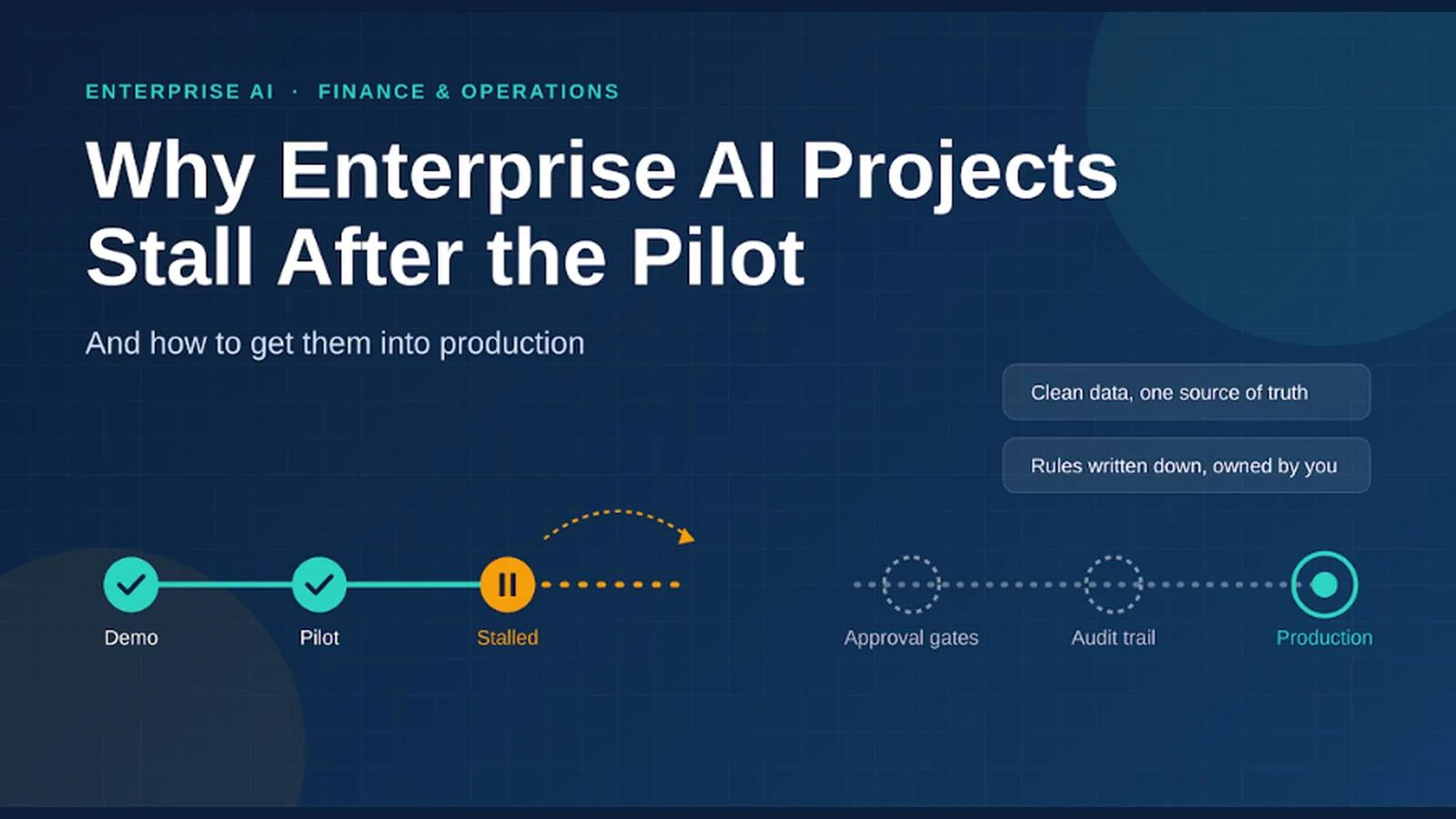
The stakes are real. MIT’s NANDA initiative reported in 2025 that roughly 95% of enterprise generative AI pilots produced no measurable profit-and-loss impact. Gartner has also predicted that at least 30% of generative AI projects would be abandoned after proof of concept. The cause is rarely the model. It is usually weak strategy, poor integration, or unclear ownership, and the partner model you choose shapes all three.
What does an AI consulting services provider do?
An AI consulting services provider is an external advisory firm that helps an organization decide where AI creates value, how it should be governed, and how success will be measured. The work ends with decisions and documents, not production software.
Typical deliverables include:
- A prioritized use-case portfolio ranked by business value and feasibility
- A data readiness assessment covering quality, access, and lineage
- A governance approach aligned with the NIST AI Risk Management Framework
- A business case with baseline metrics
This model suits organizations that do not yet know which problems to solve first.
When does a custom AI development company make more sense?
A custom AI development company makes more sense when the use case is defined and the enterprise needs a production system built, integrated, and maintained. It is an engineering partner that designs, trains, deploys, and supports AI systems for a specific business need.
Consider a logistics operator that wants demand forecasting inside its existing planning software. The problem is clear. What is missing is data engineering, model development, and MLOps experience. A development partner closes that gap faster than hiring a team from scratch.
This model works best when:
- Time to production matters more than building internal skills
- The work needs specialized expertise, such as computer vision or retrieval-augmented generation
The trade-off is dependence. If the contract is silent on documentation, code ownership, and handover, the enterprise may struggle to change the system later.
When does building an in-house AI team make sense?
Building in-house makes sense when AI is central to a company’s products or competitive advantage, when data is too sensitive to share, or when a steady pipeline of use cases justifies permanent headcount.
The benefits are deep domain knowledge, full control of intellectual property, and learning that stays inside the company. The costs are slower starts and real hiring risk. Senior machine learning engineers are scarce, and recruiting them can take months.
A middle path often works well. An external partner builds the first one or two systems while internal engineers pair with them. Ownership shifts inward as capability grows.
How should enterprises choose an AI strategy partner?
Choose a partner by testing evidence of production delivery, not the polish of the pitch. A practical process looks like this:
- Define the business outcome first. Name the metric that must move, such as claims cycle time or forecast error.
- Audit internal skills honestly. Map strengths across data engineering, modeling, deployment, and governance.
- Decide what you must own. Anything tied to competitive advantage or sensitive data should end up in-house.
- Ask for production references. Request systems that have run for over a year, and ask how accuracy and drift are tracked.
- Write knowledge transfer into the contract. Include paired work, documentation, and a fixed handover date.
Common mistakes to avoid
- Outsourcing the thinking. A partner can shape the roadmap, but executives must own the priorities.
- Skipping data work. No provider can deliver accurate models on fragmented, ungoverned data.
- Buying development before strategy. Building a system before confirming the use case produces polished software nobody needs.
- Having no exit plan. Contracts without handover terms create long-term dependence.
Key Takeaways
- An AI consulting services provider fits strategy, prioritization, and governance work.
- A custom AI development company fits defined builds that need specialized engineering.
- In-house teams fit core, differentiating AI and sensitive data.
- A hybrid path, partner-led first and internally owned later, suits most enterprises.
Conclusion
The choice between an AI consulting services provider, a custom AI development company, and an internal team is less about cost than about where capability should sit in three years. Enterprises that treat outside partners as a bridge to internal ownership, rather than a permanent substitute, tend to build AI programs that outlast the first pilot.
FAQ
Is hiring an AI consulting services provider worth it for mid-sized companies? It often is, especially when a company lacks senior AI talent or a clear use-case pipeline. A short strategy engagement can prevent months of work on low-value projects. The return depends on scoping: fixed deliverables, a defined business metric, and a plan for internal teams to own results afterward.
What is the difference between AI consulting and custom AI development? AI consulting focuses on decisions: which use cases to pursue, how to govern AI, and how to measure value. Custom AI development focuses on execution: building, integrating, testing, and maintaining the system. Separating the two in scope helps buyers judge results and avoid open-ended engagements.
How long does an AI strategy engagement usually take? Most AI strategy engagements run from four to twelve weeks. Shorter ones cover use-case discovery and prioritization. Longer ones add data readiness reviews, architecture recommendations, governance design, and a business case. Build work usually follows as a separate phase with its own timeline and budget.
What should a contract with a custom AI development company include? It should define deliverables, success metrics, data access and security terms, and IP ownership, including trained models and code. It should also set documentation standards, a handover date, and exit terms so the enterprise is not locked into one provider indefinitely.
When should a company build an in-house AI team? Build in-house when AI is central to your products or competitive position, when data is highly sensitive, or when you have a steady pipeline of use cases. It also makes sense once a few external pilots have proven value and need continuous ownership.