 Vipin PG
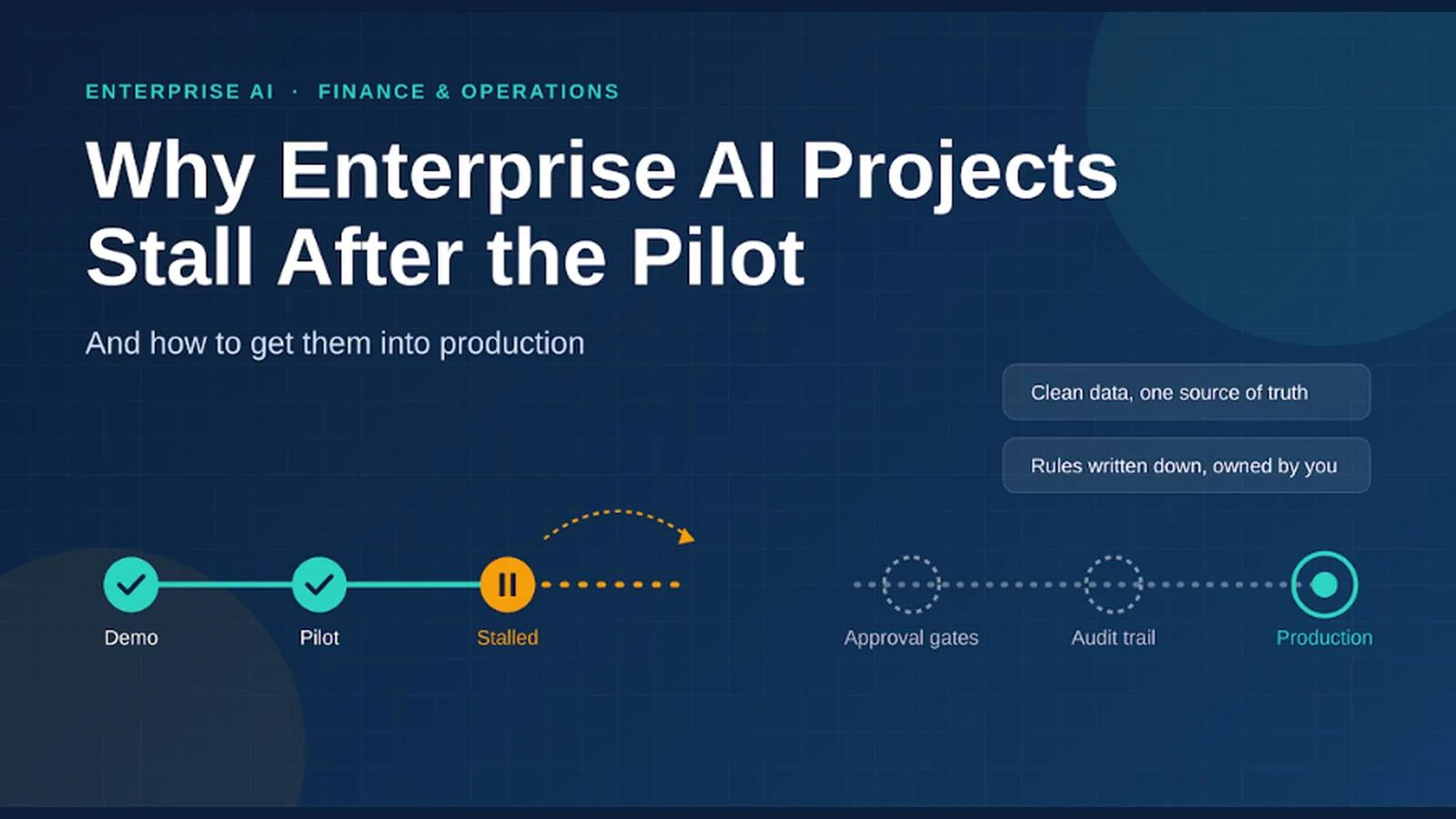
The demo went well. The agent matched invoices to purchase orders, flagged the exceptions, and the controller in the room nodded. Six months later, it is still a demo.
Most finance and IT leaders can name a stalled pilot. The model is rarely the cause. The cause is the data the agent reads, the rules nobody wrote down, and the lack of control over what the agent may do.
This article covers why enterprise AI projects stall after the pilot, how to catch each cause early, and what to ask when you evaluate AI consulting services so the next project reaches production instead of ending as a steering committee slide.
Why a working pilot proves less than you think
A pilot is a controlled environment. It uses a hand-picked sample, one entity, one business unit and a sponsor who checks the output every day. Nobody asks for an audit trail, because nobody expects the agent to touch the ledger.
Production removes every one of those protections. The agent meets every vendor invoice format, every legacy exception, month-end volume spikes and an auditor who wants to know why a payment was released.
A pilot that “works” has only answered the easiest question. Before you scale anything, make it answer three harder ones:
- Does it hold up on exceptions, such as a short-shipped order or a duplicate invoice, and not just on clean cases?
- Can someone other than the person who built it run it, fix it and explain it?
- Can you show an auditor what the agent did, which rule it applied and who approved the result?
If the answer to any of these is no, you have a prototype. That is fine, as long as everyone calls it one.
Reasons one and two: the data and the rules were never production-grade
Reason one: the agent reads from systems that disagree
Pilots usually run on an extract that someone cleaned by hand. Production connects to the ERP (enterprise resource planning system), the bank portal, the procurement tool and a few spreadsheets. They disagree on vendor names, customer hierarchies and item codes. An agent cannot reconcile what the business has not reconciled.
The fix is to reconcile the systems behind one workflow into a single source of truth before you deploy the agent. You do not need to clean the whole enterprise. You need one trustworthy path from invoice to payment, or from order to cash.
Reason two: the rules live in people’s heads
Every finance team runs on unwritten judgment. A buyer accepts a small price variance on freight but not on materials. A collections lead gives long-standing customers more room on disputed invoices. A controller approves a familiar accrual without a second look.
Generic tools do not know any of this, which is why they look good in a demo and perform badly in a live queue. Custom AI workflow automation starts from the opposite direction: the agent is built around your approval logic, your tolerances and your exceptions.
A practical way to capture the rules:
- Sit with the three or four people who work the queue and record how they decide, not how the policy says they should.
- Turn each decision into a written rule with a threshold and an owner.
- Replay last quarter’s cases through the agent and compare its calls with theirs.
- Treat every disagreement as either a missing rule or a rule that needs to change.
Reason three: nobody designed the control model
In a pilot, a person reviews every output, so control is implicit. In production that person is gone, and teams usually pick one of two bad options. They keep a human on every action, which erases the savings. Or they remove the human entirely, until one wrong payment or credit memo gets the project shut down by the CFO.
The workable answer is human in the loop AI with gates that move over time. Consequential actions, such as releasing payments, posting journal entries, issuing credits or writing off balances, pause for human approval. Those gates loosen only after the agent proves its accuracy.
This is the core of AI agent governance, and it is concrete:
- Start with approval on every action that changes a financial record.
- Measure how often approvers agree with the agent, by action type.
- Loosen a gate only when agreement holds across a full close cycle, and tighten it again if it slips.
- Log every action with its inputs, the rule applied, the output and the approver, so the record survives an audit.
A common mistake is treating logging as a later phase. Build it first. An agent without an audit trail will not get past internal audit, and a project that cannot pass audit stalls no matter how accurate it is.
Reasons four and five: no owner, and the wrong scope
Reason four: the builder leaves and nobody can run it
Many stalled pilots came from AI consulting services that delivered a deck, or a build handed over at the end of an engagement. When the first upstream change breaks the agent, nobody inside the company knows how it works. A related risk is renting a black box. If the agent runs in someone else’s environment, you cannot inspect it, move it or change it.
The better model is an embedded AI team: forward-deployed AI engineers who work inside your finance or IT group, build alongside your people and leave the team able to build the next agent on its own. Insist that the platform runs in your own environment and that you own it.
Reason five: the scope is too big or too vague
Some programs start with an enterprise-wide AI implementation roadmap and never ship an agent. Others pilot something small with no business metric attached, so nobody can say whether it worked.
Use a sequence that matches how companies adopt this in practice. Start where AI is absent. Reconcile the systems into one source of truth. Deploy agents on contained workflows such as accounts payable automation or collections. Only then does the organization become AI-native.
Pick one queue and one metric you already track, such as days sales outstanding, cost per invoice or days to close. A short, fixed-scope assessment followed by a first agent in production within about 90 days is a realistic target, and it gives you evidence to fund the next step.
What to ask before you hire AI consulting services
Good AI consulting services are judged by what happens after the pilot, not by the pilot itself. Use these questions in vendor conversations and in your own build-or-buy review:
- Who does the work? Will engineers sit inside my team, and will my people be able to build the next agent when they leave?
- Where does it run, and who owns it? Can it run in our environment, and can we inspect and change it?
- How do approval gates work? Can we set them by action type and loosen them only with accuracy evidence?
- What does the audit log capture? Can internal audit read it without help from the builder?
- What data work comes first? Which systems must be reconciled for this workflow, and who does that work?
- How will you capture our rules? How will you test the agent against our past decisions and exceptions?
- What is the success metric? Which number we already track will move, and what is in production at day 90?
A team that answers all seven with specifics has done this before, whether the work is custom AI workflow automation for AP, AR or close. A team that answers with a demo has not.
Conclusion: start with one workflow and one approval gate
Enterprise AI projects stall after the pilot for ordinary reasons: unreconciled data, unwritten rules, no control model, no internal owner, and a scope that was too wide or too vague. Each one is cheaper to fix before the pilot starts than after it stalls.
If you are weighing AI consulting services, favor the team that talks about your exceptions, your approval gates and your audit trail before it talks about models. Start with one contained workflow, one approval gate and one metric. Prove it, then widen it.
FAQ
Why do enterprise AI pilots fail to reach production?
Most stall because of the environment around the model, not the model itself. Common causes include fragmented data, undocumented business rules, no approval gates or audit trail, no internal team able to maintain the agent, and a scope that is either too broad or has no business metric attached.
How long should it take to move an AI pilot into production?
For a contained workflow such as invoice matching or collections, a first agent in production within about 90 days is a reasonable target. It depends on how clean the underlying data is and how clearly the approval rules are written down, so a short assessment up front helps set a realistic date.
What should AI consulting services deliver beyond a pilot?
They should deliver a production agent on a platform you own, written rules and approval gates, a complete audit log, and an internal team trained to run and extend it. A slide deck or a demo alone is not enough. The test is whether you can build the next agent without them.