
Not long ago, a developer’s AI tool was a smart tab-completion engine sitting quietly in the corner of VS Code. It was helpful, occasionally impressive, and very easy to ignore. That era is over.
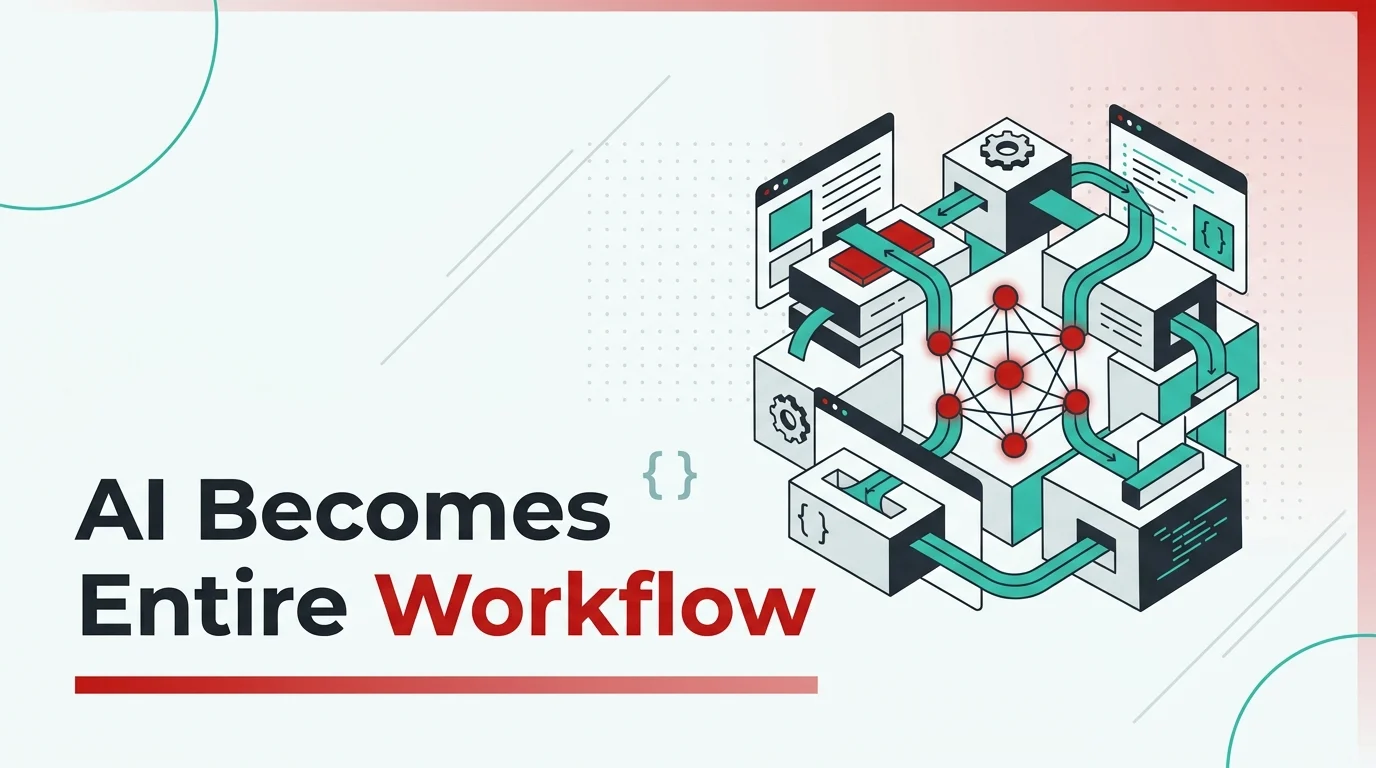
In 2026, AI is no longer a feature bolted onto your development environment. For a fast-growing majority of developers, it is the development environment — handling architecture decisions, writing multi-file features, generating comprehensive test suites, managing deployments, and even running monitoring checks. The shift from “AI as copilot” to “AI as the entire workflow” has happened faster than most people in the industry expected, and it’s reshaping how software gets built from the ground up.
The numbers make this impossible to dismiss. According to the Stack Overflow 2025 Developer Survey — which collected over 49,000 responses across 177 countries — 84% of developers are now using or actively planning to use AI tools in their development process, up from 76% the previous year. Among professional developers, 51% report using these tools every single day. That is not a trend. That is a transformation.
From Autocomplete to Autonomous Agents: What Actually Changed
The most important thing to understand about AI dev tools in 2026 is that the category has fundamentally split. What used to be a single type of product — “AI that suggests code as you type” — is now three distinct philosophies of how AI should fit into development work.
The first tier is the classic inline assistant: tools like GitHub Copilot that live inside your existing editor and offer suggestions, completions, and conversational help. These are the most widely deployed and the easiest to adopt without disrupting your current workflow.
The second tier is the AI-native IDE — tools like Cursor and Windsurf that aren’t just enhanced text editors but full development environments rebuilt from scratch around AI interaction. These tools don’t wait to be invoked. They understand your entire repository, track what you’re working on, and proactively make changes across multiple files simultaneously.
The third tier is the terminal-based autonomous agent — most notably Claude Code — which operates outside any IDE entirely. You give it a task in plain English, and it reads your codebase, writes the code, runs the tests, iterates on failures, and reports back. It is, functionally, a junior engineer you can direct via command line.
Understanding this taxonomy matters because developers in 2026 aren’t choosing between these tools — they’re stacking them. A typical power-user workflow now looks like: Cursor or Windsurf for daily feature work, Claude Code for deep architectural refactors, and GitHub Copilot as a reliable baseline that works across every context.
The Tools Reshaping the Developer Stack
GitHub Copilot — The Reliable Default
GitHub Copilot remains the most widely deployed AI coding tool on the planet, serving 4.7 million paid subscribers across 90% of Fortune 100 companies. Its strength has always been reach and reliability — it works in VS Code, JetBrains, Visual Studio, Xcode, and Neovim, and requires almost no onboarding friction.
The 2026 version is significantly more capable than its 2023 incarnation. Copilot now offers model selection across GPT-4o, Claude, and Gemini. A new Coding Agent shipped with full MCP (Model Context Protocol) support, allowing it to operate on GitHub issues autonomously — analyzing problems, writing code across a repository, and opening pull requests without manual intervention. For enterprise teams already invested in the GitHub ecosystem, the integration depth is genuinely difficult to replicate elsewhere.
The honest limitation: Copilot’s multi-file editing and deep agentic capabilities still trail behind dedicated AI-native IDEs. It’s an excellent tool for teams that want a reliable, cost-controlled AI boost without rebuilding their entire workflow around it.
Cursor — The AI-Native IDE Leading the Market
Cursor has become the darling of the AI development world, and the metrics back this up: 1 million+ users and 360,000 paying customers, with the product reaching $1 billion in annual recurring revenue in under two years. That kind of growth in the developer tooling space is essentially unprecedented.
What makes Cursor compelling is Composer mode — its ability to plan and execute changes across multiple files simultaneously. You can say “refactor the authentication system to use JWTs instead of sessions” and watch Cursor analyze your auth files, generate a migration plan, edit eight files at once, write tests, and update documentation, all in a single flow. The UI generation quality is consistently excellent, and its Supermaven-powered autocomplete is widely considered the fastest in the industry.
Cursor also offers model flexibility that no other tool currently matches — you can route different tasks to different underlying models, using whichever performs best for your specific context. This is particularly valuable for teams with varied workloads across frontend, backend, and infrastructure work.
Windsurf — The Best Value in Agentic IDEs
Windsurf (formerly Codeium’s IDE) pioneered the “Cascade” collaboration model — a design philosophy where the line between “you typing” and “AI typing” is intentionally blurred. Rather than invoking AI as a tool, Windsurf treats it as a real-time collaborator that participates in coding rather than completing it.
After its $250 million acquisition, Windsurf has continued to iterate rapidly. Its Arena Mode — which runs two AI models side by side on the same task with identities hidden, letting you vote on which output better fits your codebase — gives developers empirical data on model quality rather than relying on benchmark rankings. For cost-conscious developers, the free tier remains one of the most generous in the space, and the Pro tier at $15/month offers strong value for the feature set.
Claude Code — Deepest Reasoning, Largest Context
Claude Code is the outlier in this list, and intentionally so. It’s not an IDE. It’s a terminal-based agent built by Anthropic that operates on the principle that for genuinely complex, multi-file work, you don’t need AI inside your editor — you need an AI that can think architecturally and execute with minimal supervision.
The benchmarks support this claim. Claude Code achieved an 80.8% score on SWE-bench Verified — the industry’s most rigorous real-world coding benchmark — leading the field among available tools. Its context window of 1 million tokens means it can load and reason about an entire repository at once, something neither Cursor nor Windsurf can match at depth. In independent developer testing, Claude Code consistently produced the highest code quality scores with zero security issues, described by one developer as code that “reads like a senior developer wrote it.”
The tradeoff is speed and interface. Claude Code is slower to reach an initial result, and the terminal-only experience takes adjustment. Most experienced developers use it not as a daily driver but as the heavy machinery for the hard problems — large refactors, complex architectural decisions, and multi-agent parallel workflows that smaller tools struggle with.
AI Is Now Everywhere in the Dev Workflow — Not Just in the Editor
One of the most significant shifts in 2026 isn’t which tool developers are using — it’s where AI now appears across the development lifecycle. The days of AI being exclusively a code-writing assistant are well behind us.
According to recent developer analytics covering more than 135,000 professionals, AI assistance now touches every major phase of software development. Developers are using AI tools for:
- Architecture design — mapping out system structure, evaluating tradeoffs between microservices and monoliths, designing database schemas
- Code generation and refactoring — writing features, migrating legacy code, updating dependencies across large codebases
- Test generation — producing comprehensive unit, integration, and end-to-end test suites automatically from feature code
- Documentation — auto-generating inline comments, API docs, and README files with 7.5% measurable improvement in documentation quality
- CI/CD and deployment — generating infrastructure code, Cloud Run deployments, and pipeline configurations
- Code review — completing reviews 15% faster by flagging common errors and consistency issues automatically
- Debugging and error analysis — tracing root causes through logs and suggesting targeted fixes
Developers now save an average of 3.6 hours per week through AI assistance, and those who use AI tools daily are merging roughly 60% more pull requests than their peers who don’t. AI-authored code — code committed to production with little or no human modification — now makes up 26.9% of all production code across the industry, up from 22% the previous quarter and a tiny fraction of that just two years ago.
The Real Numbers Behind the Productivity Claim
The productivity statistics are impressive enough to take seriously — and nuanced enough to deserve some honest scrutiny.
AI-assisted developers write code up to 55% faster on certain task types, particularly boilerplate, scaffolding, standard patterns, and test generation. Microsoft-backed trials found a 21% productivity boost in complex knowledge work, and AI agents improve efficiency in structured enterprise workflows by over 30%. Developers who use AI tools are twice as likely to report entering a regular “flow” state, according to McKinsey research, and burnout risk has dropped by 17% for regular AI users.
But there are honest caveats worth understanding. The biggest single frustration — cited by 66% of developers in Stack Overflow’s survey — is dealing with “AI solutions that are almost right, but not quite.” About 45% say that debugging AI-generated code is more time-consuming than writing equivalent code manually. Independent analysis found that pull requests containing AI-generated code have roughly 1.7× more issues than those written entirely by humans, which means team-wide productivity gains require corresponding investments in review processes and automated scanning.
The trust gap is real too. 96% of developers don’t fully trust that AI-generated code is functionally correct without verification, according to Sonar’s State of Code report, which surveyed more than 1,100 working developers. Nearly all developers (95%) spend meaningful time reviewing, testing, and correcting AI output. The smart takeaway isn’t that AI is oversold — it’s that teams who treat AI output as a high-quality first draft requiring review outperform those who either blindly accept it or dismiss it entirely.
How Developers Are Actually Stacking These Tools
The teams getting the most productivity value from AI in 2026 aren’t the ones using the most tools. They’re the ones using the right tools for distinct parts of the workflow. A framework that’s emerged from real-world usage looks like this:
For daily IDE work: Cursor (if you want the most powerful AI-native IDE) or Windsurf (if value and free tier matter, or you prefer the Cascade collaboration model).
For terminal-based automation and complex tasks: Claude Code for deep reasoning, architectural work, and large-scale refactors where context depth is the limiting factor.
As a universal baseline: GitHub Copilot at $10/month, because it works everywhere in your existing tools and covers everyday completions without switching environments.
A practical illustration of how these layers interact: a developer might use Cursor to build a new feature across multiple files in their Next.js app, switch to Claude Code to handle a complex authentication refactor that requires understanding the entire codebase at once, and rely on Copilot for quick completions and inline chat across the rest of their day-to-day coding. Each tool earns its place in the stack by doing something the others don’t do as well.
For a detailed head-to-head comparison of how these tools perform on real production tasks, the 2026 AI code editor comparison from Rapid Developers is one of the most thorough independent assessments available, covering eight evaluation dimensions from code quality to enterprise security.
The Emerging Role of AI in Architecture and System Design
Perhaps the most underreported shift in developer AI adoption is how far it’s moved up the stack — past code generation and into architectural thinking. Senior engineers who previously kept AI tools at arm’s length for real design decisions are increasingly using them as thought partners for system architecture.
Tools like Claude Code handle this particularly well. Its combination of a 1M token context window, strong reasoning through Claude’s Opus model, and terminal-based execution means it can hold an entire system in working memory while thinking through structural decisions. Developers are using it to evaluate tradeoffs between architectural patterns, identify bottlenecks in proposed designs, and generate implementation plans before a single line of production code gets written.
This is a meaningful change. When AI operates at the architectural level, it’s not just accelerating existing work — it’s changing what one developer can take on alone. The calculation around team size, project scope, and shipping timelines shifts when a single engineer with the right AI stack can do work that previously required three or four people.
What’s Coming Next — and What to Watch
The direction the market is heading is toward deeper autonomy, not just better suggestions. Multi-agent workflows — where several AI agents work in parallel on different parts of a codebase simultaneously, with one orchestrating agent coordinating the others — are already available in Claude Code’s Agent Teams feature and are being integrated into Cursor and other IDE-based tools. The ability to decompose a large task, distribute it across parallel agents, and merge results is going to become standard capability within the next 12 months.
GitHub Copilot Workspace, which operates at the GitHub issue level and can autonomously plan an implementation, write code, and open a pull request from a natural language issue description, signals where the fully integrated CI/CD-native AI workflow is heading. The gap between “describing what you need” and “having it merged and deployed” is narrowing quickly.
New entrants are also worth watching. Google made Gemini Code Assist fully free for individual developers in March 2026 — not a reduced tier, completely free — which changes the calculus for developers building on GCP infrastructure. Amazon Q continues to mature for AWS-native workflows. OpenAI Codex, while not leading the pack for general development, is well-positioned for automated code generation pipelines in CI environments. The competitive pressure on every major tool is intense, which is genuinely good for developers.
Final Thoughts: The Dev Stack Has Permanently Changed
The honest way to read the 84% adoption number isn’t as a prediction about where AI is going — it’s a statement about where the industry already is. AI tools are no longer something developers evaluate at a team offsite or pilot in a hackathon. They are embedded in the daily mechanics of how professional software gets built, reviewed, tested, and shipped.
The developers and teams getting the most from this shift share a few things in common. They treat AI output as a draft, not a deliverable. They invest in review processes that keep pace with the accelerated code volume. And they’re intentional about which tool gets which job, rather than betting everything on a single platform.
The copilot era was about speed. The workflow era is about leverage — doing more ambitious, more complex work with a smaller team and tighter timelines. For developers willing to build that muscle, the upside in 2026 is substantial.
Statistics in this article are drawn from the Stack Overflow 2025 Developer Survey, JetBrains State of Developer Ecosystem 2025, Sonar’s State of Code Developer Survey 2026, DX Q4 2025 Impact Report, and independent platform benchmarks including SWE-bench Verified.