
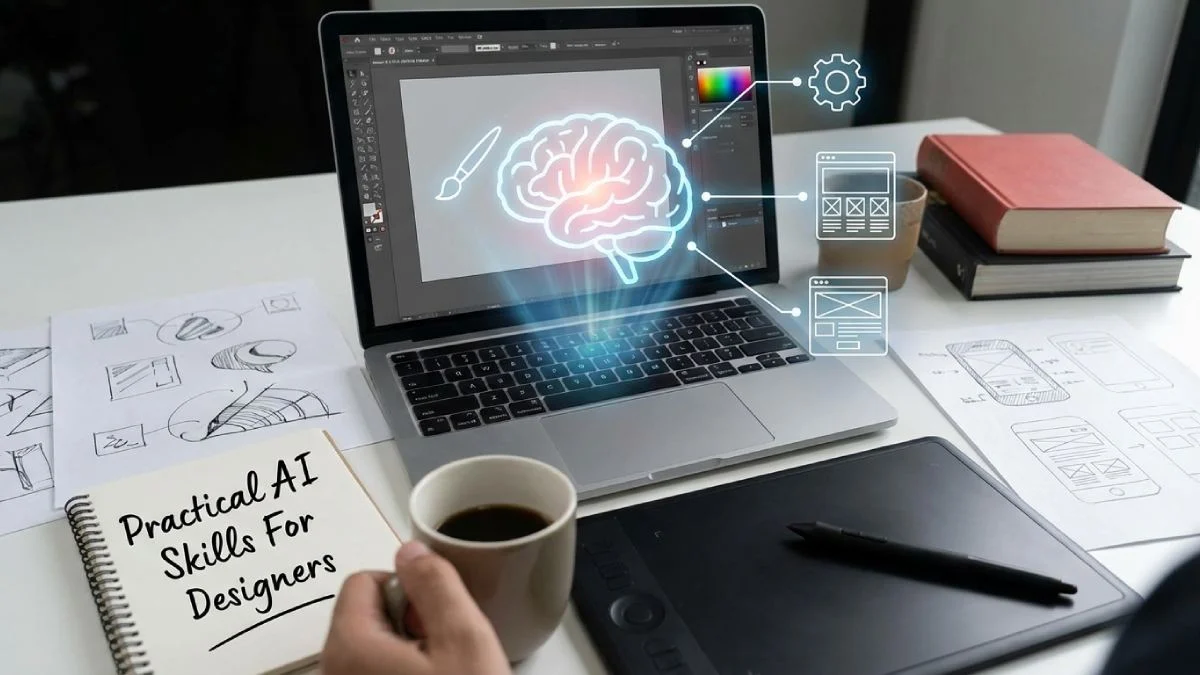
The design world has changed.
In 2026, it’s not about who can push pixels the fastest. It’s about who can direct outcomes.
AI now handles wireframes, variations, layout suggestions, copy drafts, even asset generation. What it cannot replace is judgment, taste, empathy, and strategic thinking. The designers who thrive today don’t compete with AI. They orchestrate it.
Here’s a practical guide to the 20 AI skills that matter most right now.
Core AI Fundamentals & Prompting
1. Advanced Prompt Engineering
Basic prompts produce average results. Structured prompts produce professional work.
Designers must learn to define:
- Role (“Act as a senior UX researcher…”)
- Context (target users, platform, constraints)
- Output format (tables, bullet flows, structured summaries)
- Boundaries (tone, accessibility requirements, device limits)
Clear inputs lead to usable outputs. Without structure, AI defaults to generic answers.
2. AI Tool Stacking
No single tool does everything well.
Smart designers combine:
- Strategy and research with tools like ChatGPT
- Visual asset generation via Midjourney
- Interface refinement using Figma AI features
The power is in orchestration. When tools are chained together intentionally, the workflow becomes dramatically faster and more coherent.
3. AI Limitation Awareness
AI is strong at pattern recognition. It is weak at lived experience.
It struggles with:
- Nuanced emotional context
- Ethical tradeoffs
- Deep cultural sensitivity
- Multi-layered business decisions
Designers must know when to trust AI and when to override it. Judgment is still human.
4. Prompt Library Management
High-performing teams don’t reinvent prompts every day.
They maintain:
- Shared prompt repositories
- Version-controlled prompt templates
- Documented use cases
- Performance notes
This turns AI from an experiment into infrastructure.
Ideation & Strategy
5. AI-Assisted Brainstorming
Creative blocks shrink when AI becomes a sparring partner.
Designers can:
- Explore 20 positioning angles in minutes
- Generate edge-case user flows
- Stress-test assumptions
It accelerates divergence. Humans still decide convergence.
6. Data-Driven Persona Generation
Instead of manually synthesizing raw survey data, designers can feed structured data into AI to produce:
- Realistic user personas
- Empathy maps
- Behavioral motivations
- Friction analysis
It doesn’t replace research. It accelerates interpretation.
7. Automated Competitor Analysis
AI tools can scrape and summarize:
- UX flows
- Feature sets
- Pricing models
- Messaging patterns
What once took days can now take hours. The strategic interpretation still belongs to the designer.
8. Business ROI Articulation
In 2026, design is measured by outcomes.
Designers must quantify how AI-accelerated decisions improve:
- Conversion rates
- Retention
- Onboarding completion
- Time-to-market
If you can connect design decisions to revenue, you become indispensable.
UX Research & Synthesis
9. Pattern Recognition & Synthesis
AI excels at identifying repetition across large datasets.
Designers can upload:
- Interview transcripts
- Survey responses
- Support tickets
The system highlights recurring pain points, emotional triggers, and behavioral themes. This drastically shortens synthesis cycles.
10. Automated Testing Scenarios
AI can generate structured usability scripts aligned with:
- Core user journeys
- Edge-case scenarios
- Accessibility considerations
- Bias minimization
This improves consistency and reduces oversight.
11. Synthetic User Testing
AI-simulated personas allow early-stage validation before human testing.
It won’t replace real users. But it can:
- Flag obvious UX breakdowns
- Detect logic gaps
- Stress-test navigation paths
That saves budget and time.
12. Sentiment Analysis
Massive feedback datasets are hard to process manually.
AI can analyze:
- App store reviews
- Social mentions
- Support logs
It extracts emotional tone and categorizes complaints, revealing where friction truly exists.
UI & Visual Design Enhancement
13. Generative Asset Creation
Modern tools like Midjourney v6 and Adobe Firefly allow designers to generate:
- Custom illustrations
- Icons
- Hero visuals
- Background textures
The skill lies in controlling style, consistency, and brand alignment.
14. AI-Powered Rapid Prototyping
Platforms such as Uizard and Figma AI can convert:
- Text descriptions
- Hand-drawn sketches
- Wireframe ideas
Into editable high-fidelity layouts within minutes.
Speed matters. Iteration speed matters even more.
15. Harmonious Style Generation
AI can propose:
- Accessible color systems
- Typography pairings
- Visual hierarchy adjustments
Designers must refine these outputs to ensure:
- Brand personality alignment
- WCAG compliance
- Emotional coherence
AI suggests. Designers curate.
16. Dynamic Visual Personalization
Machine learning allows interfaces to adapt subtly based on user behavior.
This includes:
- Layout adjustments
- Content prioritization
- Visual emphasis shifts
- Micro-interaction timing
Designers now think in systems, not static screens.
Content, Handoff & Workflow
17. Microcopy Iteration
AI can generate dozens of variations for:
- Error messages
- Empty states
- CTA buttons
- Onboarding prompts
This makes A/B testing faster and more strategic.
18. Automated Accessibility Auditing
AI plugins now detect:
- Contrast issues
- Missing alt text
- Structural navigation flaws
- Semantic inconsistencies
Accessibility is no longer an afterthought. It’s integrated into active design workflows.
19. No-Code Workflow Automation
Tools like Zapier and Make allow designers to automate:
- Feedback syncing
- Task creation
- File versioning
- Status notifications
Less admin. More thinking.
20. Design-to-Code Translation
AI coding assistants help designers understand how visual decisions translate into front-end implementation.
Bridging design and development:
- Reduces miscommunication
- Speeds up handoff
- Improves system consistency
Designers who understand code constraints build more realistic systems.
The Real Shift
The best designers in 2026 are not just creators. They are product thinkers.
They:
- Direct AI rather than fear it
- Validate decisions with data
- Tie design work to measurable impact
- Take ownership of the full user journey
AI handles repetition. Designers handle meaning.
If you master these 20 skills, you won’t just keep up with the industry. You’ll lead it.