 Vipin PG
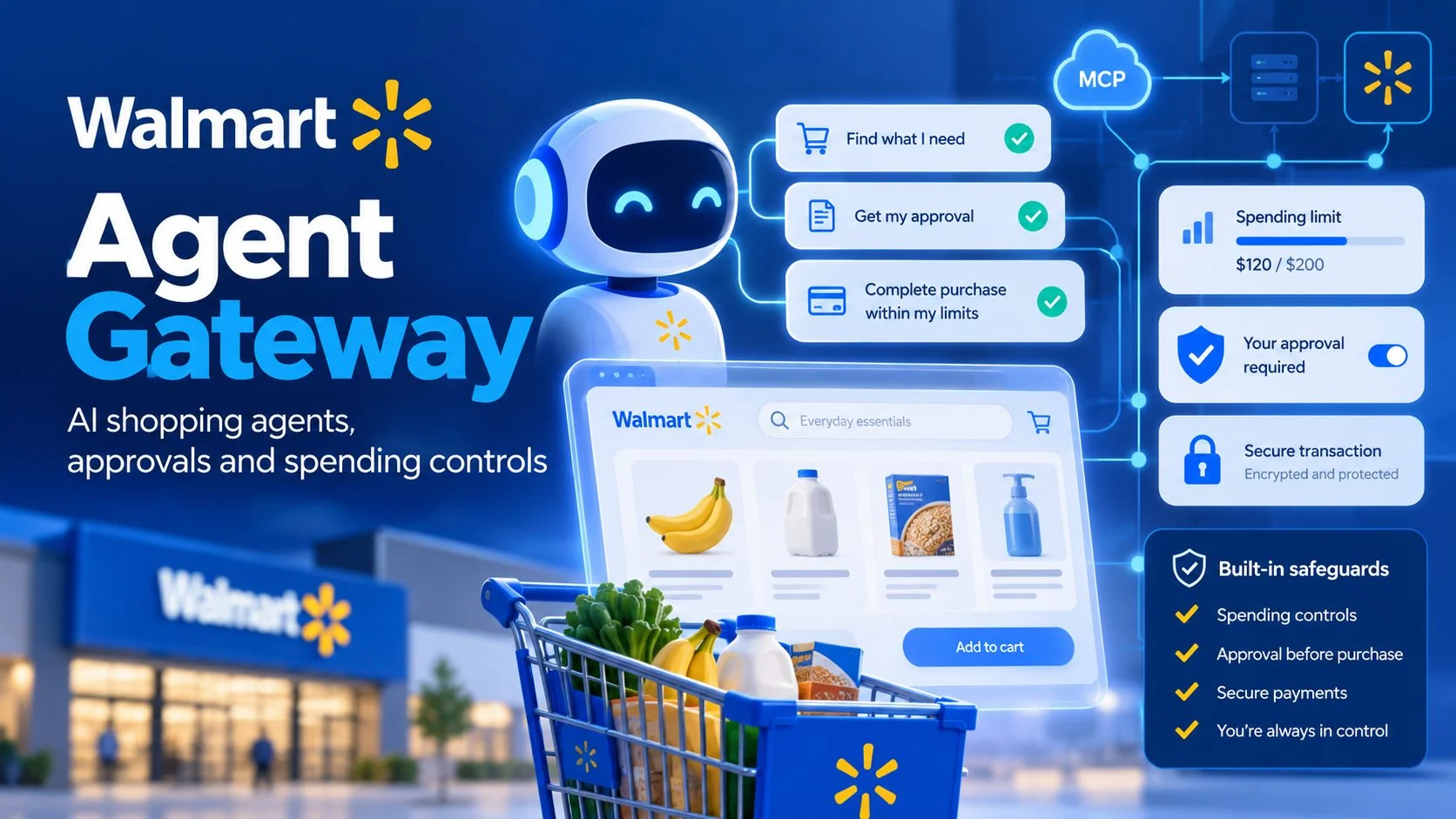
Walmart has introduced a way for AI shopping agents to connect directly to its retail systems, although the spending controls available to individual shoppers remain unclear. Announced on October 21, 2026, the Walmart Agent Gateway is currently an invitation-only beta. Walmart plans to introduce Agent Profiles in “the next month,” without giving a specific release date.
The Gateway is intended for developers building shopping agents. Walmart’s beta page lists spending limits and approval settings among its features, but warns that availability may vary by participant. Its public documentation does not establish which controls are working for each customer or transaction.
In its October 2026 announcement, Walmart outlines a connection for shopping agents, account-linked identities for those agents, and rules limiting their actions. The company says customers will be able to shop through their preferred apps and agents while retaining control over purchases.
Three components with different launch timelines
Walmart’s plan has three components. The Agent Gateway gives agents a route into Walmart’s shopping systems. Agent Profiles are intended to identify each agent within a customer’s account and keep its purchases separate. Walmart’s terms set boundaries on agent behavior, including a requirement to follow shopper intent.
The Gateway beta is starting with companies and developers. Agent Profiles, according to Walmart, are “launching in the next month.” The announcement gives no firm date for that launch and does not identify which beta participants can already complete purchases.
Access to the Gateway therefore does not establish whether a shopper can use the full set of proposed permission and approval controls.
The beta is limited, and controls may vary
Developers can request access to Walmart’s Gateway beta, which the company describes as early-stage, limited and invitation-only. Walmart also reserves the right to suspend access or change functionality during testing.
The public beta page lists agent shopping, real-time answers, spending limits and approval settings. However, Walmart cautions that some advertised features may change or remain unavailable to certain participants. The capabilities a developer can actually use may depend on their access and configuration.
The Agent Gateway beta page does not confirm that every participant can configure a customer spending cap. The announcement schedules Agent Profiles for the following month, while the company’s terms say customer approval is required by default. How that default works across active beta accounts is not publicly explained.
There is no basis for assuming beta purchases lack protection. Equally, the published material does not confirm that every advertised control is operating across all beta transactions.
How Walmart AI shopping agents connect through MCP
Walmart wants shopping agents to communicate with its systems through a structured interface instead of navigating the consumer website in a browser. The company describes browser-based shopping by agents as slow and prone to errors or stalled interactions.
The Gateway uses MCP, or Model Context Protocol. MCP allows AI applications to discover and call tools offered by an external server. Those tools can retrieve information or initiate actions, depending on what the server exposes. The protocol does not decide which shopping permissions Walmart grants.
The MCP tools specification leaves user interaction and approval design to individual implementations. Its guidance recommends human oversight, including ways to reject tool calls and confirm operations. That recommendation does not establish what confirmation flow Walmart uses in its beta.
Walmart has not published an inspectable Gateway tool catalogue, tool input schemas, a detailed identity flow or access scopes. Without those details, developers outside the beta cannot trace how an agent’s request becomes an order or determine exactly which information each tool exposes.
What agents may learn from a shopper’s “usuals”
Walmart says agents can find a shopper’s regularly purchased products without receiving their wider purchase history. Its examples include sourdough bread and a particular brand of milk. According to the company, an agent can identify these familiar items without being given broader shopping history or personal information.
The precise data exchanged remains undocumented. Walmart has not specified the fields returned by a “usuals” request, how long an agent may keep those results, or whether a customer can review a record of disclosures.
Walmart also separates its privacy responsibilities from those of the agent provider. Information a shopper gives to an agent provider’s app falls under that provider’s privacy policy. Information the agent supplies to Walmart is handled under Walmart’s Privacy Notice.
Shoppers therefore need to consider what Walmart shares with an agent for a shopping task and what the agent provider subsequently stores or uses. The announcement and beta page do not provide enough implementation detail to assess that data flow fully.
Agent Profiles and purchase permissions
Agent Profiles are intended to give each shopping agent its own identity within a Walmart customer’s account. Walmart says a profile will be created when a customer first uses an agent through the Gateway and linked to the account through a Walmart sign-in.
The company plans to let customers view agent purchases separately and delete an agent profile. It describes two approval options: approving each purchase individually or allowing purchases within a customer-selected spending limit.
Walmart mentions $50, $100 and $200 as examples of limits. It has not said those amounts will be the only available choices. The company may also seek additional approval for a purchase below the selected limit, so setting a cap would not necessarily make every smaller order automatic.
Walmart compares an Agent Profile to adding a cardholder with a spending limit. Its announcement does not specify whether a cap applies to each transaction or across a time period, and it does not explain any additional approval thresholds. Those details will affect how much spending a customer can authorize in practice.
Rules for purchases and payment information
Walmart’s agent terms say customer approval is required by default and agents must operate within the shopper’s intent. The company may ask for additional approval even when an order is below a configured limit. These are Walmart’s stated requirements; the public material does not independently demonstrate how they are enforced.
Walmart says shopping agents cannot access payment-card details or add or modify a customer’s payment methods. It also says its returns process applies when an agent fails to act as intended and that agents violating the terms may be blocked from the site.
The public announcement does not describe the technical enforcement of these rules, possible exceptions, or a dedicated process for auditing and disputing unintended purchases. The checkout experience and available remedies will be important in assessing the protections.
MCP security depends on the Gateway’s implementation
MCP includes an authorization framework for certain deployments, but support for that framework is not universal. Its HTTP authorization approach defines how an application may obtain permission to access a server.
The MCP authorization specification establishes OAuth-based requirements when that approach is used over HTTP. Walmart has not publicly confirmed whether its Gateway beta follows that flow, what permissions an access token carries, or how an agent’s identity is verified.
In May 2026, the National Security Agency warned that security practices around MCP had not kept pace with adoption. Its guidance covers risks involving dynamic tool invocation, implicit trust and information shared through context. The agency was discussing MCP generally, not evaluating Walmart’s implementation.
The NSA’s MCP security guidance raises questions relevant to developers testing the Gateway: how agents authenticate, whether permissions are restricted to the task, which events are logged, how long data is retained, and how incidents are handled. The answers depend on the deployed service, rather than the protocol name.
Who is responsible when an agent makes a mistake?
Purchase approvals cannot resolve every dispute involving an AI shopping agent. A June report from Bloomberg Law described how retailers, banks and AI companies are dealing with questions of responsibility when consumers challenge purchases or agents act autonomously.
The report cited consumer-law and financial-services experts who discussed how authorization, disclosures and the payment method can influence a dispute. Those observations do not establish how Walmart would handle a specific case, but they show why checkout conditions and remedies deserve attention.
Walmart says its normal returns process applies if an agent fails to follow the shopper’s intent. The announcement does not explain how an incorrect order would be attributed, investigated or contested, or whether an Agent Profile changes that process. The NSA’s broader warnings about context sharing also leave open questions about how customer information is protected during shopping tasks.
An accidental order, an attempt to manipulate an agent’s instructions, a compromised account and a disagreement between the shopper and agent provider would each raise different questions. Walmart’s published rules describe intended safeguards, but their effectiveness in these situations remains to be demonstrated.
What shoppers and developers should check next
Developers interested in the Gateway can request access to the beta, while accounting for its invitation-only status and uncertain feature availability. Acceptance into the program does not guarantee access to every control listed on Walmart’s website.
Shoppers considering an AI shopping agent should examine the actual account connection and checkout process. Important details include when an Agent Profile is created, which permissions are requested, how purchase approval works, whether spending limits apply per order or over time, and how a profile can be deleted. The agent provider’s privacy policy matters alongside Walmart’s.
Further technical documentation or a working demonstration could clarify the Gateway’s available tools and permission scopes, the data returned for a “usuals” request, whether orders can proceed without a confirmation prompt, and which activities are logged.
For now, Walmart has opened a limited developer beta and outlined plans for customer-facing controls. Its public materials do not yet show that the same spending safeguards are available to every shopper using Walmart AI shopping agents.