
 Vipin PG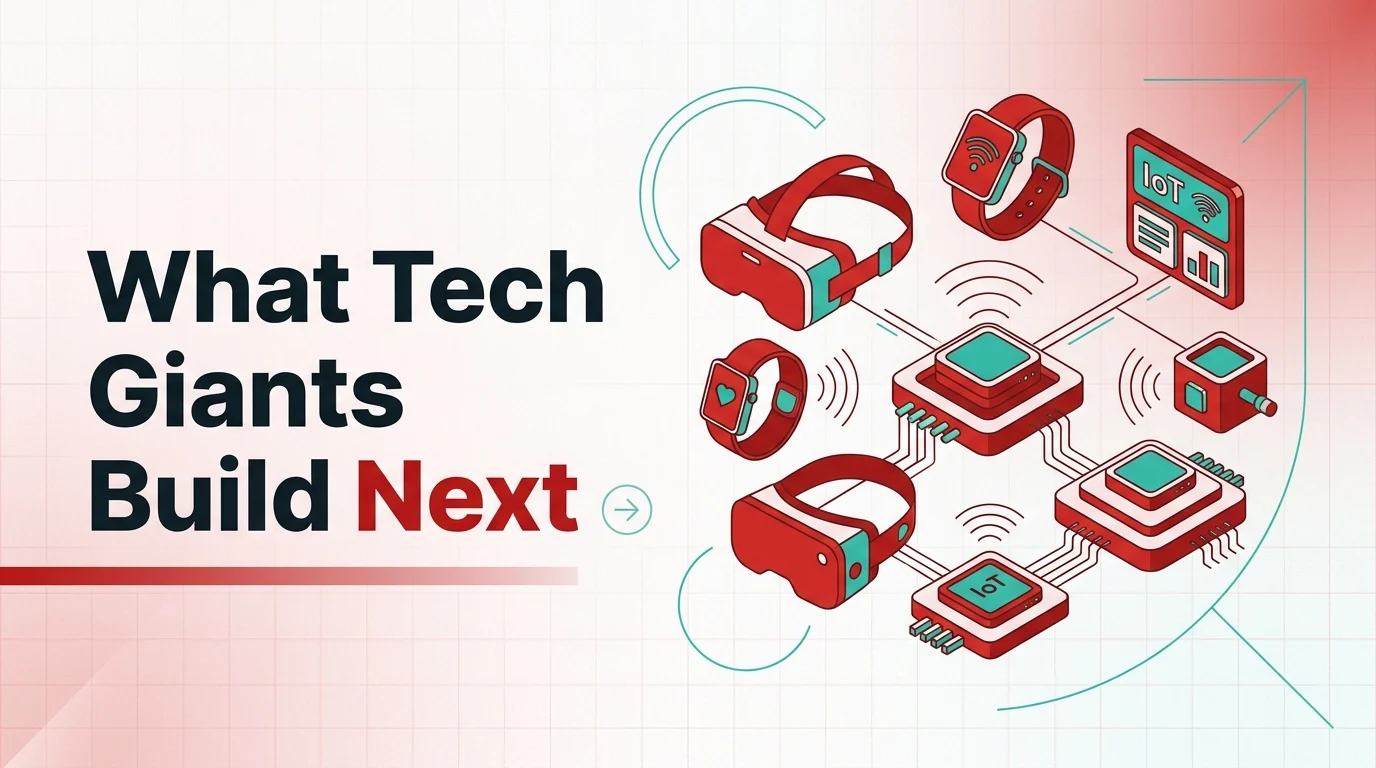
Think about the last time a new smartphone genuinely surprised you. Not just a better camera or a slightly faster chip, but something that made you feel like the phone in your hand was completely different from the one before it. For most people, that feeling stopped a while ago.
That’s not just a feeling — the numbers back it up. In 2013, people were replacing their phones roughly every 2.4 years. By 2025, the global average has stretched to 3.5 years. In the US, people are holding onto their phones for nearly 3.84 years before upgrading. In the UK, only 17% of users replace their phone within two years now.
Smartphones aren’t going anywhere tomorrow. But the biggest tech companies in the world are quietly — and in some cases very loudly — betting that the next big thing in personal computing won’t be a phone at all. And they’re putting serious money behind that bet.
Why the Smartphone Has Peaked
For roughly two decades, the smartphone was the most important piece of technology most people owned. It replaced the camera, the map, the music player, the television remote, and the wallet. Every year brought real, noticeable improvements — and people upgraded accordingly.
That era is over, at least in terms of excitement.
Today, the main reason most people upgrade their phone is a worn-out battery — not because they want new features. In fact, 75% of consumers say poor battery life is what finally pushes them to get a new device. Compare that to AI features, which only 17% of Americans say actually influences their buying decision. Manufacturers are spending billions marketing AI capabilities on phones, and most buyers simply don’t care.
Hardware-wise, things aren’t looking great either. Global smartphone shipments are expected to fall 13.9% in 2026, dropping to 1.08 billion units — the lowest since 2013. A big part of this is a memory chip shortage, because chipmakers are now prioritizing high-end AI server chips over the components that go into budget smartphones. The result is that phone prices are rising sharply, and entry-level smartphones are becoming harder to find in many markets.
For big tech, this isn’t just a slow quarter. It’s a structural signal that the phone era is maturing, and the time to build what comes next is now.
The $150 Billion Bet on What Comes Next
Apple, Google, Meta, Samsung, Microsoft, and Neuralink have collectively committed over $150 billion in research and development into what the industry is calling the post-smartphone era. The market they’re chasing is estimated to be worth $3 trillion by 2030.
The central idea isn’t complicated. Right now, if you want to do anything digital, you pull a phone out of your pocket, look down at a flat glass screen, tap around, and put it away. That works, but it’s also a bit clunky when you think about it. You’re removing yourself from your physical surroundings dozens of times a day to stare at a rectangle.
What these companies are building is an alternative: technology that works around you, not the other way around. Glasses that whisper directions into your ear. A ring on your finger that tracks your heart rate and sleep without you touching it. Smart environments that adjust the lights when you’re stressed. Devices that answer questions before you even reach into your pocket.
This is broadly called ambient computing — and it’s already a $44 billion market today, projected to grow to over $425 billion by the mid-2030s.
Smart Glasses: The Next Big Peripheral
Of all the devices being developed right now, smart glasses are getting the most attention — and the most money.
In 2025, smart glasses outsold traditional VR headsets by three to one, with 110% year-over-year growth. Meanwhile, bulky VR headset sales dropped 14% in the same period. People don’t want to strap a heavy box to their face. They want something that looks normal.
Meta and Ray-Ban: Already Winning
Meta figured this out early. Instead of trying to build a full augmented reality display, they partnered with EssilorLuxottica (the company behind Ray-Ban) and released glasses that look exactly like sunglasses. No screen, no projection — just a camera, speakers, and an AI assistant built into frames that look completely normal.
The result? Over two million units sold. More than every other smart glasses product combined.
These Ray-Ban Meta glasses let you listen to music, take hands-free photos, get real-time translations, and ask the built-in Meta AI questions — all without ever pulling out your phone. They work because they don’t ask you to change your behavior. You just wear them like regular sunglasses.
Meta has put over $50 billion into its AR and VR divisions since 2019. The current glasses are just the beginning — the company is waiting for display technology to mature before adding a visual overlay to the same frame design.
Google: Building the Operating System, Not Just the Hardware
Google is playing a different game. Rather than building one device, they’re building the software platform that runs all of them — the Android of smart glasses, called Android XR.
Developed with Qualcomm and Samsung, Android XR is designed to power glasses from many different brands. Google’s own products include display-free audio glasses launching in late 2026, partnered with brands like Warby Parker, Gentle Monster, and Gucci. These use Gemini AI to translate conversations in real time, give voice navigation, and understand your surroundings through a built-in camera.
For users who want actual AR displays, Google’s Android XR already powers XREAL’s “Project Aura” — glasses with a 70-degree field of view through OLED see-through lenses. That’s genuinely impressive for 2026 hardware.
Samsung: Joining the Race
Samsung is launching its own smart glasses — called Galaxy Glasses — in late 2026. The first version won’t have a display either, putting it in direct competition with Meta’s Ray-Ban glasses. They’ll run on Qualcomm’s Snapdragon AR1 chip, include a 12MP Sony camera, and are priced between $379 and $499. A display version is expected in 2027, priced between $600 and $900.
Apple: Watching, Waiting, Then Moving
Apple is taking its time, which is typical. The $3,499 Apple Vision Pro established what premium mixed reality could look like — dual 4K displays, incredible eye tracking, a polished interface. But it’s heavy, it causes eye strain for 45% of users, and only 12% use it daily. Sales dropped 45% in late 2025.
Apple is now quietly shifting resources toward lightweight AR glasses, rumored to launch in 2027. Apple’s advantage here is obvious — the glasses will connect seamlessly to the iPhone, Apple Watch, and Mac, using the iPhone as the processing engine so the glasses themselves can stay light and stylish. And Apple’s retail stores give it a huge edge in fitting what is, ultimately, a very personal accessory.
The Real Goal: True Holographic AR
Display-free audio glasses are the stepping stone. The actual destination is glasses that can project full-color, high-resolution holograms directly into your field of view — bright enough to see in sunlight, light enough to wear all day.
Meta’s internal prototype, called Orion, is the closest thing to that right now. It weighs 98 grams, has a 70-degree field of view, and uses advanced silicon carbide waveguides to project 3D content. To keep it light, the heavy processing is handled by a small compute puck you carry in your pocket.
For input, Meta developed a wristband that reads the electrical signals your nerves send to your fingers. You can scroll, click, and navigate by barely moving your fingers — almost invisibly. That solves the awkward problem of waving your hands around in public to control an AR display.
The tech making all of this possible is called MicroLED. Unlike regular screens, MicroLEDs don’t need a backlight, so they use much less power and stay visible in bright light. The market for this optical technology was worth $17 million in 2025 and is growing at nearly 24% per year. Manufacturing breakthroughs in late 2025 — including a new projector from JBD that fits in 0.2 cubic centimeters — show that this hardware is moving from lab demos to real production faster than expected.
Smart Rings: The Quietest Part of the Ecosystem
While everyone watches the glasses race, a smaller but fast-growing category is quietly taking off: smart rings.
The global smart ring market was worth around $423–$502 million in 2025/2026, and is projected to reach $1.6–$2.5 billion by 2032/2033. The US dominates this market, making up 82% of North American sales.
Products like the Oura Ring and Samsung’s Galaxy Ring track sleep, heart rate, stress, and activity — all without a screen, without notifications, and without needing to be looked at. You just wear it. The data is there when you want it.
The medical side of this is growing even faster. Clinical-grade health monitoring through a ring — detecting early signs of illness, tracking recovery, or monitoring chronic conditions — is the segment expected to grow at 40.7% per year. That’s not a fitness tracker. That’s a health device that happens to look like jewelry.
In the longer-term vision of ambient computing, a smart ring that detects rising stress levels could automatically signal your smart home to dim the lights and lower the temperature — no phone, no app, no interaction required.
The Products That Failed — And What They Taught Us
Not everything in this space has gone well. Two high-profile devices launched with enormous hype and failed badly, and their failures are worth understanding.
The Humane AI Pin
Built by former Apple executives, backed by $230 million in venture capital, and priced at $699 plus a $24/month subscription — the Humane AI Pin was a small device you clipped to your shirt. It used a laser to project a tiny interface onto your palm and handled AI tasks through voice commands.
It overheated constantly. The palm projection was useless in daylight. The voice AI was slow and unreliable. And the whole concept required you to talk to your shirt and stare at your hand in public — something most people simply aren’t willing to do.
The company shipped fewer than 10,000 units. HP bought the patents for $116 million — nearly half of what the company had raised. In February 2025, every existing AI Pin was permanently disabled remotely, turning $699 devices into paperweights.
The Rabbit R1
The Rabbit R1 was a $199 orange device that went viral after a CES 2024 demo showing it autonomously ordering food and booking rides using voice commands. 100,000 units were pre-sold.
The real product couldn’t reliably do what the demo showed. Voice responses took up to ten seconds. The “autonomous agent” feature barely worked. The company pivoted in September 2025 to a basic voice assistant interface, abandoning the original concept entirely. By early 2026, employees were reportedly going unpaid.
The Lesson
Both failures point to the same thing: a new device doesn’t get judged against nothing. It gets judged against the smartphone already in your pocket. If it’s slower, less reliable, or more socially awkward than just using your phone, people won’t use it — no matter how good the marketing is.
Meta’s Ray-Ban glasses succeeded specifically because they didn’t try to replace the phone. They added something the phone couldn’t do — a hands-free camera and audio always on your face — without asking you to change your habits or look strange in public.
There’s also a financial angle here. Devices that route every query through expensive cloud AI can’t make money at scale. When every voice command costs money to process in the cloud, subscription fees become unsustainable or the company runs out of money. This is why on-device AI — where the processing happens locally on the device itself, not in a data center — is so important for the future of wearables.
So What Does the Future Actually Look Like?
The smartphone isn’t going to suddenly disappear. That’s not how technology transitions work.
Think about the desktop computer. When laptops arrived, desktops didn’t vanish — they became specialized tools used for specific tasks. When smartphones arrived, laptops didn’t vanish either — they just became less central to daily life for most people. The same thing will happen to smartphones.
In the near future — roughly 2026 to 2030 — your phone will become the engine that powers your AR glasses and smart ring. It’ll handle the heavy processing, provide the internet connection, and keep everything running while the wearables on your body handle the actual interaction. Apple’s upcoming glasses strategy is explicitly built on this model.
Over time, as the display technology matures, batteries improve, and on-device AI gets more powerful, that dependence on the phone will shrink. Eventually, the glasses or whatever comes after them will be self-sufficient.
What we’re heading toward is a world where:
- Your glasses show you information overlaid on the real world
- Your ring silently monitors your health in the background
- Your environment adjusts to your needs without you asking
- Your phone sits in your bag, quietly powering all of it
The $150 billion being invested right now is an acknowledgment from the world’s biggest tech companies that the flat glass rectangle has taken us as far as it can. The next chapter is being written — gradually, imperfectly, but unmistakably.
Final Thoughts
The smartphone isn’t dying. But the era of the smartphone being the one device that everything revolves around is quietly winding down.
The companies building what’s next aren’t naive about how hard this is. The graveyard of overpriced, overhyped AI gadgets proves that getting this right requires more than good intentions and venture capital. It requires technology that actually works, fits naturally into people’s lives, and costs something reasonable.
The glasses that look like normal sunglasses but let you ask questions hands-free. The ring that tracks your sleep without charging every night. The smart room that notices when you’re stressed and adjusts itself. These aren’t science fiction anymore — they’re products launching in 2026 and 2027.
We’re not there yet. But we’re closer than most people realize.