 Vipin PG
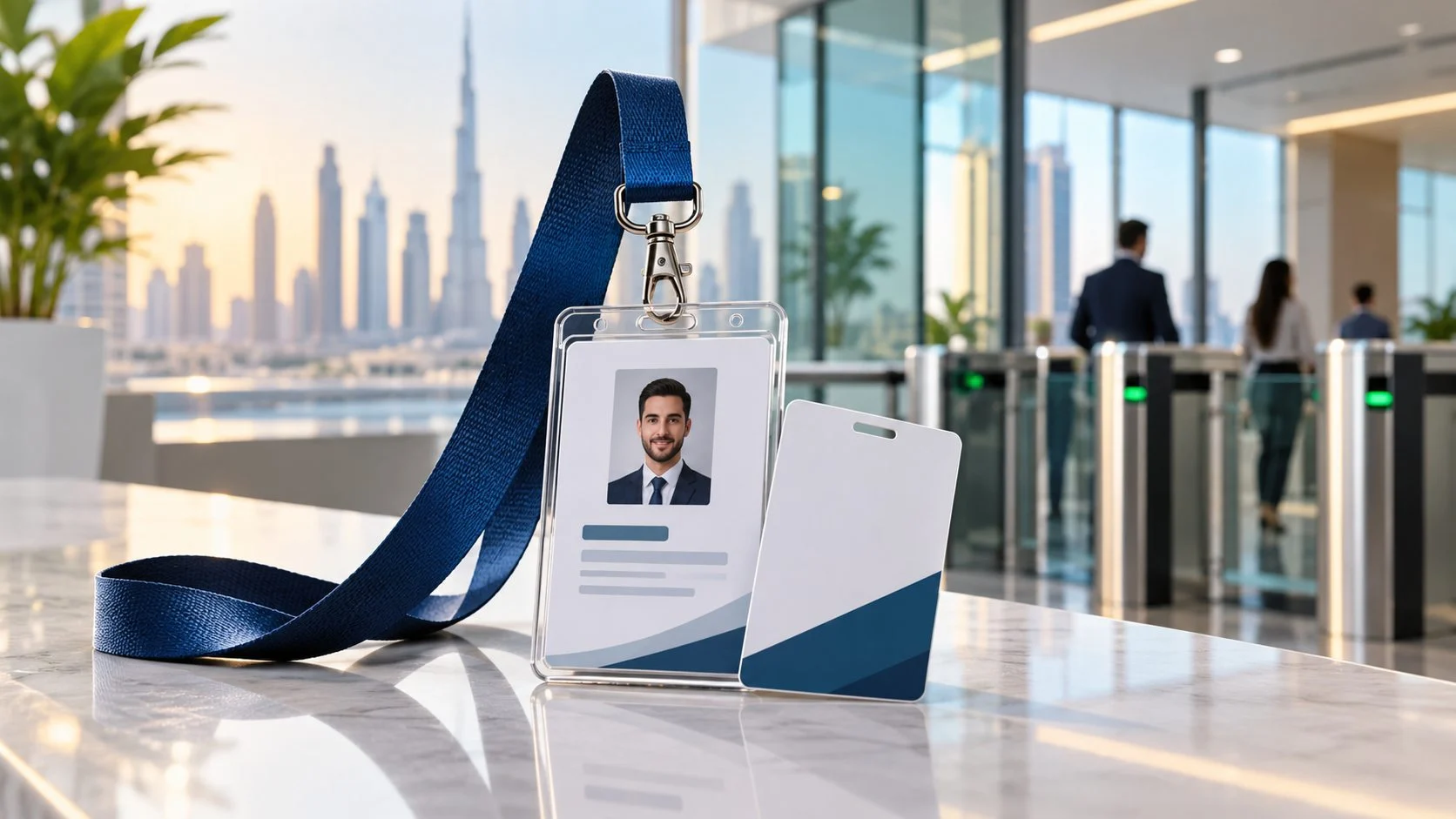
Lanyards are a familiar sight in offices, hospitals, schools, warehouses and commercial buildings across the UAE. Most people associate them with employee ID cards, but they also serve a practical purpose in workplace identification, visitor management and access control.
In a busy office, employees may need to show their identification several times a day. Security teams need to distinguish authorised personnel from visitors, while staff working across different departments need convenient access to their credentials. A suitable lanyard makes these everyday tasks easier.
Many organisations also use RFID cards, proximity credentials and electronic access-control systems. In these environments, the lanyard, card holder and identification card need to work together without affecting how employees use their credentials.
Businesses should consider the strap material, attachment quality, safety features and card compatibility before purchasing lanyards in bulk. These details become particularly important in industrial workplaces, outdoor environments and facilities with specific security requirements.
WIDENET FZC LLC (WIDENETME) operates in the identification and access-control products sector, supplying products such as RFID cards, ID card printers and related identification technologies. Companies evaluating lanyards can consider them as part of their wider employee identification arrangements.
1. Employee identification and workplace visibility
One of the main reasons businesses use lanyards is to keep employee identification cards visible and easy to access.
Consider a large commercial building where employees, contractors, visitors and delivery personnel use the same reception area. When identification cards are displayed clearly, reception staff and security personnel can carry out visual checks more conveniently.
A typical employee identification setup contains four components:
- A lanyard strap worn around the neck.
- A hook, clip or ring connecting the strap to the badge holder.
- A card holder that protects the identification card.
- An employee ID, visitor badge or compatible electronic access card.
Each component needs to suit the others. A strong lanyard will not be particularly useful if the attachment clip breaks frequently or the holder does not fit the card properly.
Companies with several departments or contractor groups sometimes use different lanyard colours to make identification easier. For example, visitors may receive a different colour from permanent employees.
Colour coding can help staff recognise different groups, but it should never replace proper identity verification or access-control procedures.
2. Carrying RFID and proximity access cards
Electronic access cards are common in workplaces where entry to offices, restricted rooms or staff-only areas is controlled through card readers.
A lanyard keeps the access card within easy reach, allowing employees to present it whenever they approach a compatible reader.
The type of card used depends on the access-control system installed at the facility.
125 kHz proximity cards
These cards are found in some established and older access-control systems. They communicate with compatible proximity readers using low-frequency radio technology.
Compatibility depends on the reader, card format and credential configuration. Two cards operating at the same frequency are not necessarily interchangeable.
13.56 MHz contactless cards
Many smart-card systems use the 13.56 MHz frequency, including technologies in the MIFARE family.
Such cards may support different communication protocols and security features. Before purchasing replacements, businesses need to confirm the exact card technology supported by their existing readers.
NFC-compatible credentials
Near-field communication, commonly called NFC, also operates at 13.56 MHz. It is used in compatible cards, devices and applications.
However, the operating frequency alone does not guarantee compatibility. An NFC-enabled device may not support every type of 13.56 MHz RFID credential.
The lanyard itself does not provide electronic access. It holds the card, while the credential and access-control system handle the actual authentication process.
It is also worth distinguishing a printed employee ID from an electronic access card. A printed card may contain only visible identification details, while a contactless credential can contain electronic information that is not displayed on its surface.
Can a lanyard interfere with RFID scanning?
An ordinary textile lanyard generally has little effect on contactless card operation. Problems are more likely to involve the card holder, nearby materials or the way the card is presented to the reader.
Metal components positioned close to a card antenna can affect performance in certain configurations. Some protective card holders also contain RFID-shielding material designed to prevent contactless communication.
That shielding may be useful for a payment card, but it can create an inconvenience when an employee needs to scan an access card throughout the day.
Before issuing lanyards and holders to employees, businesses should:
- Check that the card fits securely inside the holder.
- Avoid placing metal plates directly against the card antenna unless the arrangement has been tested.
- Confirm whether the holder contains RFID-blocking material.
- Test the card and holder together using the actual workplace reader.
- Follow the card and reader manufacturer’s instructions for scanning distance and orientation.
This is particularly useful when introducing new card holders into an existing access-control system.
3. Easier card handling and fewer misplaced badges
Employees working in buildings with multiple access-controlled doors may need to use their cards repeatedly during the day.
Keeping a card inside a wallet or pocket means retrieving it every time access is required. A lanyard keeps the credential attached to the employee and readily available.
It can also reduce the chances of an employee leaving an identification card on a desk or forgetting it while moving between work areas.
Two accessories can make frequent card use more convenient.
Quick-release buckles
A quick-release buckle allows an employee to detach the lower portion of the lanyard without removing the entire neck strap.
This can be useful when the card needs to be handed over temporarily or presented at a location where the full strap would be inconvenient.
Retractable badge reels
A retractable badge reel contains a spring-loaded cord. Employees can pull their cards towards a reader and release them after scanning.
The mechanism then retracts the card towards its normal position.
Badge reels are particularly useful around turnstiles, entrances and internal access-controlled doors.
Although lanyards make cards easier to carry, they do not prevent unauthorised use of a lost or stolen credential. Employees must still report missing cards so that access permissions can be disabled where applicable.
4. Corporate branding and professional appearance
Businesses often customise lanyards with their company name, logo, website or department information.
Using a consistent design across employees can make staff identification more uniform. Branded lanyards are also practical for conferences, exhibitions, training programmes and other events where employees represent the organisation.
They are commonly used in corporate offices, hotels, healthcare facilities, educational institutions and customer service environments.
The finished appearance depends largely on the material and printing process.
Screen-printed lanyards
Screen printing applies ink through a prepared screen onto the strap.
It works well for straightforward designs such as company names, simple logos and artwork with solid colours.
Businesses ordering large quantities with the same artwork may find this method suitable. Print durability depends on the ink, fabric, curing process and manufacturing quality.
Dye-sublimation lanyards
Dye sublimation uses heat to transfer dye into compatible polyester-based fabric.
It is useful when the design contains gradients, detailed graphics, photographs or several colours.
The process can produce a smooth printed surface because the dye becomes part of the compatible textile. Colour accuracy and the finished appearance still depend on the material and production conditions.
Woven lanyards
With woven lanyards, the design is formed using coloured yarns rather than conventional surface printing.
This creates a textured finish and can offer good durability for suitable designs.
However, very small lettering and complicated colour gradients may not reproduce as clearly as they would with sublimation printing.
Companies should choose a printing method based on the artwork, material, quantity and expected finish. For larger orders, approving a sample or artwork proof before production can help avoid unexpected results.
5. Different types of lanyards used by UAE businesses
Lanyards are available in several materials and configurations. The best choice depends on how often the badge will be used, where it will be worn and whether any additional safety features are required.
Polyester lanyards
Polyester is a common material for employee identification lanyards because it offers a practical combination of durability, flexibility and printing compatibility.
Flat polyester straps are widely suited to routine office identification, access cards, conference badges and promotional use.
Nylon lanyards
Nylon lanyards can have a smooth surface and a different finish from standard polyester straps.
They may suit organisations that want a particular surface feel or appearance for their employee identification accessories.
Tubular lanyards
Tubular lanyards have a rounded, cord-like construction rather than a conventional flat strap.
Their narrower profile can work well for lightweight badges, simple identification requirements and certain event applications.
Woven lanyards
Woven lanyards are an option for organisations that prefer their company name or logo to be incorporated directly into the fabric.
They offer a different texture and appearance from printed polyester or nylon designs.
Double-ended lanyards
A double-ended lanyard has two attachment points.
This arrangement can hold wider badges more evenly, making it useful for selected event passes and larger identification holders.
Retractable badge-reel lanyards
These combine a neck strap with a retractable cord mechanism.
Employees can extend their access cards towards a reader without removing the lanyard, which is convenient when credentials need to be scanned frequently.
Breakaway safety lanyards
Breakaway lanyards contain a release mechanism designed to open when sufficient pulling force is applied.
They may be appropriate in workplaces where a neck strap could become caught on equipment or create other snagging risks.
RFID and NFC event identification options
Some events use RFID-enabled badges, wristbands or other smart credentials for entry management and ticket validation.
These systems rely on an electronic chip or credential compatible with the intended reader.
A conventional fabric lanyard remains a carrying accessory, even when it holds an RFID card. The electronic functionality comes from the credential rather than the strap.
6. Workplace safety and breakaway mechanisms
Lanyard safety deserves particular attention in factories, warehouses, healthcare facilities and workplaces involving moving equipment.
A neck strap can become caught on machinery, doors, handles or other nearby objects. If the strap is pulled unexpectedly, it may injure the person wearing it.
A breakaway clasp is designed to separate when the pulling force reaches the release characteristics of that particular mechanism.
However, the force required is not necessarily the same for every product. A breakaway mechanism also cannot guarantee protection against every possible injury.
Before choosing neck lanyards for a workplace, organisations should assess:
- Whether employees operate near conveyors, rotating machinery or moving equipment.
- Possible snagging points around doors, work surfaces and fixed structures.
- The location of the breakaway clasp and whether it can release as intended.
- The compatibility of the safety mechanism with the strap.
- Available manufacturer specifications and product testing information.
- Whether another way of carrying the credential would be safer.
The attachment hardware also needs attention.
Swivel hooks are commonly suitable for identification badges, while split rings may be used for keys. Certain carabiners can hold heavier accessories, provided their design and rated capacity are appropriate.
Businesses should not assume that an identification lanyard is suitable for carrying tools or other equipment simply because it has a strong metal attachment.
ID card lanyards are not automatically designed for load-bearing use, fall protection or tool retention.
Where there is a significant safety risk, the workplace risk assessment should determine whether employees should wear a neck lanyard at all.
7. Choosing the right ID card holder and attachment
The card holder affects how well the credential is protected and how comfortably an employee can present it for identification or scanning.
Many employee ID cards follow the ISO/IEC 7810 ID-1 format, which measures 85.60 mm by 53.98 mm.
However, event passes, temporary visitor badges and some other credentials use different dimensions. Businesses should confirm the actual card size before selecting holders.
Soft transparent card holders
Flexible transparent sleeves protect cards from routine handling while allowing printed details to remain visible.
They are commonly suitable for identification cards that need to be displayed throughout the working day.
Rigid card holders
Rigid holders provide a more structured enclosure and can help protect cards from bending during regular handling.
They may suit employees who use their credentials frequently or work in environments where cards are more likely to be damaged.
Vertical and horizontal holders
Vertical holders accommodate portrait-style badges, while horizontal holders are intended for landscape-format cards.
The orientation should match the printed identification design and the way the card needs to be displayed.
Single-card and multi-card holders
A single-card holder is generally suitable when an employee carries one credential.
Multi-card holders may be useful when identification and electronic access are handled through separate cards.
However, the arrangement must leave enough space for the cards and should not interfere with contactless scanning.
The attachment method also needs to match the holder. A swivel hook normally connects through a suitable slot or loop, while bulldog or crocodile clips can grip compatible badge materials.
Before placing a bulk order, confirm the card dimensions, thickness, slot position and orientation. If the holder will carry an RFID card, test it with the intended reader.
8. Visitor management and businesses with multiple locations
Organisations that receive regular visitors need a reliable way to distinguish temporary guests from employees.
This is especially relevant in large office buildings, educational institutions, industrial facilities and commercial premises with several departments.
Visitors may be issued temporary identification badges after registration and any required identity checks.
Depending on the organisation’s procedures, the process may also involve host notification, restrictions on accessible areas and returning the badge before departure.
Different lanyard colours or printed labels can help identify visitors, contractors and other personnel.
For example, a visitor may receive a badge that clearly identifies their temporary status. That badge does not automatically provide electronic access to the building.
If an electronic credential is included, the access-control system must separately determine which doors or areas the visitor can access.
For companies operating across multiple locations, standardising lanyard materials and card-holder specifications can make purchasing and replacements simpler.
However, access permissions and security procedures may still need to differ between locations.
Businesses using visitor management software, RFID cards and identification printers should consider how these systems work alongside their physical identification accessories.
9. Durability and maintenance in UAE working conditions
The UAE’s climate is another factor businesses should consider when selecting lanyards.
Employees working outdoors may expose their identification accessories to prolonged sunlight, heat, dust and perspiration.
A strap that performs well in an air-conditioned office may experience different wear conditions at a construction site, warehouse yard or outdoor logistics facility.
The durability of a lanyard depends on its material, stitching, coating, printing and attachment hardware.
Businesses should inspect the following during product evaluation and routine maintenance:
- Colour fading after regular exposure to sunlight.
- Fraying around stitching and folded sections.
- Wear around attachment clips and hooks.
- Corrosion or deterioration of metal components.
- Comfort when worn for extended working hours.
- Suitability for the facility’s cleaning requirements.
- Changes to printed artwork after repeated handling.
Material names alone do not establish product quality. Different polyester straps or metal fittings can have different performance characteristics depending on their construction.
For healthcare facilities, food-handling areas and other hygiene-sensitive environments, cleaning requirements are particularly important.
Some materials may not tolerate repeated disinfection or particular cleaning chemicals. Organisations should follow the facility’s hygiene procedures and the product manufacturer’s cleaning instructions.
Regular inspections can help identify worn straps, damaged clips and holders that need replacement before they become inconvenient or unsafe.
10. Bulk purchasing, customisation and overall cost
When purchasing lanyards in bulk, comparing the price per strap is only part of the decision.
The final cost can vary depending on the fabric, strap width, printing method, number of colours, attachment hardware and any additional safety features.
Card holders, packaging requirements and order quantities can also influence the quotation.
Before contacting a supplier, businesses should prepare a clear specification covering:
- The required quantity and purpose of the lanyards.
- Preferred material, strap width and construction.
- Printing method and approved company artwork.
- Type of clip, hook or attachment mechanism.
- Card-holder dimensions and compatibility.
- Breakaway clasps or quick-release requirements.
- RFID card compatibility and scanning needs.
- Product quality, samples and approval procedures.
- Expected delivery date and future replacement requirements.
A cheaper lanyard may appear attractive for a large order, but it may have different attachment quality, printing durability or safety features from a higher-priced alternative.
For organisations issuing hundreds or thousands of identification accessories, replacement costs and product consistency should also be considered.
Keeping approved artwork, product specifications and physical sample references can make future orders easier to manage.
WIDENET FZC LLC (WIDENETME) supplies identification and access-control-related products, including RFID cards, ID card printers and associated workplace technologies. Businesses considering lanyards alongside these products should confirm the available specifications, customisation options and suitability for their intended application.
Conclusion
Lanyards remain a practical accessory for employee identification, access-card handling and visitor management in UAE businesses.
For routine office use, a polyester lanyard with a suitable card holder may be sufficient. Organisations needing detailed company branding may prefer dye-sublimation printing, while employees who scan their access cards repeatedly may benefit from retractable badge reels.
In workplaces where neck straps could become caught on equipment, safety requirements need more careful consideration. A breakaway mechanism may help address certain risks, although some tasks may require a different method of carrying credentials.
Businesses using RFID or proximity cards should also check compatibility between the credential, holder and reader before ordering large quantities.
Choosing suitable materials and attachments, checking environmental durability and arranging replacements when accessories become worn can help keep identification systems practical for everyday use.
Frequently asked questions
Why are lanyards important in UAE businesses?
Lanyards help employees keep their identification cards visible and readily available. They are useful in offices, schools, hospitals, warehouses and events where staff identification and access-card handling are part of daily operations.
Which lanyard material is best for corporate use?
Polyester is a common option for everyday corporate identification because it offers practical durability and works with several printing methods. Nylon, woven and other designs may be suitable depending on the intended application and preferred finish.
Can lanyards be used with RFID and NFC cards?
Yes. A suitable lanyard and card holder can carry RFID or NFC credentials. The electronic functionality comes from the card rather than the strap. Businesses should check the compatibility of the card, holder and reader before use.
What is the purpose of a breakaway lanyard?
A breakaway lanyard has a mechanism designed to release under pulling force. It may help reduce certain snagging hazards, although its suitability depends on the workplace risks and the product’s specifications.
Can a company print its logo on lanyards?
Custom lanyards can use screen printing, dye sublimation or woven branding, depending on the material and artwork. Businesses should approve the design and confirm production specifications before placing a large order.
What should businesses check before buying lanyards in bulk?
Check the material quality, strap dimensions, printing method, attachment strength, safety features and card-holder compatibility. Businesses should also confirm delivery schedules and approve samples. If electronic access cards are involved, test the complete assembly with the intended reader.
What products are relevant alongside lanyards?
Depending on the application, businesses may also need employee ID cards, RFID or proximity cards, card holders, ID card printers, visitor badges and compatible access-control equipment.