
 Vipin PG
If you’ve used any AI chatbot recently, you’ve probably noticed something: the responses show up a lot faster than they used to. Words used to trickle out one at a time, almost like someone typing live in front of you. Now, especially with newer AI models, entire sentences seem to appear in quick bursts. That change isn’t an accident, and it isn’t just about companies buying more powerful hardware. A big part of it comes down to a clever trick called speculative decoding , a term you’ll increasingly see mentioned in AI model release notes, but one that almost nobody explains in plain language. So let’s actually break it down, without the engineering jargon.
Why AI Chatbots Used to Feel Slow
To understand why speculative decoding matters, it helps to know how AI models normally generate text in the first place. When an AI writes a response, it doesn’t decide on the whole sentence at once. It builds the answer one word (technically, one “token”) at a time. After it picks a word, it looks at everything written so far , including that new word , and then decides what comes next. Then it does that again. And again. For every single word in the response. This is called autoregressive generation, and it’s a bit like writing a sentence where you’re only allowed to see one word ahead before deciding the next one, and you have to fully commit before moving on. It works well, but it’s inherently a one-step-at-a-time process , there’s no shortcut to skip ahead, because each new word genuinely depends on the one before it. The frustrating part is that the computer hardware running these models is usually powerful enough to handle many calculations at once. But because of this one-word-at-a-time rule, a lot of that power sits idle, waiting for the next word to be decided before it can move forward. It’s like having a team of ten workers but only ever giving one of them a task at a time while the other nine wait around.
The Simple Idea Behind Speculative Decoding
 Speculative decoding tackles this idle-time problem with an idea that’s surprisingly intuitive once you hear it: instead of making the main AI model figure out every single word by itself, bring in a second, much smaller and faster model to make quick guesses first. Here’s the easiest way to picture it. Imagine you’re texting a friend who knows you extremely well , well enough to often guess how you’re going to finish your sentence. Instead of waiting for you to type out every word, they start typing ahead based on what they expect you to say. When you catch up, you either nod along (“yep, that’s exactly it”) or you correct the parts they got wrong. Either way, you end up finishing the message faster than if you’d typed the whole thing yourself, word by word. That’s essentially what happens inside the AI system:
- A small, lightweight “draft” model quickly predicts the next several words.
- The larger, more capable “target” model , the one actually responsible for quality , checks all those guessed words at once, rather than generating each one from scratch.
- Whatever the draft model got right is accepted immediately. Whatever it got wrong is corrected right there, and generation continues from that point.
The clever part is that checking several guessed words at once is a much faster operation for the hardware than generating each word individually. So even though the AI is still technically producing the same final answer, it gets there in noticeably fewer steps.
How It Actually Works, Step by Step
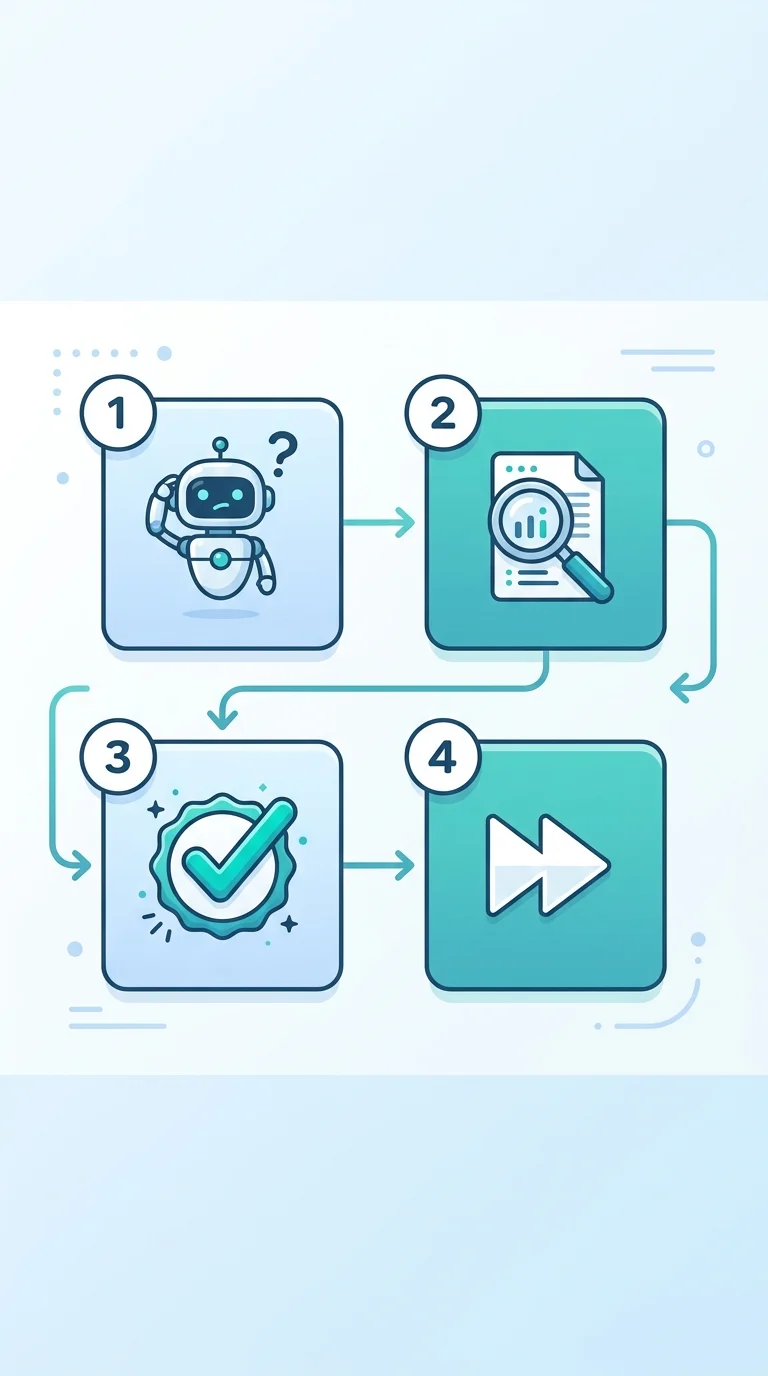 Breaking it down further, a typical speculative decoding cycle looks like this:
- The draft model proposes a chunk of words. Instead of one word, it might guess the next four or five words in one shot, based on patterns it has learned.
- The main model reviews all of them together. Because checking multiple words at once is far more efficient for the hardware than generating them one by one, this step happens quickly.
- Matching guesses get accepted instantly. If the draft model’s suggestions line up with what the main model would have produced anyway, those words are locked in immediately , no extra work needed.
- Mismatches get corrected on the spot. As soon as the main model finds a guess it disagrees with, it swaps in the correct word and the process restarts from there, with the draft model proposing again.
This cycle repeats continuously throughout the response. In practice, well-tuned setups can accept several guessed words per cycle, which is where the real speed gain comes from. Independent benchmarks and research papers on the technique have reported speed improvements in the range of roughly 2 to 3 times faster generation for everyday use, and even higher , up to around 4-plus times , in more predictable tasks like coding, where output tends to follow familiar patterns the draft model can anticipate well.
Does This Change What the AI Actually Says?
This is usually the first concern people have, and it’s a fair one: if a smaller, less capable model is “guessing” parts of the response, does that make the answer less accurate or lower quality? The honest answer is no , and this is really the elegant part of the design. The main, more capable model still has final say over every single word. It’s not blindly trusting the draft model’s guesses; it’s verifying them. If a guess doesn’t match what the main model would have generated on its own, that guess is thrown out and replaced. So the end result is mathematically the same response you’d have gotten without speculative decoding at all , it’s just arrived at through a faster route. Researchers often describe this property as “lossless,” meaning speed goes up without any tradeoff in output quality. The draft model’s job isn’t to be right all the time. It just needs to be right often enough that verifying its guesses in bulk saves more time than generating each word individually would have taken. Even when it guesses wrong, you haven’t really lost anything , the system simply falls back to normal word-by-word generation for that stretch.
Who’s Actually Using This Right Now
The point is already running quietly behind many of the AI tools people use every day. Major AI providers have built speculative decoding directly into how their models serve responses at the infrastructure level, which means it happens automatically in the background. As a regular user, you never see a setting for it or a toggle to turn it on; you just experience the result as a faster reply. It’s also become a standard part of the toolkit for teams that run open-source AI models themselves, using popular serving frameworks that support configuring it directly. And newer AI model families have started building a closely related idea called multi-token prediction (MTP) directly into the model’s own architecture, rather than relying on a separate draft model , essentially teaching the model to natively guess ahead as part of how it’s trained, not just how it’s served. Interestingly, this technique tends to shine even brighter in AI agents and coding assistants , the tools that write code, fill out structured data, or follow repetitive workflows. That’s because structured, predictable output (like code syntax or form-style answers) is exactly the kind of pattern a small draft model gets really good at anticipating, which pushes the acceptance rate , and therefore the speed gain , even higher.
A Few Related Terms You Might Run Into
Since speculative decoding tends to get mentioned alongside a cluster of other technical terms, here’s a quick, no-nonsense glossary so none of them catch you off guard:
- Draft model: The small, fast model responsible for guessing ahead. Think of it as the “intern” proposing ideas quickly.
- Target model: The main, full-size AI model that actually verifies the guesses and has the final word. This is the model whose quality you’re actually experiencing.
- Multi-token prediction (MTP): A related approach where a single model is trained to predict several upcoming words directly, without needing a separate smaller model to do the guessing.
- Prefill vs. decode: Two different stages of an AI response. Prefill is the model reading and understanding your prompt; decode is the model writing its answer. Speculative decoding specifically speeds up the decode stage.
What This Actually Means for You as a User
You don’t need to configure anything or flip a switch to benefit from speculative decoding , that’s really the point of it. But understanding it helps make sense of a few things you may have noticed recently:
- Why some AI tools suddenly started feeling faster without any announcement about “new hardware.”
- Why coding assistants and structured-output tools (like ones that fill forms or generate JSON) often feel especially quick compared to open-ended creative writing requests.
- Why AI companies can keep offering faster responses over time even while their models are getting larger and more capable, not smaller.
In short, it’s one of several behind-the-scenes engineering tricks , alongside things like caching and smarter memory handling , that let AI companies make their models faster and cheaper to run, without asking users to compromise on quality to get there.
Frequently Asked Questions
Is speculative decoding the same as a “lite” or “fast” version of an AI model? No. Lite versions (like a “mini” or “flash” model) are genuinely smaller, less capable models you choose intentionally, trading some quality for speed. Speculative decoding runs invisibly behind the full-size model and doesn’t reduce its capability at all. Can I turn speculative decoding on or off in ChatGPT, Claude, or Gemini? No, not as a regular user. It’s implemented on the provider’s server infrastructure, not as a setting inside the app. Does speculative decoding save AI companies money too? Yes , faster generation generally means better use of the same hardware, which lowers the cost of serving each response. That’s part of why providers are motivated to use it even though it doesn’t directly show up as a user-facing feature. Is this a brand-new idea? The core concept was formalized in research from Google and DeepMind back in 2023, though it has been refined significantly since then, with newer variations improving how accurately the draft step guesses ahead.
The Bottom Line
Speculative decoding is a good reminder that a lot of the AI progress you actually feel , like a chatbot suddenly responding faster , doesn’t always come from a bigger, smarter model. Sometimes it comes from someone figuring out a smarter way to use the model you already have. In this case, the fix was refreshingly simple: let a quick assistant guess ahead, and let the expert double-check the work instead of doing it all alone, one word at a time.