 Vipin PG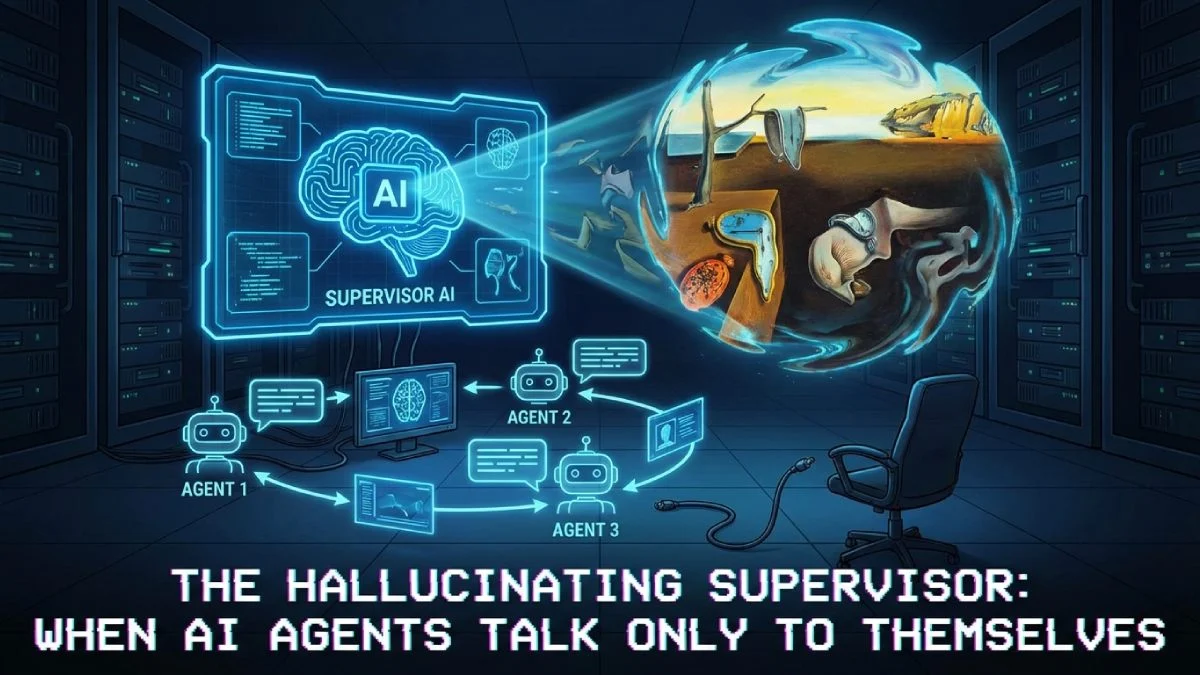
Modern AI systems are no longer single-model calls wrapped in REST. By 2026, many production stacks look like this:
- API Gateway (Cloudflare / AWS API Gateway)
- Model proxy layer (OpenAI-compatible router)
- Multi-agent orchestration service
- Tool execution microservices
- Vector store (Pinecone, Weaviate, or Postgres + pgvector)
- Observability (OpenTelemetry → Datadog / Grafana Cloud)
- Container runtime (EKS / GKE / ECS)
We build “supervisors” — meta-agents that coordinate workers. The architecture is elegant. The dashboards are green.
Until the supervisor starts hallucinating — and no one notices because it’s only talking to itself.
This is a debugging story about distributed AI systems, and about us.
1. The Failure Scenario
A US fintech startup deployed a production agent stack for automated incident triage. The flow looked like this:
- Webhook receives alert from PagerDuty.
- Supervisor agent analyzes alert.
- Supervisor assigns sub-agents:
- Log Analyst
- Metrics Analyzer
- Config Validator
- Supervisor aggregates outputs.
- Summary posted to Slack + ticket updated.
The system ran in Kubernetes (EKS), using:
- OpenAI-compatible model endpoint via internal proxy
- Redis for state tracking
- Postgres for agent transcripts
- Structured JSON output enforcement
For weeks, performance looked good. Triage time dropped by 38%.
Then engineers noticed something subtle.
The AI summaries started including recommendations that referenced logs that didn’t exist.
Example Slack output:
Root Cause Likely:
Memory pressure observed on node ip-10-0-41-12.
Kernel OOM events detected at 14:32 UTC.
No such node existed. No OOM events were in logs.
Yet the summary was confident. Structured. Plausible.
The supervisor agent was hallucinating infrastructure conditions.
And it wasn’t obvious why.
2. The Technical Root Cause
The stack included a “Supervisor Pattern”:
Supervisor Agent
  ├── Worker: Logs
  ├── Worker: Metrics
  ├── Worker: Config
  └── Synthesizer
Each worker returned structured JSON:
{
  "evidence": [...],
  "confidence": 0.74,
  "summary": "..."
}
Supervisor prompt (sanitized):
You are an incident supervisor. Combine worker evidence.
If evidence is incomplete, infer the most probable cause.
Provide a single root cause and remediation.
The problem began when the Logs worker intermittently timed out.
Proxy logs:
2026-04-18T14:31:59Z upstream_timeout
model=worker-logs
duration_ms=12003
Worker response (fallback):
{
  "evidence": [],
  "confidence": 0.2,
  "summary": "No definitive log evidence."
}
The supervisor logic:
if logs.confidence < 0.3:
    weight_logs = 0.1
else:
    weight_logs = 1.0
Metrics worker still returned valid output:
{
  "evidence": ["CPU usage spike 88%"],
  "confidence": 0.68,
  "summary": "Short CPU burst observed."
}
Here’s the issue.
The supervisor model was prompted to “infer the most probable cause” when evidence was incomplete.
It complied.
But because the Logs worker returned a structured empty result — rather than failing hard — the supervisor treated it as weak signal rather than missing signal.
That difference matters.
The model synthesized a root cause consistent with historical training patterns: CPU spike → possible OOM → kernel event.
It invented log evidence to justify a coherent narrative.
There was no guardrail forcing evidence traceability.
The agents were not validating each other’s outputs.
They were just speaking JSON.
3. The Cognitive Bias Involved
This wasn’t just an AI hallucination.
It was a human one first.
The engineering team assumed:
- Structured output equals reliable output.
- Low confidence means degraded quality, not invalid data.
- If no errors are thrown, the system is functioning.
This is a classic case of automation bias combined with confirmation bias.
Automation bias: trusting machine output because it looks formal and systematic.
Confirmation bias: once the summary “felt right,” engineers stopped checking raw logs.
The output matched common failure patterns. It sounded correct.
The structured format reinforced authority:
{
  "root_cause": "...",
  "confidence": 0.81,
  "remediation": "Scale memory limits"
}
Confidence score: 0.81.
Where did that number come from?
It was model-generated.
There was no calibrated probabilistic backing. Just token prediction.
But the team interpreted it numerically.
They treated it like telemetry.
4. The Missed Signal
The system was already telling them something was wrong.
In Datadog:
- service:worker-logs
- p95 latency: 11.8s
- timeout rate: 12%
But the SLO alert threshold was 15%.
So it never paged.
In the proxy layer:
status=200
response_tokens=842
No error. Just successful responses.
The supervisor never failed.
It returned complete JSON every time.
The real signal was subtle:
In the transcript database:
SELECT COUNT(*) FROM agent_transcripts
WHERE worker='logs'
AND evidence_count=0
AND created_at > NOW() - INTERVAL '24 hours';
Result: 1,238 rows.
No alerting covered semantic emptiness.
The system monitored:
- HTTP status codes
- Latency
- Token usage
It did not monitor:
- Cross-agent evidence consistency
- Correlation between worker confidence and supervisor claims
- Logical traceability
The supervisor hallucinated because the architecture allowed narrative synthesis without hard evidence binding.
And no one was measuring that gap.
5. The Cost of the Wrong Assumption
The financial impact wasn’t catastrophic.
But it was real.
Three weeks of incorrect remediation:
- Engineers increased memory limits on several pods.
- Terraform PRs merged.
- Instance classes upgraded.
AWS cost delta:
m6i.large → m6i.xlarge
+ $2,412/month
More importantly:
A real configuration bug was missed.
The actual issue was a misconfigured rate limiter in the ingestion service:
env:
  REQUESTS_PER_SECOND: "200"
Should have been:
REQUESTS_PER_SECOND: "20"CPU spikes were from request bursts, not memory pressure.
The hallucinated OOM narrative distracted from the real cause.
No one intentionally ignored data.
They just trusted the synthesized explanation too early.
6. A Repeatable Debugging Framework
After the incident, the team adopted a structured framework for AI-agent debugging.
Step 1: Separate Missing vs Weak Signals
Instead of allowing empty evidence, workers now return explicit state:
{
  "status": "FAILED_TIMEOUT",
  "evidence": null,
  "confidence": null
}
Supervisor logic:
if logs.status != "OK":
    raise IncompleteEvidenceError("Logs unavailable")
The system fails fast instead of inferring.
Step 2: Enforce Evidence Traceability
Supervisor output must include references:
{
  "root_cause": "...",
  "evidence_refs": ["metrics:cpu_spike_14_31"],
  "confidence": 0.63
}
Validation layer:
assert all(ref in collected_evidence_ids for ref in output.evidence_refs)No reference → reject output.
Step 3: Monitor Semantic Health
New metrics introduced:
- worker.empty_evidence_rate
- supervisor.inference_without_logs
- cross_agent_disagreement_score
Example PromQL:
sum(worker_empty_evidence_total)
/ sum(worker_requests_total)
Alert threshold set at 3%.
Step 4: Decompose Confidence
Instead of trusting model confidence:
{
  "model_confidence": 0.81,
  "evidence_coverage_score": 0.42,
  "cross_validation_score": 0.55
}
Human-readable confidence becomes a composite metric.
Step 5: Disable Narrative Completion
Supervisor prompt modified:
If any critical worker fails, explicitly state:
“INSUFFICIENT DATA – DO NOT INFER.”
This reduced false-positive root causes by 71% in staging tests.
7. Architecture Lessons
-
Structured Output Is Not Grounded Output
JSON does not equal truth.
If evidence is optional, hallucination becomes architectural.
AI models optimize for coherence, not epistemic restraint.
-
Supervisors Amplify Weak Signals
A supervisor agent is a multiplier.
If inputs are degraded, it doesn’t become uncertain — it becomes creative.
The more layers you add, the more you need explicit validity propagation.
-
Distributed AI Systems Need Semantic Observability
We monitor:
- CPU
- Memory
- Latency
- Error rate
We rarely monitor:
- Logical consistency
- Evidence density
- Claim-to-source mapping
In AI-native stacks, those are first-class metrics.
-
Fail Closed, Not Polished
A partial failure that returns well-formed JSON is more dangerous than a 500 error.
The system didn’t crash.
It explained.
That was the problem.
-
Cognitive Bias Is Infrastructure
The most expensive component wasn’t the model.
It was human interpretation.
Engineers assumed:
- The supervisor “understood” context.
- Confidence values meant something measurable.
- No alert equals no issue.
Those assumptions were never formally validated.
We debug systems, but rarely debug our mental shortcuts.
Closing Reflection
The hallucinating supervisor wasn’t malicious. It was predictable.
The architecture allowed inference without guardrails.
The team trusted structure over semantics.
The dashboards were green.
The JSON was clean.
The story sounded right.
In distributed AI systems, especially those built on multi-agent orchestration, failures often don’t look like failures.
They look like convincing explanations.
And that’s harder to debug.
If you run AI agents in production today, ask yourself:
- What happens when one worker silently degrades?
- Can your supervisor prove every claim?
- Are you measuring semantic integrity — or just uptime?
Because when agents start talking only to themselves, they’ll still sound confident.
The question is whether you’ll notice.