
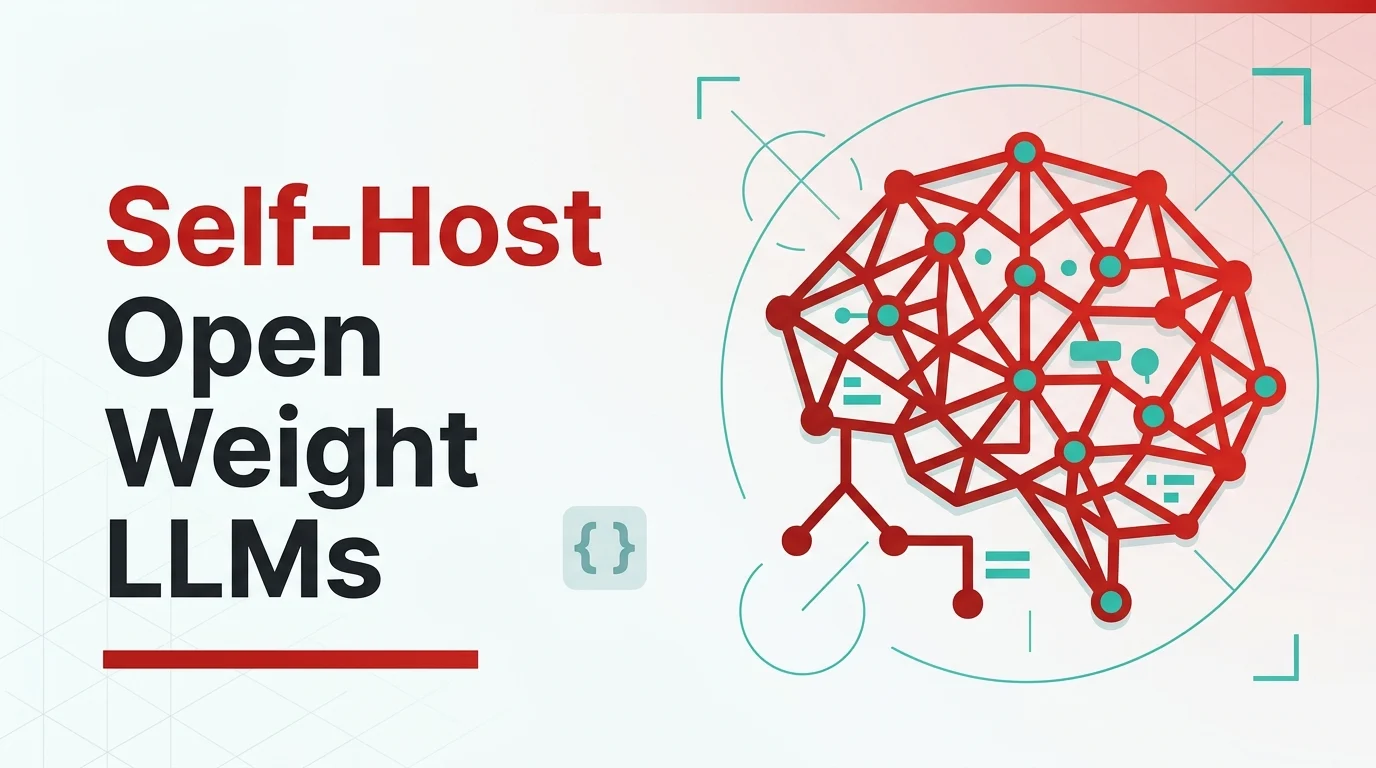
For the longest time, the answer to “which LLM should I use for my production app?” was simple: pick a GPT model tier, paste in your API key, and pay the bill at the end of the month. That calculus has fundamentally changed in 2026. The open-weight LLM field has matured to the point where self-hosting is no longer a research experiment — it is a genuine production strategy for teams that know when and why to make the switch.
This is not another benchmark comparison article. Benchmarks matter, but they are not what helps you decide whether to keep routing 50 million tokens a month through OpenAI’s API or spin up your own inference stack. That decision comes down to your volume, your data sensitivity, your team’s infrastructure comfort, and whether the economics actually pencil out. We will walk through all of it — the real crossover point, the models worth running in production today, the hardware realities, and the licensing traps to avoid.
Why 2026 Is a Real Inflection Point (Not Just Hype)
The open-source LLM field has been described as competitive before, but 2026 genuinely feels different. According to Epoch AI data cited by BentoML, open-weight models now trail the best proprietary models by roughly three months on average — down from over a year just 18 months ago. Practically speaking, that gap is closing faster than most development cycles.
What changed? Several things converged at once:
- Mixture-of-Experts (MoE) architectures became mainstream. Models like DeepSeek V3.2 (685B total parameters but only ~37B active per token) and Qwen 3 235B (235B total, 22B active) deliver performance that rivals much larger dense models at a fraction of the inference cost.
- Distillation got serious. DeepSeek’s R1 distilled variants brought reasoning-class performance to single-GPU hardware. You can now run a 32B model on a single RTX 4090 that outperforms what required a cluster two years ago.
- The API pricing floor dropped dramatically. OpenAI, Anthropic, and Google all slashed prices over the past year, which sounds like bad news for self-hosting — but it also lowered the quality bar for what an open-weight model needs to clear to be competitive.
- Inference tooling matured. vLLM’s PagedAttention, TGI from Hugging Face, and the broader Ollama ecosystem have made deploying production-grade inference significantly less painful than it was even 12 months ago.
None of this means you should drop your API subscription today. It means the decision is now worth taking seriously rather than dismissing out of hand.
The Cost Crossover: When the Numbers Actually Make Sense
The threshold question everyone searches for and nobody answers directly: at what volume does self-hosting become cheaper than the GPT API?
The honest answer is that it depends heavily on which model tier you are comparing against and what you count as a cost. But the data is clear enough to give you a working framework.
A detailed TCO analysis published by DevTk.AI in February 2026 puts the breakeven for self-hosting Llama 4 on a $2/hour GPU against GPT-5 at approximately 6.8 million tokens per month. That is the token-only math. When you add engineering maintenance time — realistically 1-2 weeks of senior engineer time per major model update, several times a year — the real crossover moves higher, somewhere between 5 million and 15 million tokens per month depending on your team’s fully-loaded engineering costs.
Here is the cost picture broken down by volume tier:
Under 5 Million Tokens Per Month: Stay on the API
At this volume, the per-token cost of a managed API is almost certainly lower than the infrastructure overhead of self-hosting. You are not running GPUs at high utilization, which is the core assumption that makes self-hosting economics work. A GPU running at 30-40% average utilization — which is typical for most production workloads with peak and off-peak traffic — effectively triples your cost per token compared to the theoretical minimum. Meanwhile, the API has zero idle cost: if traffic drops to zero on a Sunday night, your bill drops to zero. That flexibility is genuinely valuable at low volumes.
5 to 50 Million Tokens Per Month: The Decision Zone
This is where the analysis gets specific to your situation. Several factors push you toward self-hosting even if the raw token math does not yet clearly favor it:
- You are handling sensitive data (healthcare, legal, financial) that you cannot route through a third-party API
- You need fine-tuning on proprietary data, which the major APIs either do not support or charge a significant premium for
- You have consistent, predictable traffic rather than spiky workloads — high GPU utilization makes the math work
- You are already running other infrastructure that your LLM stack can share costs with
50 Million Tokens Per Month and Above: Self-Hosting Pays
At scale, the economics become compelling. Industry data shows a fintech company that moved chat triage from GPT-4o Mini to a self-hosted hybrid approach cut monthly AI spend from $47,000 to $8,000 — an 83% reduction. At these volumes, a well-run self-hosted deployment typically costs 5 to 10 times less than equivalent API usage over a two-year horizon. The fixed infrastructure cost gets spread over enough tokens that the per-token rate drops far below what any managed API charges.
The 5 Best Open-Weight Models for Self-Hosting in Production (March 2026)
The model landscape shifts quickly, but as of March 2026, these are the open-weight models with the strongest case for production self-hosting. We have organized them by the hardware tier they realistically require, since your GPU situation is often the deciding constraint.
1. Qwen3.5-27B — Best for Single RTX 4090 / Consumer GPU
License: Apache 2.0 | Parameters: 27B dense | VRAM Required: ~14GB at INT4 quantization
If your team has a single high-end consumer GPU and wants to run a capable general-purpose model in production, the Qwen3.5-27B is the current benchmark. It is Apache 2.0 licensed (meaning no restrictions on commercial deployment), runs comfortably on an RTX 4090 in 4-bit quantization, and covers coding, reasoning, and everyday language tasks without breaking the hardware budget.
The Qwen family from Alibaba has earned a reputation for punching above its weight relative to parameter count. This model fits teams running small-scale production workloads: internal tools, developer assistants, document summarization pipelines, and similar applications where you do not need frontier-class reasoning but want something meaningfully better than a toy model.
What it is not: A replacement for GPT-4 class performance on complex multi-step agentic tasks. For that, you need to go up a tier.
2. DeepSeek R1 Distill Qwen 32B — Best Reasoning Model for Single GPU
License: MIT | Parameters: 32B dense | VRAM Required: ~18-20GB at INT4
This is one of the most consequential models in the self-hosting story of 2025-2026. DeepSeek’s R1 distilled variants brought genuine chain-of-thought reasoning to single-GPU hardware. The 32B distill achieves 72% on AIME 2025 and 62.1% on GPQA Diamond on a single RTX 4090 — numbers that would have required a multi-GPU cluster just 18 months ago.
The MIT license is as permissive as it gets. There are no restrictions on commercial deployment, fine-tuning, or modification. For teams building coding assistants, legal document analysis tools, or any application that benefits from structured reasoning, this model represents an extraordinary value proposition on modest hardware.
The one caveat worth raising: DeepSeek is a Chinese company, and some organizations with strict data residency requirements have concerns about models with Chinese origin, even when run entirely on-premises. For most teams this is irrelevant — the weights run locally and no data leaves your infrastructure — but it is worth a conversation with your legal team if you are in a regulated sector.
3. GPT-oss 120B — Best Single-H100 Option for Enterprise Teams
License: Apache 2.0 | Parameters: 117B total / 5.1B active (MoE) | VRAM Required: Single H100 80GB
GPT-oss 120B sits at a useful intersection: it is enterprise-grade in capability, Apache 2.0 licensed, and fits on a single H100 without aggressive quantization. The benchmarks are strong — 62.4% SWE-bench Verified, 88.3% HumanEval, 97.9% AIME — and the MoE architecture means that while the total parameter count sounds large, only a small fraction are active on each token, keeping inference fast and cost-effective.
For teams that have access to cloud H100 instances (roughly $2-4 per hour) and want a proven, well-documented model with clean licensing and strong benchmark coverage, GPT-oss 120B is the most defensible single-GPU enterprise choice in the current generation. At high utilization on a cloud H100, you break even against DeepSeek’s hosted API pricing within roughly 2-3 months.
4. DeepSeek V3.2 — Best Performance-Per-Dollar at Scale
License: Non-standard (review required) | Parameters: 685B total / 37B active (MoE) | VRAM Required: 4x H100 or aggressive INT4 quantization on single H100
DeepSeek V3.2 is the model that genuinely worries OpenAI. In benchmark rankings tracked by WhatLLM through early 2026, it consistently sits in the S or A tier alongside models costing orders of magnitude more per token. The MoE architecture is efficient — 37B active parameters per token from a 685B pool — and the raw capability on coding and instruction following tasks is exceptional.
The non-standard license is the main friction point. Unlike Apache 2.0 or MIT models, DeepSeek V3.2’s license requires careful review before production commercial deployment. Most use cases are fine, but there are specific restrictions around using the model to train competing LLMs. If your legal team can clear it, this is one of the highest-capability self-hosted options available. If license ambiguity is a blocker, step down to Qwen 3 235B (Apache 2.0) for similar capability with cleaner terms.
5. Mistral Small 4 — Best for Multilingual and Constrained Production
License: Apache 2.0 | Parameters: 119B total / 6B active (MoE, 128 experts) | VRAM Required: 2-4x A100 depending on quantization
Released in March 2026, Mistral Small 4 is the most interesting recent addition to the production-ready self-hosting roster. The architecture is unusual: 128 experts with only 4 active per token, giving it 6B active parameters from a 119B pool. It unifies instruction following, configurable-depth reasoning, and multimodal capabilities (text and images) in one model under Apache 2.0.
Mistral has always been strong on European language support and regulatory-friendly deployment, which makes this model particularly well-suited for teams building applications in multilingual European or South Asian contexts. For a Kerala-based team serving multilingual users, this is worth a close look. The relatively modest active parameter count also means better inference throughput than comparably-sized dense models.
The Hardware Reality: What You Actually Need
Model selection and hardware selection are inseparable. Choosing a model that does not fit your GPU setup means either heavy quantization (which degrades quality) or prohibitive cloud costs (which kills your cost advantage). Here is the practical breakdown:
Consumer / Hobbyist Tier: RTX 3090 / RTX 4090 (24GB VRAM)
You can run 7B to 32B parameter models in INT4 quantization. This is good enough for real production workloads with modest concurrency requirements — internal tools, personal assistants, low-volume APIs. According to Onyx’s self-hosted LLM hardware guide, an RTX 4090 running a 32B model in INT4 quantization generates 30-50 tokens per second for a single user, which drops significantly under concurrent load. For anything above 5-10 simultaneous users, you start hitting throughput walls.
Entry Enterprise Tier: Single H100 80GB
The practical workhorse for self-hosted LLM production in 2026. A single H100 can run 70B models comfortably in INT4, or 120B MoE models at near-full precision. Cloud H100 instances run approximately $2-4 per hour. At 70% utilization on a 7B model using vLLM, a single H100 serves roughly 400 requests per second at 300 tokens each — at a cost of around $0.013 per 1,000 tokens, compared to GPT-4o mini’s $0.15-$0.60 range. The math becomes very clear at that scale.
Cluster Tier: 4x H100 or 4x H200
This is where the flagship open-weight models like GLM-5, Kimi K2.5, and full-precision DeepSeek V3.2 run at full quality. Cluster deployments carry significant infrastructure overhead and are only appropriate for teams with dedicated MLOps capacity. If you are at this tier, you almost certainly already know you need to self-host — the question is which model, not whether to do it.
Inference Frameworks: Choosing the Right Stack
The model is half the equation. The inference framework determines whether your deployment actually performs in production or becomes an operational nightmare.
Ollama: The Fast Path to Development
Ollama is the “Docker for LLMs” — one command pulls and runs models, it handles quantization automatically, and it exposes an OpenAI-compatible API without configuration. It runs on macOS, Linux, and Windows with automatic hardware detection. The OpenAI-compatible endpoint means you can drop it into any existing code that calls the OpenAI API with a one-line URL change.
Where Ollama falls short is production concurrency. It caps at roughly 4 parallel requests by default and peaks around 41 tokens per second under load. Use it for development, prototyping, internal tools with single-digit users, and air-gapped environments. Do not use it as your primary serving layer for a customer-facing API under meaningful load.
vLLM: The Production Standard
vLLM was built for throughput. Its PagedAttention algorithm reduces memory fragmentation by over 40%, enabling larger batch sizes and significantly higher concurrency than alternatives. It is the framework you reach for when you need to serve dozens of simultaneous requests efficiently. The setup is more complex than Ollama, but the performance gap at scale justifies the investment.
A common and sensible pattern: prototype on Ollama, validate the model choice and API contract, then swap in vLLM before going to production. This lets you move fast early without painting yourself into a performance corner.
Text Generation Inference (TGI): Hugging Face’s Production Server
TGI is Hugging Face’s battle-tested production serving solution. It supports a wide range of model architectures, handles quantization natively, and integrates cleanly with the Hugging Face ecosystem. If your team is already using Hugging Face for model storage and fine-tuning workflows, TGI is the natural production serving choice.
Licensing: The Detail That Can Derail You
The open-weight ecosystem has a messy relationship with the word “open.” Most popular models are open-weight, not open-source in the traditional OSI sense. The distinction matters in production:
- Apache 2.0: Clean for commercial use, modification, and redistribution. Covers Kimi K2.5, GLM-4.7, GLM-5, MiMo-V2-Flash, GPT-oss 120B, Qwen 3.5, Qwen 3 235B, Mistral Small 4, and most Mistral models. This is the license you want if you need maximum flexibility without a legal review.
- MIT: Even simpler than Apache 2.0. Covers DeepSeek R1 distilled variants. Essentially no restrictions.
- Non-standard / Custom: DeepSeek V3.2, Llama 4 (Meta’s custom license), and some other models fall here. These typically allow commercial use but may restrict using the weights to train competing models or require attribution. Always read the specific terms before shipping to production.
- Falcon 2.0 style: Free under a certain revenue threshold (in Falcon’s case, $1 million), with royalties above that. Fine for most early-stage teams, but a potential issue at scale.
The safest default: if you need clean, uncomplicated commercial rights and do not want to involve your legal team, stick to Apache 2.0 or MIT licensed models. The Apache 2.0 roster in 2026 includes genuinely excellent models at every size tier, so this constraint rarely forces you to accept lower quality.
When to Stay on the GPT API (The Honest Cases)
This article would be incomplete without saying plainly that self-hosting is the wrong choice for a meaningful portion of teams, even in 2026. The API wins in several specific situations:
- You need frontier-class reasoning. For genuinely complex multi-step agentic tasks, GPT-5 class models still outperform the best self-hosted options. The gap has narrowed, but it has not closed for the hardest reasoning tasks.
- Your volume is below 5 million tokens per month. The fixed infrastructure cost — GPU rental, engineering maintenance, monitoring, failover planning — is almost certainly higher than what you would spend on a managed API at this scale.
- Your team has no MLOps capacity. A self-hosted LLM is a service you own and operate. That means driver updates, CUDA version management, model updates, and incident response. If nobody on your team has done this before, the learning curve has a real cost.
- You need the absolute latest model. Open-weight models trail frontier models by roughly three months. If your application genuinely depends on cutting-edge capability — not just “good enough” capability — the managed API is the only path to the newest models immediately.
- Traffic is highly variable. The API scales to zero on quiet periods. Your self-hosted GPU does not. If your application has extreme traffic spikes followed by long idle periods, the economics of self-hosting degrade rapidly.
A Practical Decision Framework
Here is a direct decision path for teams evaluating the switch:
Step 1 — Measure your current token volume. Pull your API usage logs and calculate your actual monthly token consumption. If you are under 5 million tokens per month, stop here and stay on the API unless you have a hard data privacy requirement.
Step 2 — Identify your hard constraints. Do you handle data that cannot leave your infrastructure? Do you need fine-tuning on proprietary data? Either of these constraints pushes you toward self-hosting independent of volume.
Step 3 — Assess your infrastructure capacity. Do you have team members with Linux, Docker, and GPU experience? Self-hosting a production LLM is not a weekend project for a backend developer who has never touched CUDA. Be realistic about the operational burden.
Step 4 — Pick a model that fits your GPU reality. Do not pick a model and then figure out hardware. Work backward from what you can actually afford to run continuously, then find the best model that fits. The Onyx Self-Hosted LLM Leaderboard is a useful resource for mapping models to hardware tiers.
Step 5 — Run a parallel pilot. Before cutting over completely, run your self-hosted model in parallel with your existing API for 2-4 weeks. Measure output quality on your specific workload (not generic benchmarks), measure latency under your actual request patterns, and measure the actual engineering hours consumed. Only migrate fully if the pilot data supports it.
Quick Reference: Top Self-Hostable Models by Use Case (March 2026)
| Use Case | Recommended Model | Min Hardware | License |
|---|---|---|---|
| General purpose, budget hardware | Qwen3.5-27B | RTX 4090 | Apache 2.0 |
| Reasoning / Coding on single GPU | DS-R1-Distill-Qwen-32B | RTX 4090 | MIT |
| Enterprise single-server deployment | GPT-oss 120B | 1x H100 80GB | Apache 2.0 |
| Maximum capability at scale | DeepSeek V3.2 | 4x H100 | Custom (review required) |
| Multilingual + multimodal production | Mistral Small 4 | 2-4x A100 | Apache 2.0 |
| Privacy-first coding assistant | Qwen3.5-27B or DS-R1-32B | RTX 4090 | Apache 2.0 / MIT |
| Document summarization at volume | Gemma 3 27B or Phi-4 | RTX 3090 / 4090 | Apache 2.0 |
Final Thoughts
The question in 2026 is not “are open-weight models good enough to self-host?” — they clearly are, for a wide range of production applications. The real question is whether your specific situation — your token volume, your data requirements, your team’s operational capacity, and your hardware budget — makes self-hosting the right move for you right now.
For teams crossing the 5-10 million token per month threshold with consistent traffic and at least one engineer comfortable with GPU infrastructure, the case is genuinely compelling. The models available today under Apache 2.0 and MIT licenses are production-quality, the inference tooling has matured significantly, and the cost savings at scale are not marginal — they are transformational.
For everyone else, the managed API ecosystem in 2026 is also more competitive than it has ever been. As detailed in the TLDL LLM pricing overview for March 2026, API prices dropped roughly 80% across the board from 2025 to 2026. If you are not yet at the volume where self-hosting pays, you are paying a lot less than you were a year ago to stay on the API — and that is a reasonable trade for zero operational overhead.
The worst decision is a false binary: either full API dependence or a rushed migration to self-hosting that bogs your team down in infrastructure work instead of product work. Build a thoughtful hybrid if needed, pilot carefully, and let your actual usage data make the call.