 Vipin PG
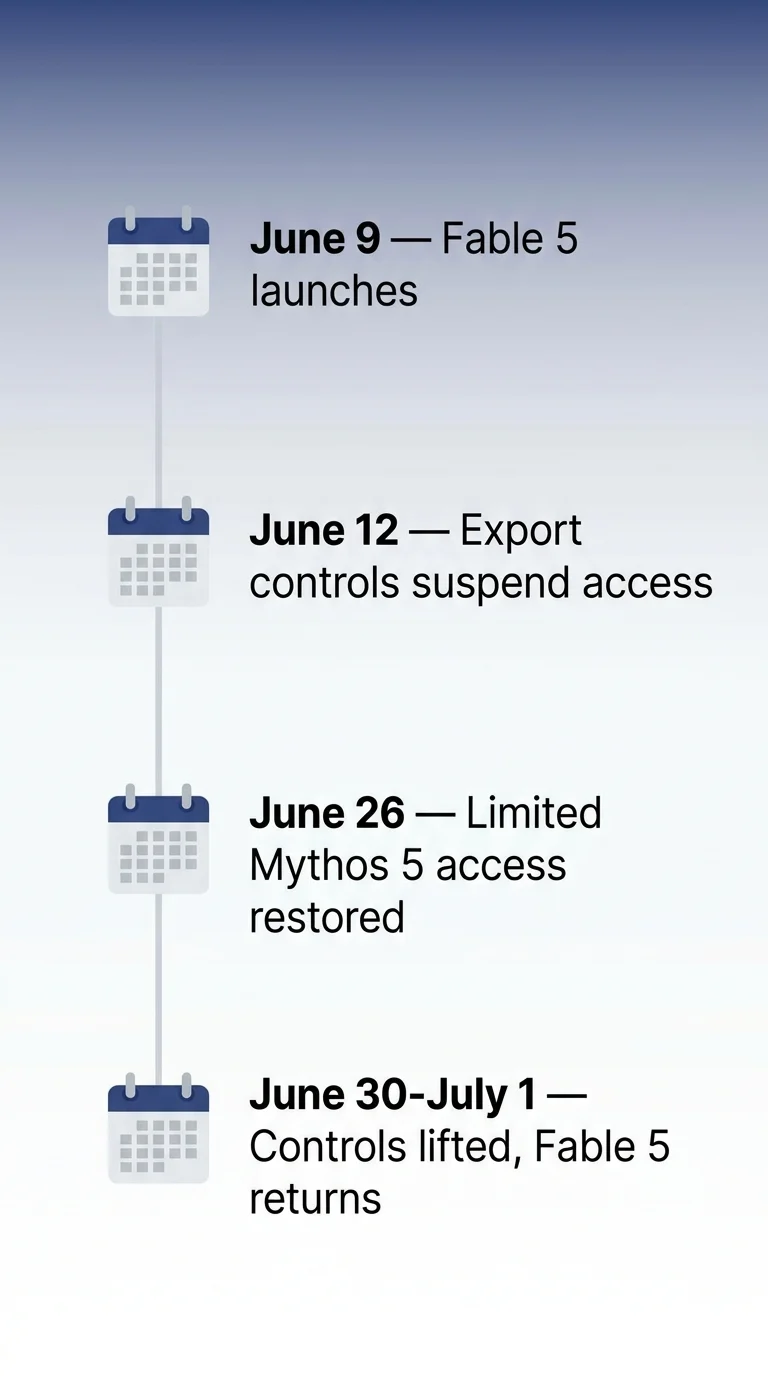
Claude Fable 5 had a strange first month. Anthropic launched it on June 9, 2026, calling it the most capable model it had ever made generally available, alongside a more permissive sibling, Claude Mythos 5, reserved for a small group of cyberdefenders. Three days later, on Friday, June 12, the US government sent Anthropic an export control directive ordering it to cut off access to both models for any foreign national, including Anthropic’s own foreign employees, effective immediately.
Anthropic has said it received the letter at 5:21pm ET that day. Because the order took effect right away and there was no reliable way to check every user’s nationality in real time, the company made the call to suspend both models for everyone, not just the users the directive technically covered. That’s the part that made headlines: a frontier model going fully dark, worldwide, days after launch, over a directive whose reasoning wasn’t spelled out in writing.
The reversal came in two steps. On June 26, the Commerce Department eased restrictions enough to let Mythos 5 reach a vetted group of more than 100 companies and some government agencies. Then, on June 30, the department lifted the export controls on both models entirely. Fable 5 came back online globally the next day, July 1, across Claude.ai, the Claude API, Claude Code, and Claude Cowork.
What Actually Triggered the Shutdown
The government’s letter to Anthropic reportedly didn’t detail its national security concern in writing, which left the company to reconstruct the trigger itself. According to Anthropic’s own account, the issue traced back to a threat intelligence report from Amazon researchers describing a way to prompt Fable 5 into identifying software vulnerabilities and, in one case, producing proof-of-concept exploit code.
Anthropic pushed back hard on how serious this actually was. The company said the vulnerabilities surfaced by the technique were previously known and relatively minor, and that other publicly available models could find the same flaws without any special workaround. It went further after the fact, testing other frontier systems against the same technique and reporting that Claude Haiku 4.5, Sonnet 4.6, Opus 4.6, Opus 4.7, and Opus 4.8, along with GPT-5.4, GPT-5.5, and Kimi K2.7, could reproduce comparable results. In Anthropic’s framing, this wasn’t a Mythos-level cybersecurity capability slipping out into the world — it was a borderline case where Fable 5’s safeguards were, if anything, being overly cautious about routine defensive security work like reading a codebase and flagging bugs in it.
That distinction matters for anyone trying to understand why the shutdown happened at all. Anthropic wasn’t disputing that a jailbreak existed. It was disputing that the jailbreak revealed anything dangerous enough to justify a global blackout of a model that thousands of paying customers, including enterprise and government users, were already relying on. Cybersecurity outlet CyberScoop noted that some security professionals had separately complained the original guardrails were also blocking routine defensive work, not just malicious use — which cuts both ways on whether the safeguards were too loose or too tight to begin with.
What Changed When Fable 5 Came Back
Anthropic didn’t just flip the model back on unchanged. Working with the government over the two-week suspension, the company trained an updated safety classifier specifically targeting the technique described in the Amazon report.
According to Anthropic’s official statement on the redeployment, the updated classifier blocks the reported technique in more than 99% of cases.
There’s a real tradeoff attached to that fix. Because the classifiers were tuned conservatively to get the model back online quickly, some ordinary coding and debugging requests are now more likely to get flagged and rerouted to Claude Opus 4.8 instead of being handled by Fable 5 directly. Anthropic has said it expects to narrow the false-positive rate over the coming weeks as it collects more data on what legitimate use actually looks like versus misuse.
Worth knowing: Mythos 5 is the same underlying model as Fable 5, but it doesn’t carry the safety classifiers at all. It’s still only available through Anthropic’s Project Glasswing trusted-access program, which now includes over 100 organizations and select government agencies. If you don’t have Glasswing access, Fable 5 is the version you’ll be working with, refusals and all.
What It Means for Builders
If you have an integration calling Fable 5 through the API, three things are different now compared to before the suspension.
- Refusals are a normal response, not an error. When Fable 5’s classifier blocks a request, the Messages API now returns
stop_reason: "refusal"as a standard HTTP 200 response rather than throwing an error, and it reports which classifier triggered the decline. If your error handling was only watching for 4xx/5xx status codes, it will miss these. - You have three ways to handle a refusal. Anthropic added a server-side
fallbacksparameter (currently in beta on the Claude API and on the Claude Platform via AWS) that automatically retries a declined request against another model. There’s also client-side SDK middleware for TypeScript, Python, Go, Java, and C#, or you can just catch the refusal and retry manually against Opus 4.8 yourself. - Billing has a grace window, then reverts. Pro, Max, Team, and select Enterprise plans get up to 50% extra weekly usage on Fable 5 through July 7, 2026, to make up for the outage. After that, usage moves to standard limits or usage-based credits depending on your plan. Enterprise seats specifically need credits enabled, or Fable 5 access drops for those users once the bonus window closes.
Availability-wise, Fable 5 is back on the Claude API, Claude Platform, Amazon Bedrock, Google Cloud, and Microsoft Foundry. Spec-wise, nothing changed from launch: it’s still a 1M-token context window by default with up to 128,000 output tokens per request, and it responds to the same prompting techniques as other Claude models, with some differences in how you structure long-context and reasoning instructions.

Should You Plan Around This Happening Again?
This is the harder question, and it’s worth being honest about it rather than smoothing it over. A model that Anthropic itself called state-of-the-art went from fully available to fully dark, globally, on less than a day’s notice, over a dispute the company says it still doesn’t fully agree with. Industry analysts covering the episode have pointed out that there’s currently no established, predictable process for how the US government approves or pulls access to frontier models — decisions can happen fast, and companies building products on top of these models don’t get much warning.
Anthropic’s response to that gap is a proposed industry framework, drafted with Amazon, Microsoft, Google, and other Project Glasswing partners, for scoring how severe a given jailbreak actually is before anyone reaches for the kill switch. The company has also said it’s scaling up collaboration with the US government on model testing, including giving officials pre-release access to models and safeguards for evaluation. Whether that framework actually prevents a repeat of mid-June, or just makes the next one faster to resolve, is something we’ll only know the next time it’s tested.
If you’re running production workloads on Fable 5 or Mythos 5, the practical takeaway isn’t to avoid the models — it’s to make sure your integration has a graceful fallback path already wired in, because you now have direct evidence that access can change with very little warning.
The Bottom Line
Fable 5 is back, with tighter documentation around how it fails, a formal fallback mechanism for when it does, and a public paper trail of exactly what triggered the suspension in the first place. That last part is arguably the more useful outcome for builders: you now know what “blocked” looks like in the API, and you have official tooling for handling it instead of just hoping it doesn’t happen to you.